Bird Call: Monogamy lessons from birds
Albatross and hawks do it.
Greater sage grouse and prairie chickens don’t do it.
Humans do and don’t do it.
Let’s do it, let’s stay monogamous. Or not.
We’re all a little birdlike in our varying levels of comfortability with commitment, aren’t we? Some of us are bald eagles who pair up early and stay together for life. Others are songbirds who gravitate toward serial monogamy, picking new partners for shorter relationships, a year here, maybe a few years there. And then there are those lothario greater sage grouses, who resist being tied down and take many a female lover after singing and prancing their little hearts out at leks, or mating ceremonies, every spring.
Colorado is well-known across the world for its grouse leks, and attracts many a birding tour around late March and early April to lek sites in the northwestern part of the state.
Bold, sweet, personable pickpockets: Meet the Abyssinian ground hornbills at Cheyenne Mountain Zoo
“Fifty to 60 of them (the males) will compete and the females decide who the alpha male is and will mate with them,” said John Drummond, a field trip leader and speaker for Aiken Audubon Society. “Off he goes with one female and the rest of the males compete for the rest of the females in the circle.”
I, myself, most closely resemble the songbird at this point in my life, though I’m not opposed to becoming a hawk someday. This is all while trying to avoid male hummingbird types, who are apparently do-nothing gadabouts after they entice a lady with love songs and an acrobatic courtship dance. After fertilizing the eggs the male ghosts her, but stays on the lookout for other females to mate with before calling it a spring season. Does he help with building the nest and raising the young? Nope. Jerry Springer would have had a heyday with a boy hummingbird.
I love a good bird couple. Whenever a Eurasian collared-dove noisily alights in my backyard, I know its mate won’t be far behind. And for the last couple of years I’ve kept tabs on Big Red and Arthur, a pair of red-tailed hawks in Ithaca, N.Y., thanks to The Cornell Lab’s nest cam.
The sweet pair successfully launched three new fuzzy, awkward hawks into the world this spring. So heartwarming to watch, though I could have done without some of the various dead animals Arthur dropped off for their meals. I know, I know, it’s nature. But sometimes I get tired of her seemingly cruel, cold-hearted ways.
While bald eagles are all about locking it down early with their mate, the apex predators also live an alternate lifestyle that speaks to my solitary nature. Come winter, eagles separate, each preferring to pass the colder months doing some reflecting, introspecting and good hard work on themselves. Kidding. There I go anthropomorphizing again.
The eagle couple reunites at the same nest each year, though if one or the other doesn’t return, the remaining bird will say yes to a new mate.
“There’s only a change if one dies or becomes infertile,” Drummond said. “Often a dying spouse will be replaced with another bird.”
Bird Call: American kestrels on decline, nest boxes needed in Colorado to help grow population
Great blue herons got the same memo. Once the frantic nesting portion of the year has quieted down, everyone pulls a Ross and Rachel from “Friends” and goes on a break.
The birds live their best solitary lives stoically standing on beaches, marshes and rivers, relishing the peace and quiet while eyeballing tasty fish treats to impale, before packing it up and heading back to family life.
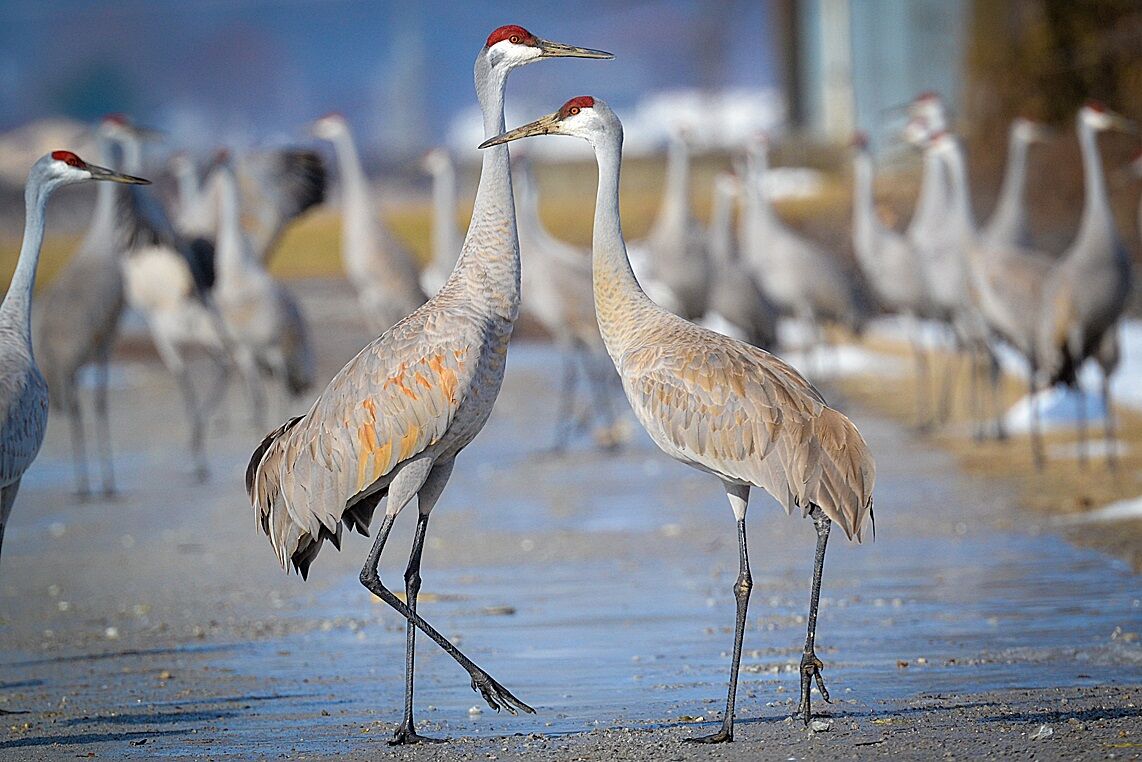
While many large birds, including swans, geese, ducks, cranes and storks, prefer monogamy, question marks remain about the commitment habits of smaller species, as they’re harder to track. But from what researchers can tell, common backyard birds, like goldfinches, chickadees and robins, come together for only one breeding season or one nesting period.
It seems similar to what researchers call the honeymoon phase of a relationship. You meet your potential beloved, the dopamine kicks in, and you fall in lust, love or infatuation (you decide), with all those accompanying schmoopy feelings that color the first stages of a relationship.
And then that particular onslaught of hormones and other chemicals fade, while other hormones responsible for long-term attachment and comfort increase.
“A lot of research has been done on larger birds,” Drummond said. “They’re easy to follow and stay together as a family. Smaller birds come back to the same place as the previous year, but we’re not sure if they breed with the same female.”
Bird Call: 125 of Pikes Peak region’s most common birds in new book by Woodland Park author
But really, when it comes to the courtship rituals of humans and birds, we seem more similar than dissimilar. We both make bids for the attention of someone who intrigues us — birds through sweet trills, gorgeous plumage or acrobatic moves. Don’t humans do the same thing? Only with expensive meals, flowers and sweet talk?
Male woodpeckers work hard for their ladies, excavating four or five tree holes or other nesting options every year, of which she has the final say. I don’t know about you, but I’ll take a boy woodpecker over a boy hummingbird any day.
Contact the writer: 636-0270