Empty shops and offices: Can downtown Denver come back?
Some experts wonder if downtown could reclaim its old glory, though they add it holds cards that can lure tenants and their employees into giving the central business district a fresh look
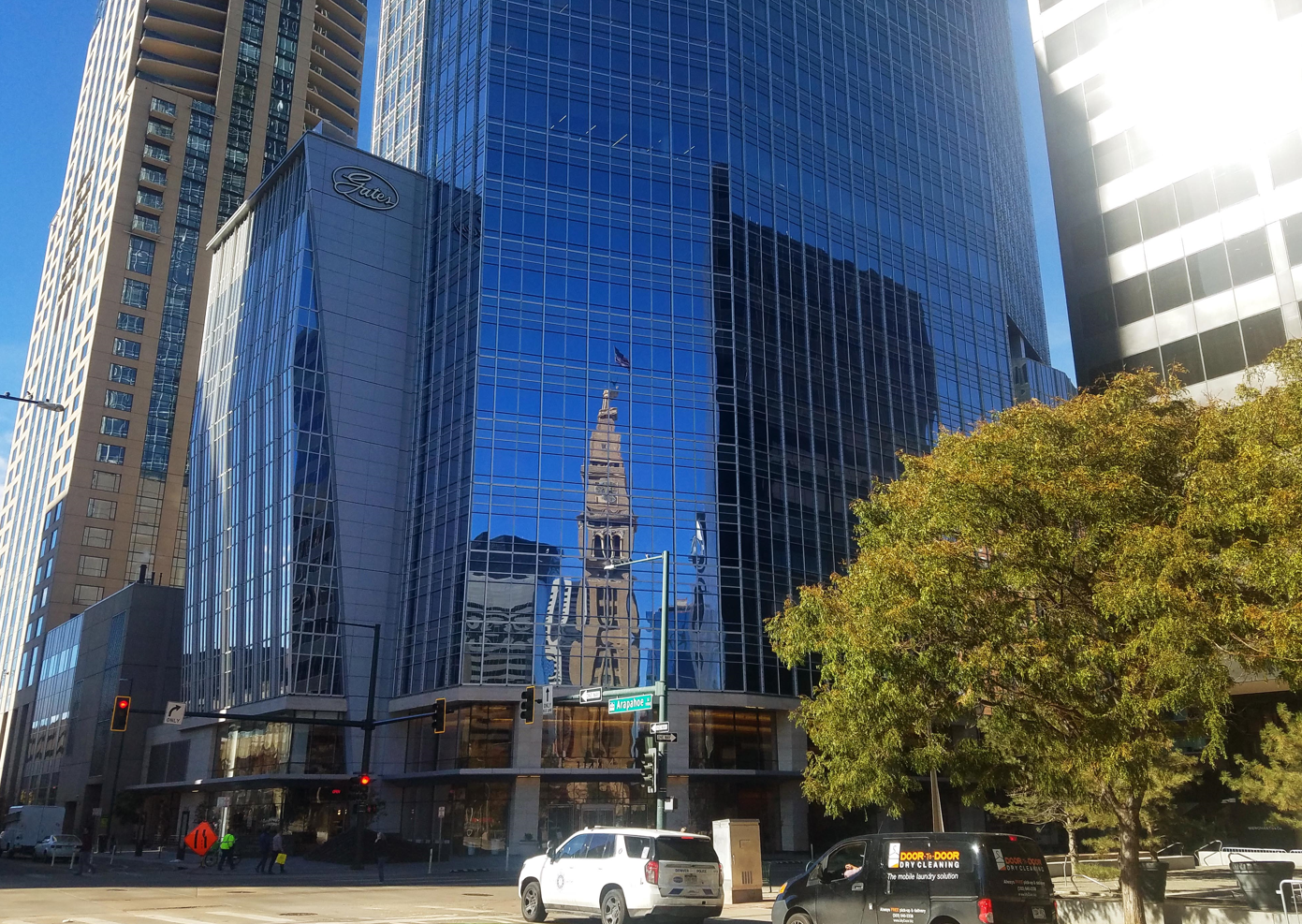
Brokers say that Downtown Denver office vacancies, which soared in the wake of the Covid pandemic to a near-record 30%, may get worse before they get better.
The depressed numbers are prompting experts to wonder if downtown could reclaim its old glory or if the exodus of tenants downsizing or fleeing for locations closer to where they live could someday reach a tipping point.
Still, they add that downtown is holding cards that can lure tenants and their employees into giving the central business district a fresh look.
Total vacancies downtown, which combine unleased offices, as well as leased spaces that tenants are trying to market, hit 30.6% during the third quarter, according to a quarterly report released two weeks ago by commercial real estate services firm CBRE.
That low follows a net loss of 381,600 sq. feet of leased space tracked over the quarter, totaling 477,300 feet lost over the year. CBRE maps downtown to include four blocks of Uptown east of Lincoln, and the LoDo and Riverfront areas west to Platte Street but doesn’t tally in the RiNo area north of the ballpark.
Although that 30% figure marks the worst performance since the 1990s, brokers are certain the numbers will worsen as some large leases expire that will not be renewed.
“I’d say we haven’t seen the bottom of the market yet,” says Alexander F. Becker, principal at Real Estate Consultants of Colorado in downtown, which did around a hundred commercial transactions last year.
“It’s not wrong to think it could get worse,” adds Jon Treter at Coldwell Banker Commercial Realty (not affiliated with CBRE) at 6th Avenue and Grant Street south of downtown.
Treter — who says he is currently working on a deal in Coeur d’Alene, Idaho, where office vacancies are below 5% — notes that central business districts are suffering nationally, as employees gravitate toward offices closer to home, with some moving to smaller, more remote markets.
Glenn Mueller, professor at University of Denver’s Franklin L. Burns School of Real Estate and Construction Management and an authority on commercial cycles, told The Denver Gazette that the market could see another three-to-five years of declining demand. He adds that it generally takes five to eight years to create major office projects, at a moment when developers have no clear picture of where that demand will head in the longer term.
“One of the big questions is will people really want to continue to be in downtown,” Mueller says.
To steer that in a positive direction, brokers say that Denver needs to continue focusing financial resources on the optics and workings of the CBD. Newly arrived Denver Mayor Mike Johnston announced in September that he plans to direct $58 million of his 2024 spending plan on downtown and its showplace, the 16 Street Mall.
The mall, built in 1982, came to symbolize a revival for downtown Denver after decades of urban decline. Now, the mall is undergoing $150 million makeover targeted at its public spaces, ones that are looking down-at-the-heels decades after their heyday.
Some $21 million of Johnston’s new spending would tackle optics along the mall itself, where empty storefronts and homelessness are cited by brokers as among the factors undercutting downtown’s popularity.
Like other brokers, Becker and Treter both note that downtown’s picture is bleaker than in suburban markets. CBRE’s quarterly reports show more than a million feet were lost metro-wide over the quarter, bringing total vacancies to 22.8%. The Southeast market along the DTC corridor currently stands at 21.3% vacant.
While all large, national markets are still suffering from the work-from-home phenomenon that took off during the pandemic, brokers say the CBD’s current image problem puts it at a disadvantage to Cherry Creek and the latter’s toney shopping-dining district a few miles southeast, as well as to further-out areas, where office goers see fewer homeless and a cleaner streetscape.
Earlier this year, the Cherry Creek submarket reported an incredibly tight office vacancy rate of around 1%, according to the business executive group CoreNet Colorado. Such a vacancy rate, which practically means all of its offices and stores are occupied, stands in sharp contrast to what’s happening downtown.
Ultimately, high vacancies mean lost revenues for the city from downtown, while full occupancy in Cherry Creek means increasing reliance on the latter to fund Denver’s coffers. Put another way: if Denver loses shops, restaurants and commercial offices to other cities, that directly translates to declining revenues for officials’ spending priorities, such as combatting homelessness, which brokers cite as a reason for the exodus from downtown.
Indeed, that creates a catch-22 downtown, as a dearth of employees prompts restaurants and attractions to close — the exact amenities that employees want to see if they’re to be coaxed back to their downtown desks.
Meanwhile, the CBD looks all the less attractive now as the mall lies torn up—seemingly a low point decades after Denver and its mall were drawing national kudos for their vitality.
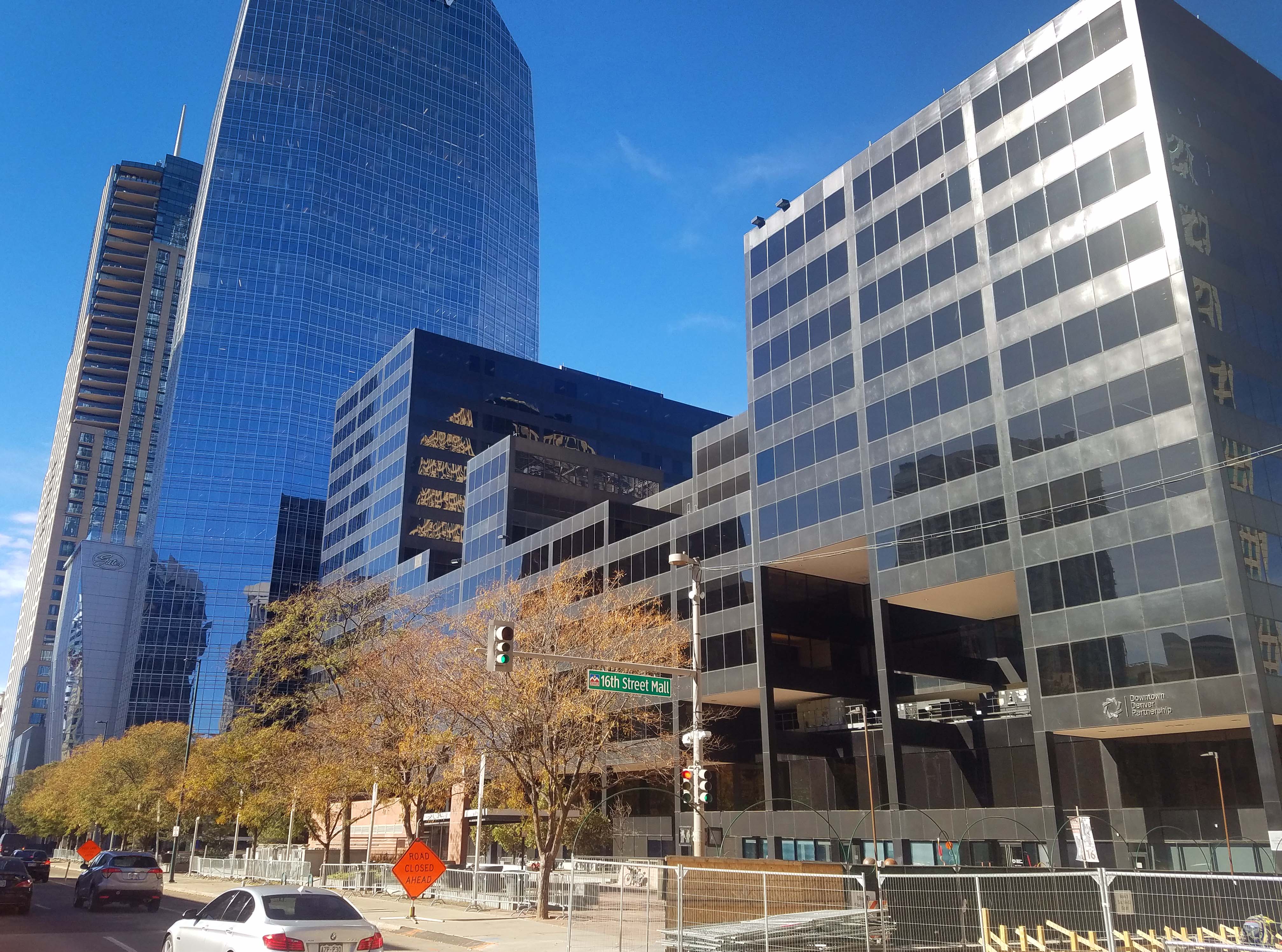
“There is no question that record vacancy is a concern and a priority for us,” says Kate Barton, executive vice president of the Downtown Denver Partnership, the coalition that helped pioneer the city’s transformation three decades ago.
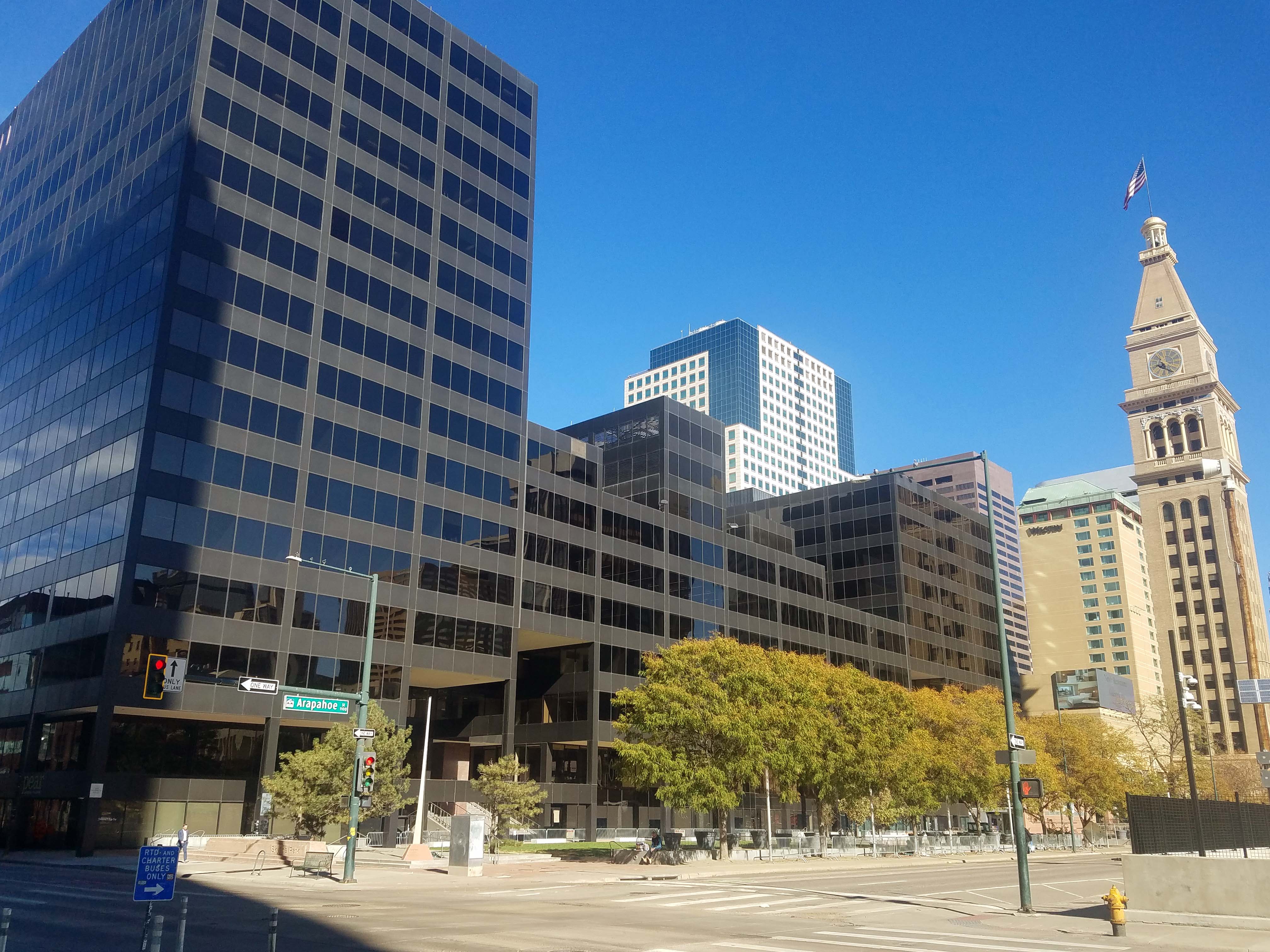
Today, Barton’s office looks out on the battle’s ground zero — the corner where the mall crosses three-block-long Skyline Park by legendary architect Lawrence Halprin, who, during the 1960s and 1970s, envisioned similarly imaginative projects in San Francisco, Minneapolis and other commercial business districts that were looking to turn around.
Six years ago, the Downtown Denver Partnership moved into Park Central, on Skyline Park between Lawrence and Arapahoe, built in 1973 as a block-long corporate railroad headquarters that, even now, when viewed from the park, projects a sleek, modernist vision of a railroad locomotive, its towers mimicking the engine’s stacks and cab.
“We were very intentional in moving to Skyline Park,” says Barton.
The mall and park outside, torn up and fenced off during construction, will be completed and luring visitors in less than a year. Or at least that’s the vision.
Barton says she is already seeing signs of a turnaround taking shape.
The newly transformed Colorado Convention Center is already luring traffic, Barton notes. Downtown visitor numbers actually picked up in 2022 and now exceed pre-pandemic counts.
She adds that her group is tracking new restaurant leases, a good sign that there will be attractions that reach out to returning employees.
Is a generational shift plaguing downtown?
Denver’s market has famously gone through boom-bust cycles dating back to the city’s earliest years. But completing a turnaround now requires addressing what the Burns School’s Mueller calls a secular rather than a cyclical change — a broader, generational shift expressed by Millennials and Gen-Xers that arrived with the pandemic.
“People got used to working at home quickly, not having a commute,” Mueller tells The Gazette.
“Tech was driving demand for office growth, but now that has subsided. Anyone doing tech related work could do that more easily from home,” Mueller notes.
But in other industries, an office may be more essential, where in-person collaboration has better value.
Capping downtown’s bad numbers in October came the news that Xcel Energy will likely vacate its Colorado headquarters at 1800 Larimer Street when its lease expires in 2025, in favor of the trendier RiNo district, where developer Hines is creating a 235,000-square-foot commercial center named T3 RiNo.
Some brokers are scratching their heads at that move, wondering if employees will really find that a better lure there than in downtown if the city manages to overcome the latter’s problems and revive attractions. The current headquarters at 1800 Larimer is blocks from Coors Field and Union Station and stands among a very few recently built downtown office towers, showing a contemporary, trendy look.
DU’s Mueller says Denver has advantages in making a turnaround.
“You’ve got what we call gateway cities — New York, Chicago, San Francisco — that were growing massively, when, with Covid, suddenly, people can work anywhere,” Mueller says.
San Francisco, despite its widely publicized problems with crime and homelessness, is still the most expensive city to live in in the U.S. And although Denver prices have climbed, its affordability recently puts it among the Top Four cities luring urban growth. (No. 1 is Austin).
“It’s a nice place to live. People like the whole vibe,” he adds.
“Denver is better off than many of the CBD marketplaces,” adds Jeff Castleton, executive managing director for Newmark Group, which leases Xcel’s current building and has offices there.
“The factor that prompts people to move here is the quality of life, and that is to our benefit,” Castleton tells The Gazette. “We’ll get more than our share of educated employees.”
A crisis or opportunity?
Like other brokers, Castleton notes that occupancy rates are much better in Class A and Class A-plus buildings, with the newest amenity packages, than in older buildings that line the southeastern end of the mall. According to CBRE, Class A buildings in Lower Downtown, where the newest amenities lie, stand at only 9.5% vacant.
“There’s pretty good activity in the smaller tenant base,” Castleton adds. “The tech market has the ability to stay remote; but law firms and energy firms have people back in the office.”
“Things appear to be headed in right direction. Street traffic and pedestrian traffic are up, and when you get on the highways it feels like 2019 again,” he adds.
At CBRE, where the quarterly numbers are tracked, First Vice President Allison Berry says that there’s a silver lining to downtown’s numbers.
“For those of us who never left downtown and never stopped trying to get leases signed, there is plenty of positivity if you’re willing to look for it,” she tells The Denver Gazette in an email.
“My team sees 30% vacancy as 30% more opportunity,” she adds.
“Tech was a huge driver of leasing activity pre-pandemic and many tech companies are now enforcing a return-to-work policy,” she adds. “Legal and professional services leasing activity has remained strong the past few quarters, as companies are taking advantage of the attractive concession packages from landlords and upgrading their office space to recruit and retain employees.”
“Yes, there are buildings that are very compromised, but it’s not simply a lack of leasing demand. Valuations are low, debt is due, and some owners are choosing not to spend more capital to lease a struggling asset,” she says, adding, “These are the buildings that are largely contributing to that vacancy rate, but once the debt markets recover there will be a significant amount of investment sales activity.”
Coldwell Banker’s Treter says that it’s a mistake to underestimate the job waiting to turn around the CBD — noting that he walked into one of Union Station’s trendiest spots on a recent Sunday, one that would have been packed a few years back, to see only four sets of diners at tables.
But despite the vacancies and the operating costs faced by owners of the largest buildings, Treter says those companies have resources to see the situation through: “The big owners have seen this movie before, and they know what to do to weather this storm.”
“Denver still means less people and less congestion,” Treter says. “There is still a nucleus of like-minded people who love it and just want to live here. That’s always a good sign for employers.”
Newmark’s Castleton notes a growing sentiment among brokers — that as large corporations downsize to accommodate employees wanting to keep their longer weekends, they run a risk of cutting too much fat by signing a lease that will prove less than favorable when downtown’s charms reemerge.
Adds CBRE’s Berry, “There are many buyers biding their time until they can acquire one of these assets at a lower basis, spend the capital to improve the asset, and then compete for deals.”