Challenges and solutions for Colorado’s public lands
Panel discussion highlights funding, compatibility, climate change, and over-development.
There is a stark philosophical divide between recreational and commercial users of public lands that came into into sharp focus at a panel discussion about public lands policy and problems at the second annual Sun Fest, hosted by the Colorado Sun.
There is no such thing as a non-consumptive use, said Brian Jones, regional policy coordinator for Backcountry Hunters and Anglers. Everyone who uses public lands consumes something from them, including bicyclists, hikers, and mineral extraction.
“Folks say consumptive or non-consumptive users, and usually hunters and anglers are put into a consumptive user group and everyone else is non-consumptive,” said Jones. “The fact of the matter is everyone’s consumptive. If we’re humans and we’re on planet earth and we’re on public lands, we’re consumptive. You may not be consuming — taking or harvesting an animal and taking it home — but you’re consuming the habitat and the ability for those wildlife species to be out there.”
Kathleen Sgamma, president of the Western Energy Alliance said uses like oil and gas pay handsomely to conserve public lands — providing funding second only to the federal government — from a very small physical footprint. The Alliance is a trade organization representing oil and natural gas producers in Colorado and across the intermountain west.
“In terms of conservation, we provide more conservation funding than anything else other than the federal government,” Sgamma said. “With the land and water conservation fund, with the Great American Outdoors Act, it makes available $2.8 billion every year for conservation and infrastructure on federal lands. And 93% of those funds come from oil and natural gas, with no other source that even comes close. So, you take away oil and natural gas development on federal lands, you don’t have that source of funding.”
“I would just challenge everyone to think about these issues in a big picture,” said Alicia Marrs, director of western water for the National Wildlife Federation. “We are talking about public lands. We’re all owners of public lands, right? We benefit from them in some way, shape, or form, whether we can physically touch them or they’re providing our drinking water or cleaning our air.”
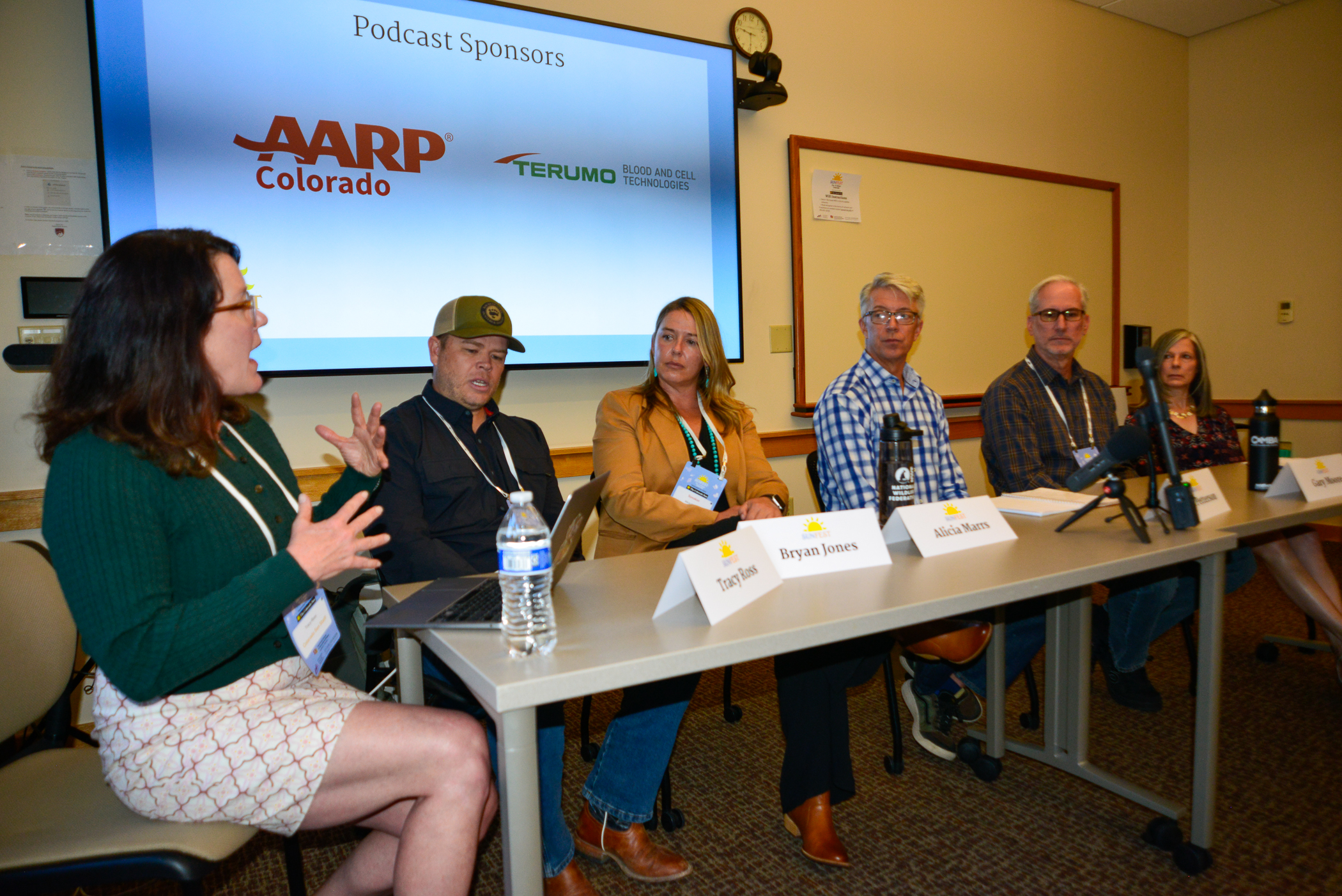
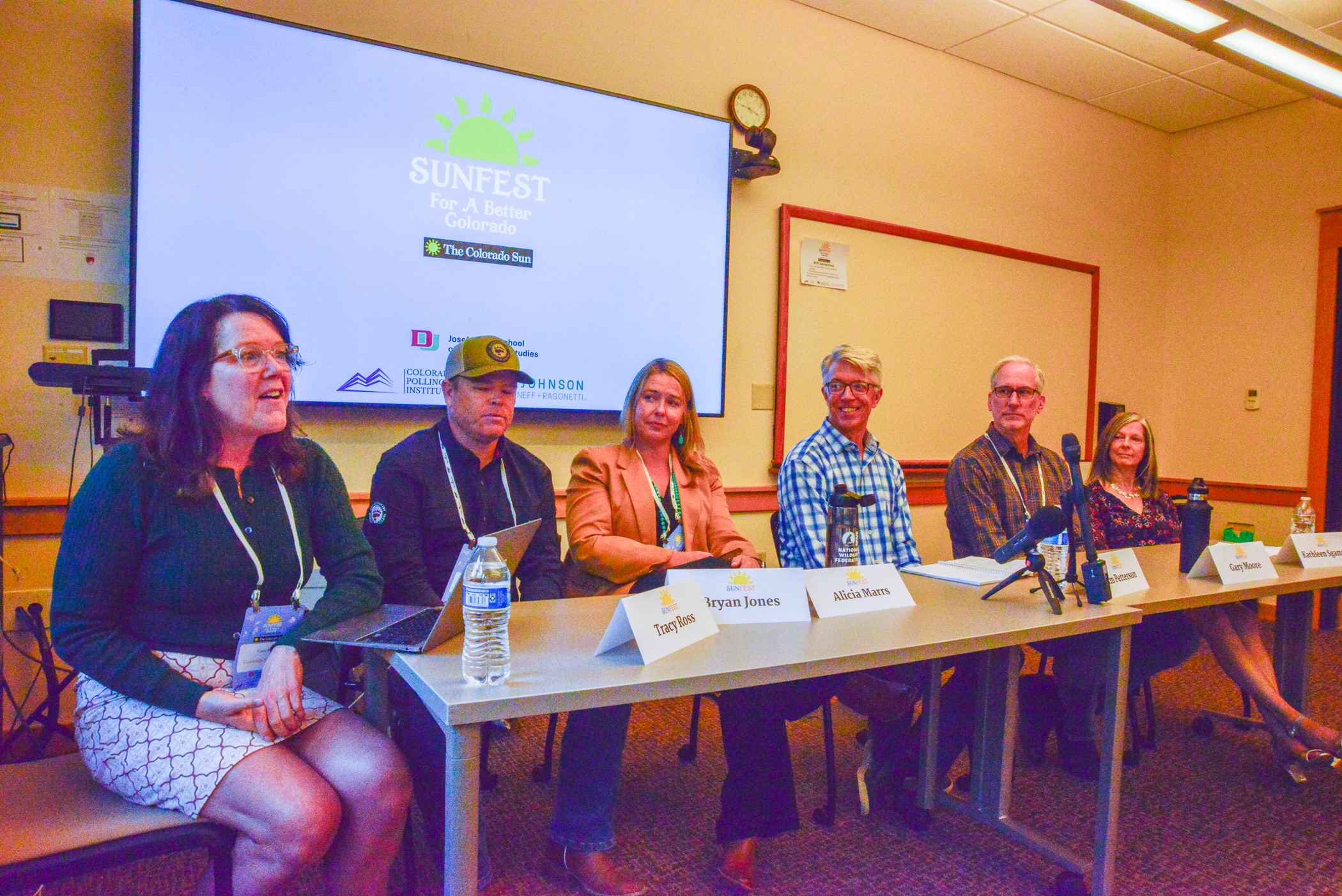
The Sept. 27 discussion was moderated by Colorado Sun rural reporter Tracy Ross.
Panelists included Jones, Marrs, Sgamma and Jim Petterson from the Trust for Public Land, Gary Moore from the Colorado Mountain Bike Association.
Ross kicked off the discussion by highlighting some of the challenges facing public lands, including overpopulation, crowding, climate change, wildfires, overdevelopment of trails and extractive uses like oil and gas and mining.
“Sometimes you’ll go places, and it’ll feel like no one’s there and no one will ever be there because they’re so remote,” said Ross. “But they’re actually threatened by various things as we know. “And so, we are here to talk about ways that we can not only understand where we are now in this moment of time with public lands, but how we can protect them and move forward in sharing them in the future.”
Ross brought up a draft of Colorado’s Outdoor Strategy Plan from Colorado Parks and Wildlife and the plan’s goals of climate resilient conservation and restoration, exceptional and sustainable outdoor recreation, and coordinated planning and funding.
Jim Petterson, the mountain west region vice president for the Trust for Public Land, an organization dedicated to “working with communities to create parks and protect public land where they’re needed most” said the crux of the problem is the plan will be paid for.
“The Colorado Outdoor Strategies is a massive undertaking trying to coordinate a whole host of different goals around the outdoors,” Petterson said. “We have a lot of challenges with the uses of those lands. So many of those challenges could be addressed if we were investing in the infrastructure, the stewardship of those lands. We just aren’t doing it at the federal, state, or even at the local level in many cases.”
He pointed out that nationally, between county and municipality outdoor access funding efforts, about 80% of the time voters approve them.
“I mean, just in the last five years, our organization has worked with municipalities and counties to pass measures to the tune of about three-to-four billion worth of funding over the next 20 years,” Petterson said.
He also said Colorado is “somewhat ahead of the game” because of the Great Outdoors Colorado and Conservation Trust Fund money that comes from the Colorado Lottery. According to state records, the Conservation Trust Fund distributed nearly $82 million to fund acquisition, development and maintenance of public recreation sites in 2023.
GOCO, which gets up to 50% of lottery proceeds, issues grants to fund work on trails, parks, wildlife, open space and rivers.
Gary Moore, executive director for the Colorado Mountain Bike Association pointed out that much of the 22 million acres of public land in Colorado is federal land managed by the U.S. Forest Service and the Bureau of Land Management, and that both agencies are “horrifically underfunded.”
Moore said trying to legally build new bike trails is difficult because the agencies are so focused on wildfire fuels mitigation that they won’t even look at new proposed trail plans. Recreation, Moore said, is now the largest industry in Colorado and neither agency can manage those impacts. He lamented the circuitous years-long process of getting federal funding grants to the point where projects can begin.
“Because the work that we do and the authorized trails that we build planning is a huge piece of that,” said Moore. “We just opened trails in Idaho Springs yesterday. In fact, that has been a seven-and-a-half-year process to get to this point. At least half of that was the planning and just what is this land? What’s up there now? What would we like to see?“
Jones said the problems with trails fragmenting animal habitat isn’t limited to unapproved bicycle trails, but that hikers also forge social trails that affect wildlife, including big game and some 900 other non-game species affected by human use of public lands.
Moderator Ross said that a BLM final public lands rule puts conservation, wildlife habitat, and cultural resource protection on equal footing with extractive uses.
“The public lands rule joins a list of recent announcements by the Biden administration and the BLM that they say will bring balance to management of BLM lands in mature communities and local managers have the tools they need to create a sustainable future,” Ross said.
Ross asked Sgamma how she felt about the rule.
Sgamma replied: “Oh, well, I mean we can fast forward. We’ve sued on it.”
The rule is “simply unlawful,” she said, because it doesn’t accord with the Federal Land Policy and Management Act that directs how BLM manages the uses of federal lands.
“I mean in (the Act) there are primary uses of federal lands. Those are basically providing fuel, crude and fiber. So, ranching, mining, oil and gas — and that conservation is a goal. It is not a use, per se. There are conservation tools that BLM has, but it cannot elevate conservation to be a use.”
The lawsuit Sgamma referenced was filed July 12, 2024 in United States District Court for Wyoming by a multi-use coalition of forestry mining, energy, and agricultural interests including sheep and cattle growers. Sgamma told The Denver Gazette that a schedule for briefing hasn’t been issued yet, and that a decision is “months away.”
There are 645 million acres of federal lands nationwide, she said.
“About 28% of the U.S. is managed as federal lands. Of that BLM has 23 million acres under lease,” said Sgamma. “But of those 23 million acres, there are about 550,000 that are actually disturbed with oil and gas activity on them. And that equates to 0.06% of federal lands.”
“I’ll just note that we definitely disagree with the viewpoint with the public lands rule because I think that it actually provides an opportunity to add another tool in the toolbox to actually incorporate the science in terms of how BLM manage the land,” said Marrs. “When we talk about managed lands, you can’t manage lands and make sure that they’re healthy and functioning for all of the multiple uses that BLM is charged to allow and empower without thinking about the water that supplies and maintains the forage or provides refuge for the habitat or for the wildlife.”