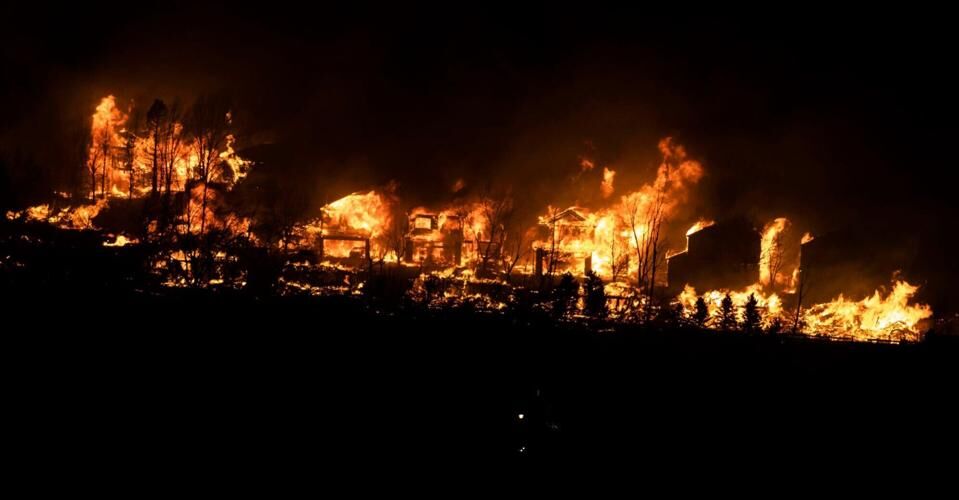
Class action suits have already been filed over Hawaii wildfires. Here’s how they’re different from the Marshall fire lawsuits

As embers are still smoking in Lahaina, Hawaii and the death toll at 110 people, lawyers have already descending on the island in search of new clients who might be interested in suing the power company whom they suspect may have started the blaze.
The Hawaii Supreme Court office which investigates complaints made against attorneys are alarmed at how quickly three class action lawsuits were filed there.
“Fire victims are vulnerable right now. They’re shocked and dismayed over their losses,” said Bradley Tamm Chief Disciplinary Counsel for the Hawaii Supreme Court Office which oversees attorney complaints. “There may be sharks swimming around the island, but really?”
Tamm said that within days after Hawaii’s devastating wildfire tore through Lahaina, a class action lawsuit had already been filed against Hawaiian Electric Company naming two defendants who lost their townhome in the blaze.
The situation has gotten so bad, Tamm fired off a memo Monday warning residents to be on the lookout for legal fraud.
“People are entitled to competent legal representation but sometimes it’s a little bit shocking how virulent some professionals can be,” said Tamm. “Welcome to the 21st Century.”
Plaintiff lawyers often dispatch representatives of their offices to sign up clients in the wake of wildfire disasters. The plaintiff law firms now working in Maui represented fire victims in a $13.5 billion settlement with PG&E, which was driven into bankruptcy in 2019 after its utility equipment sparked some of the deadliest wildfires in California history.
Tamm said that attorneys are not allowed to call, knock on doors or contact people face-to-face, but that they are sending out fliers and asking victims to call. If a family tells an attorney they’re not interested, the law firm must back off.
“You aren’t going to have your agents sitting in the ER handing out business cards,” he said. “It’s an anti-ambulance-chaser rule.”
Colorado’s power company, Xcel, is facing its own legal battles in the aftermath of the Marshall Fire. So far, at least eight mass action lawsuits have been filed here, mostly originating from law firms based in California which have representation in Colorado.
But the major difference between the civil lawsuits in Hawaii and those here in Colorado is that almost all of the Marshall Fire lawsuits were not filed until after the cause was determined by the Boulder County Sheriff and the Boulder District Attorney, who declined to file criminal charges. But the lawsuits appeared within hours of the announcement.
After 18 months of investigation, Boulder County Sheriff Curtis Johnson announced June 8 that the fire was caused by two distinct ignitions: One sparked by an unmoored Xcel Energy power line and another from embers of a week-old trash fire at the nearby Twelve Tribes property. Twelve Tribes is a religious group, whose members live in a community setting at 5325 Eldorado Springs Drive. Civil suits typically face lower standards for proof and evidence than a criminal prosecution.
In an earlier interview, attorney Ben Petiprin said his law firm, Spreter/Petiprin, started watching the Marshall Fire case from the first few days after it broke out Dec. 20, 2021. He said that his firm will not sue the Twelve Tribes organization because though the fire had two ignition points, he believes that “Xcel is responsible for the entire fire. They have deep pockets and the 12 tribes has an insurance policy, but they don’t have the kind of money that will make our clients whole from the fire.”
Law firms in Colorado have been holding Town Halls for Marshall Fire victims to explain what exactly goes into a mass action lawsuit.
The Hawaii lawsuits are similar to the ones filed in California against its power company Pacific Gas and Electric, which filed for bankruptcy protection in January of 2019 when it was faced with potentially ruinous lawsuits over California’s 2018 wildfires.
In the weeks after Hawaii’s Aug. 8 wildfire, which killed 110 people, law firms have been sending experts to the island to look into utility power lines as being a possible source of ignition, but so far no cause has been determined.
Attorneys with Watts Guerra, Singleton Schreiber, and Frantz Law Group said they have been collecting evidence, interviewing eyewitnesses and reviewing reports that indicate that damaged power infrastructure owned by Hawaiian Electric Industries Inc. created the spark for the flames.
“All evidence — videos, witness accounts, burn progression, and utility equipment remaining — points to Hawaiian Electric’s equipment being the ignition source of the fire that devastated Lahaina,” said Mikal Watts, a Puerto Rico-based plaintiffs lawyer at Watts Guerra who has won millions of dollars in settlements in other wildfire cases, including against California utility giant PG&E Corp.
Hawaiian Electric said it doesn’t have information on what caused the fires, according to an email statement from spokesman Darren Pai.
“Access to the impacted area is also limited for safety and emergency response concerns,” Pai said. “After the immediate emergency has passed, we will work with the county and others to investigate what happened on Maui.”
That said, many things can spark a fire in the right conditions, including backfiring cars and trucks dragging chains along a road.
Sensors that monitor power flow into households detected a major grid fault just after 11:38 p.m. local time on Aug. 7, about 20 minutes before a fire was first reported in Maui, followed by dozens of faults overnight, said Bob Marshall, chief executive officer of Whisker Labs Inc.
The company’s plug-in household devices determine whether a fault is taking place on utility equipment through the magnitude of voltage swings. In Maui, the strongest readings came around Lahaina.
Michael Wara, a wildfire expert who is director of the Climate and Energy Policy Program at Stanford University, said there is “no question” that the utility should have cut power to reduce wildfire risk with the forecast of gusty winds. The controversial practice is now used by utilities in California, Nevada and Oregon after power lines sparked catastrophic fires during dry windstorms in California.
“We had a situation here with very high winds, very high heat,” said James Frantz, whose firm, Frantz Law Group, is looking at power lines as a culprit and has been signing up residents and businesses in Maui who lost their homes. “And all those factors call for de-energizing those lines when that event occurs. They did not do that and they had the power to do it.”
Frantz Law Group has an office in Honolulu and is working with a local law firm on the investigation.
Hawaii Electric doesn’t have a formal power shutoff program for fire risk, Pai said.
Attorney Gerald Singleton said his group, Singleton Schreiber, was flying investigators to Maui this weekend to look into witness accounts of falling power lines and then fires starting, although an actual cause has yet to be determined.
“This wasn’t something they couldn’t have predicted,” Singleton said of the high winds taking down lines. “It’s hard to understand why more precautions weren’t taken.”
If there is a link to power lines, Hawaiian Electric will have to be shown to be negligent or that it could have reasonably prevented a loss, a higher legal standard than the one applied to utilities in California, according to a note Friday by Guggenheim Securities. The New York-based investment research firm downgraded Hawaiian Electric’s stock to $32 from $35 based on the fire exposure risk.
This story was written with help from Bloomberg News