




Colorado legend: Nearly 100 years ago, the legend of Rattlesnake Kate was born
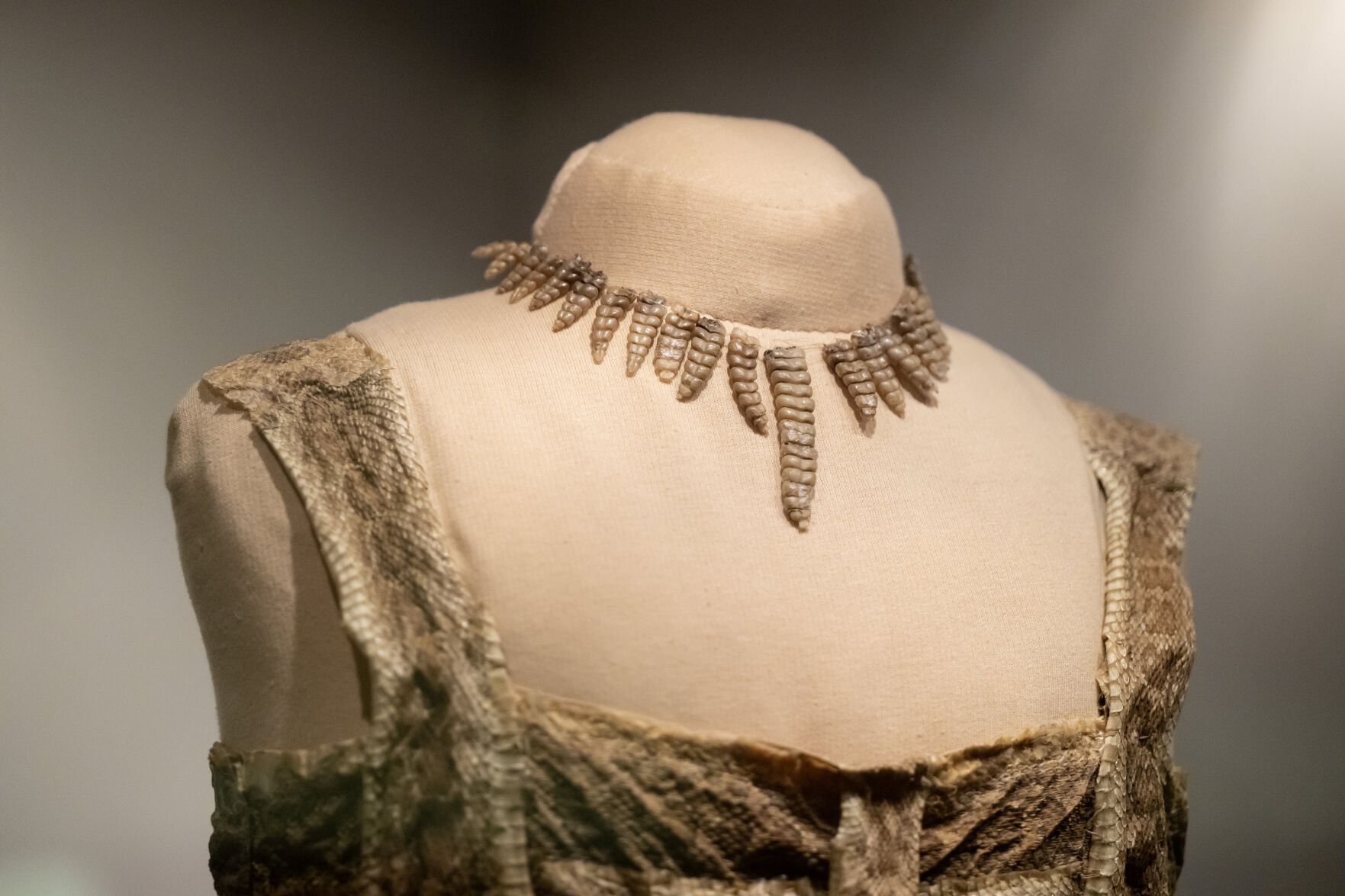
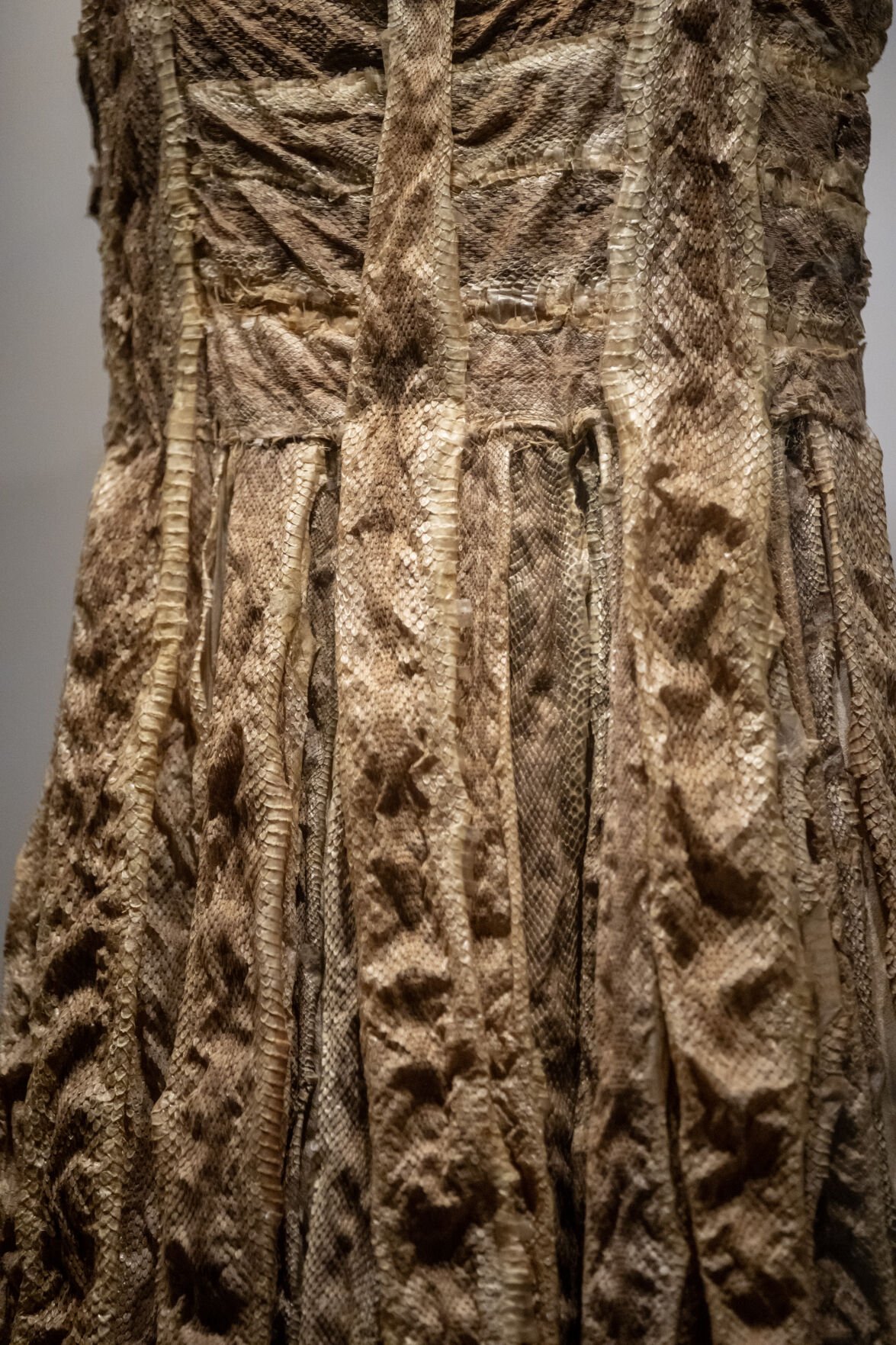
GREELEY • Almost 100 years ago on these plains of northeast Colorado, a woman created a dress of her enemies — of rattlesnake skin down to the rattling hem.
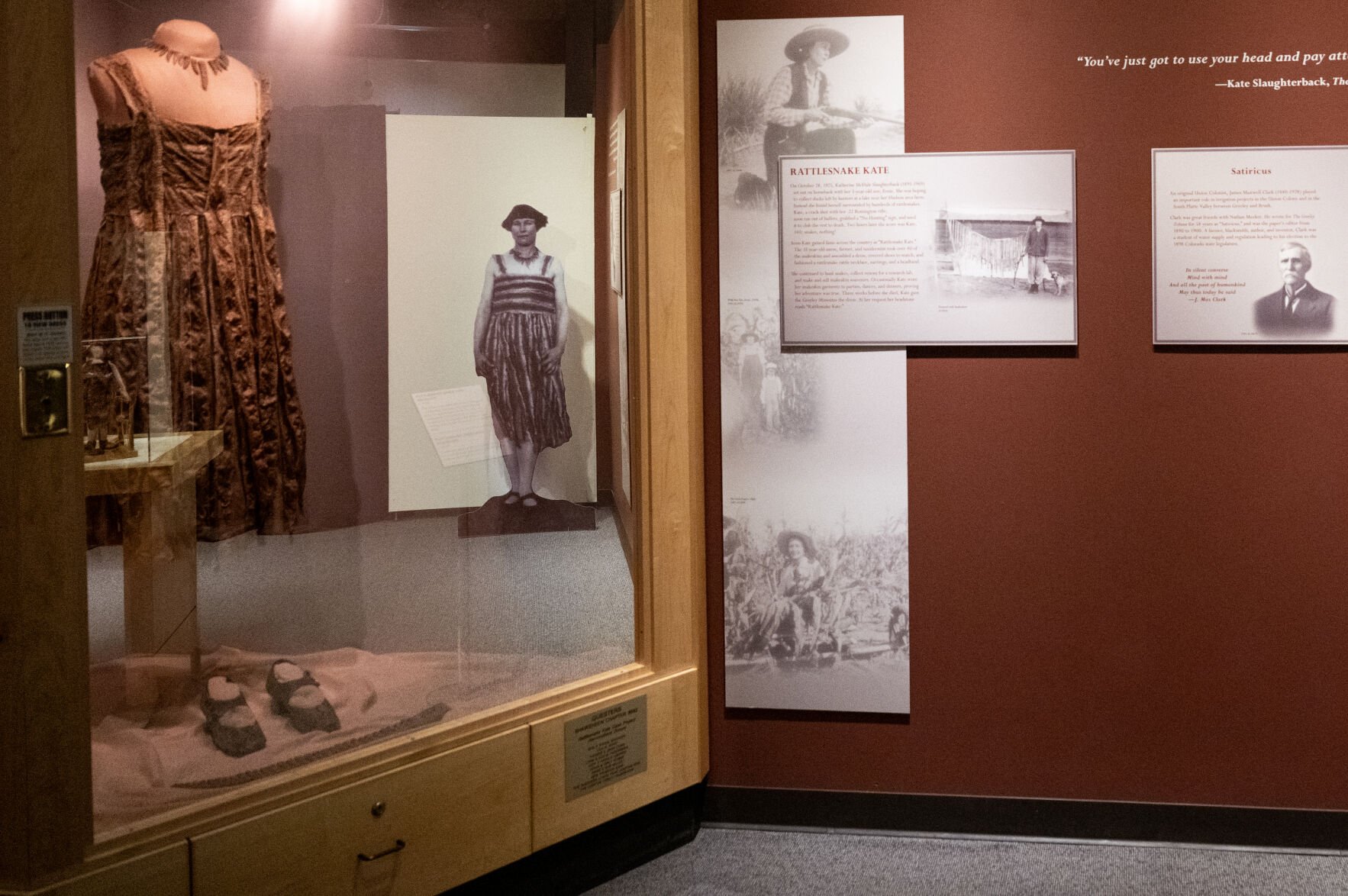
Almost 100 years ago the legend of Rattlesnake Kate was born. And here at the Greeley History Museum, her creation remains the main attraction.
People can’t resist. “A lot,” the museum’s manager, Chris Bowles, says here at the display also showcasing a necklace of rattles, shoes with rattles at the toes, and the .22 Remington rifle that claimed Rattlesnake Kate’s first slithering victims.
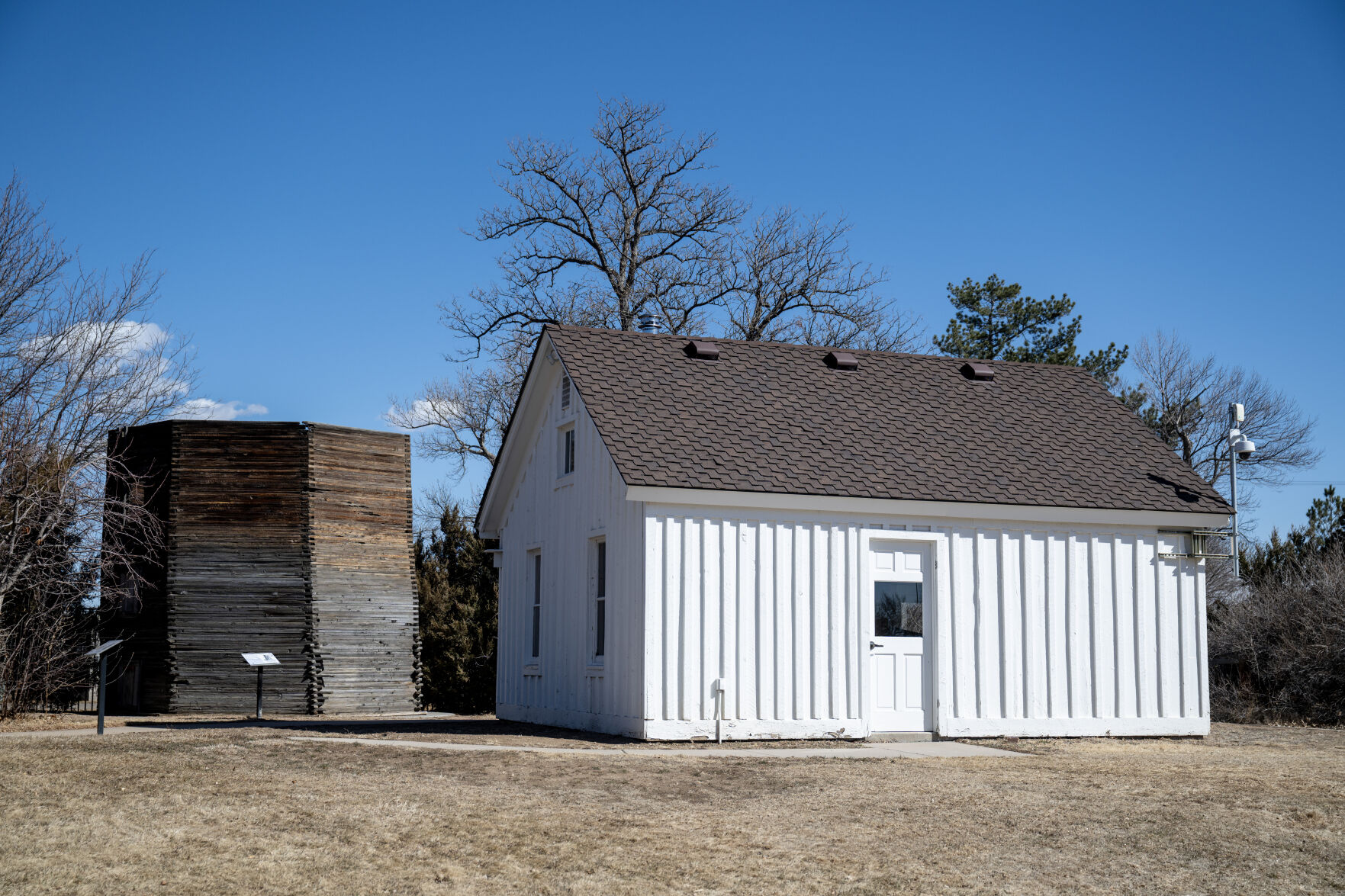
A mile away, the museum maintains something else left by Kate: a small building from her farm on these plains. On the outside, one sees rings left by cans; apparently Kate used them for insulation. Inside, one sees a replica of the second weapon she was said to have wielded that fateful day of Oct. 28, 1925: a “NO HUNTING” signpost.
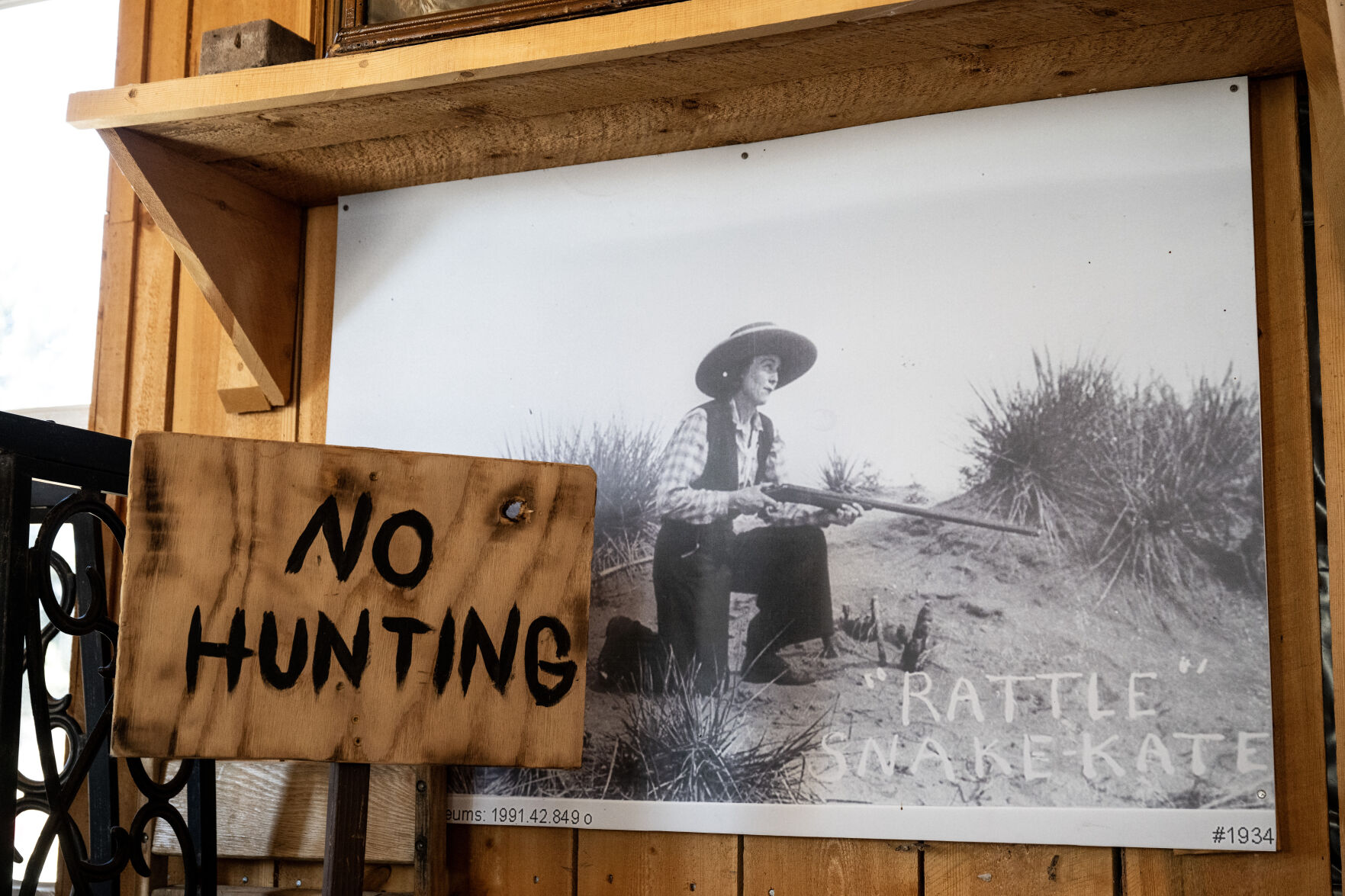
“That’s where we tell the kids the story,” says Gus Rudnick, the museum’s Rattlesnake Kate expert guiding field trips. “They love it. It’s got a wow factor to it.”
The story goes like this:
Katherine McHale Slaughterback and her 3-year-old boy, Ernie, were riding horseback while on the lookout for ducks left by hunters who had permission to cross the “NO HUNTING” sign. The mother dismounted to open a gate.
“That’s when she heard a rattlesnake right next to her,” Rudnick says. “She pulled out her gun to shoot it. And as soon as she did, three more rattlesnakes popped up around her.”
She shot one after another until she ran out of ammo, the story goes. In her words: “I fought them with a club not more than 3 feet long, whirling constantly for over two hours before I could kill my way out of them and get back to my faithful horse and Ernie, who were staring at me during my terrible battle not more than 60 feet away.”
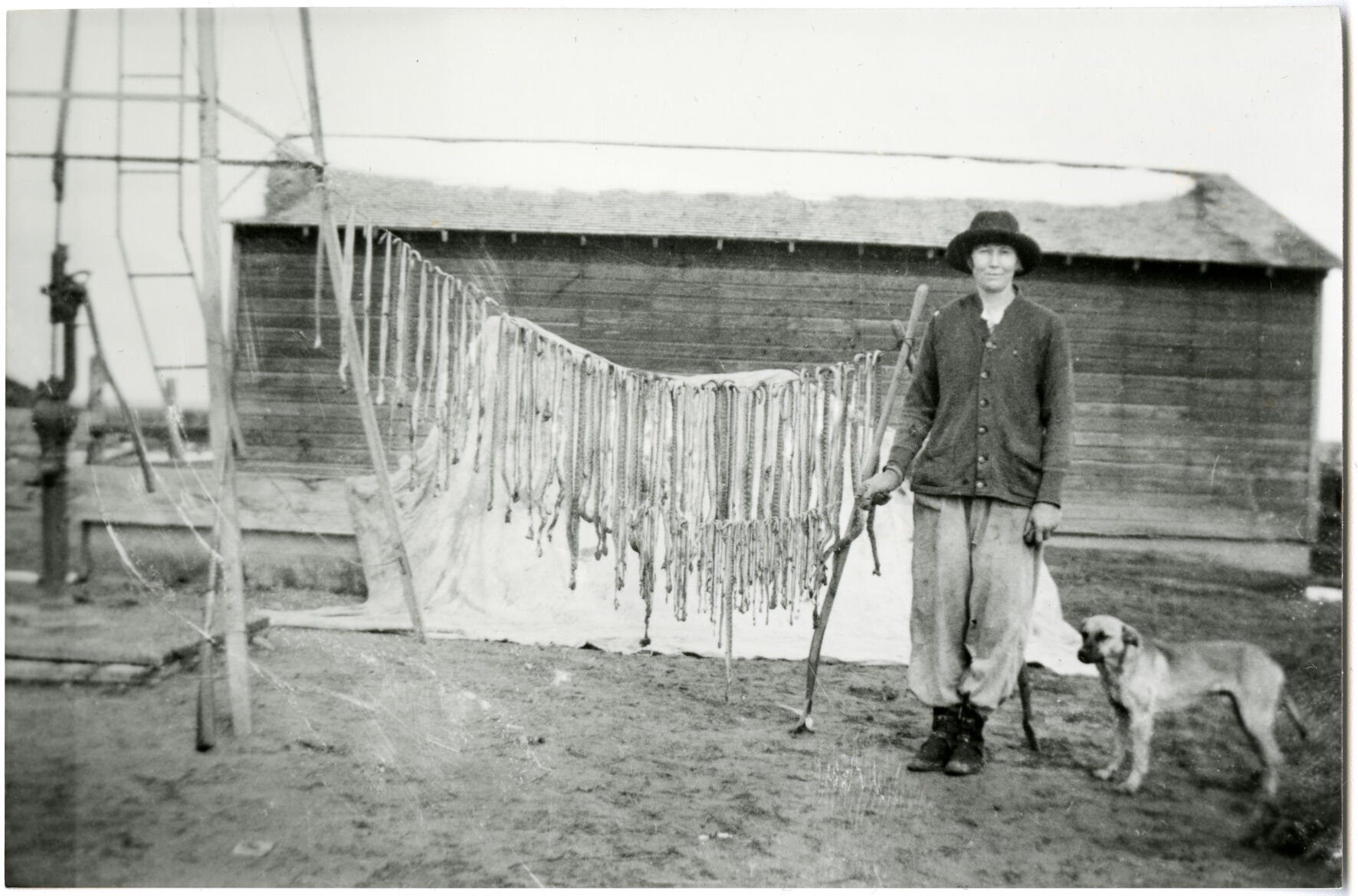
She killed 140 snakes, the story goes. The story reached the Fort Lupton newspaper, accompanied by a photo with the woman and a long string of rattlesnake skins.
“It showed up in over 100 newspapers within a week,” Rudnick says. “The story went national very, very quickly.”
A century later, the story still captivates.
It captivated a former member of the hit band the Lumineers, Neyla Pekarek. She picked Rattlesnake Kate as the subject of her first solo album, which was followed by a musical in 2021.
Around then on a History Colorado podcast, Pekarek spoke of an emotional connection she developed with the mythical-seeming character she came to see as a real, complex woman the more she researched.
A native Coloradan, Pekarek told the “Lost Highways” podcast she had never heard of Rattlesnake Kate. “And that was kind of striking to me as well,” she said. (A new exhibit by History Colorado, “Ms. Destiny,” includes Kate among the state’s “undercelebrated women,” those “who took fate into their hands, overcame barriers and defined their realities.”)
Pekarek continued in the podcast: “I thought, if I felt understood and seen by reading about this person, I imagine there’s other people that feel that way, too.”
Maybe other women feel angry sometimes, she recognized. To her, that had to be Kate that day in 1925, angry.
Why spend two hours bashing 140 snakes? Pekarek wondered on the podcast. “I mean, she was a woman that had a lot to be mad about.”
She was not so unlike other pioneer women of the day, Rudnick notes. At her core, by all accounts, Kate was a hard, hard worker — tending to crops and animals on the dry, unforgiving plains while raising Ernie. She did this mostly alone.
“Other farmers’ wives did a lot of work, a heck of a lot of work,” Rudnick says. “They just weren’t so vocal about it. And maybe they didn’t have six husbands.”
Slaughterback was the name Kate took, for the last husband she divorced. It seems she kept the name — maybe because it was the name that coincided with her fame, some have theorized.
She evidently profited on the fame. She accused Jack Slaughterback of running off with her profits.
“Jack Slaughterback said she was a fabulous sweetheart but not a good wife,” Rudnick says.
Rudnick is the young woman telling Rattlesnake Kate’s story at the Greeley museum following a woman before her, the late Peggy Ford Waldo.
Ford Waldo was the one who brought the story to the modern masses after coming by the rattlesnake dress in the museum’s storage room in 1979. Kate had donated it just before she died 10 years prior.
It could be said she died as one of the last legends of the Old West. And like every legend, Rattlesnake Kate’s is mixed with fact and fiction, Ford Waldo said on that History Colorado podcast.
But there’s plenty of evidence to confirm the rattlesnake battle — the dress, the pictures, the consistent account of Kate and others, and the fact that huge rattlesnake dens are not uncommon on northeast Colorado’s migratory path.
And another thing is certainly true, Ford Waldo told the podcast: “She knew who she was, and she knew who she was early on.”
Young Katherine McHale, it seems, wanted to be like the adventurous men she read about as a child. “She read lots of dime novels about the American West,” Ford Waldo said.
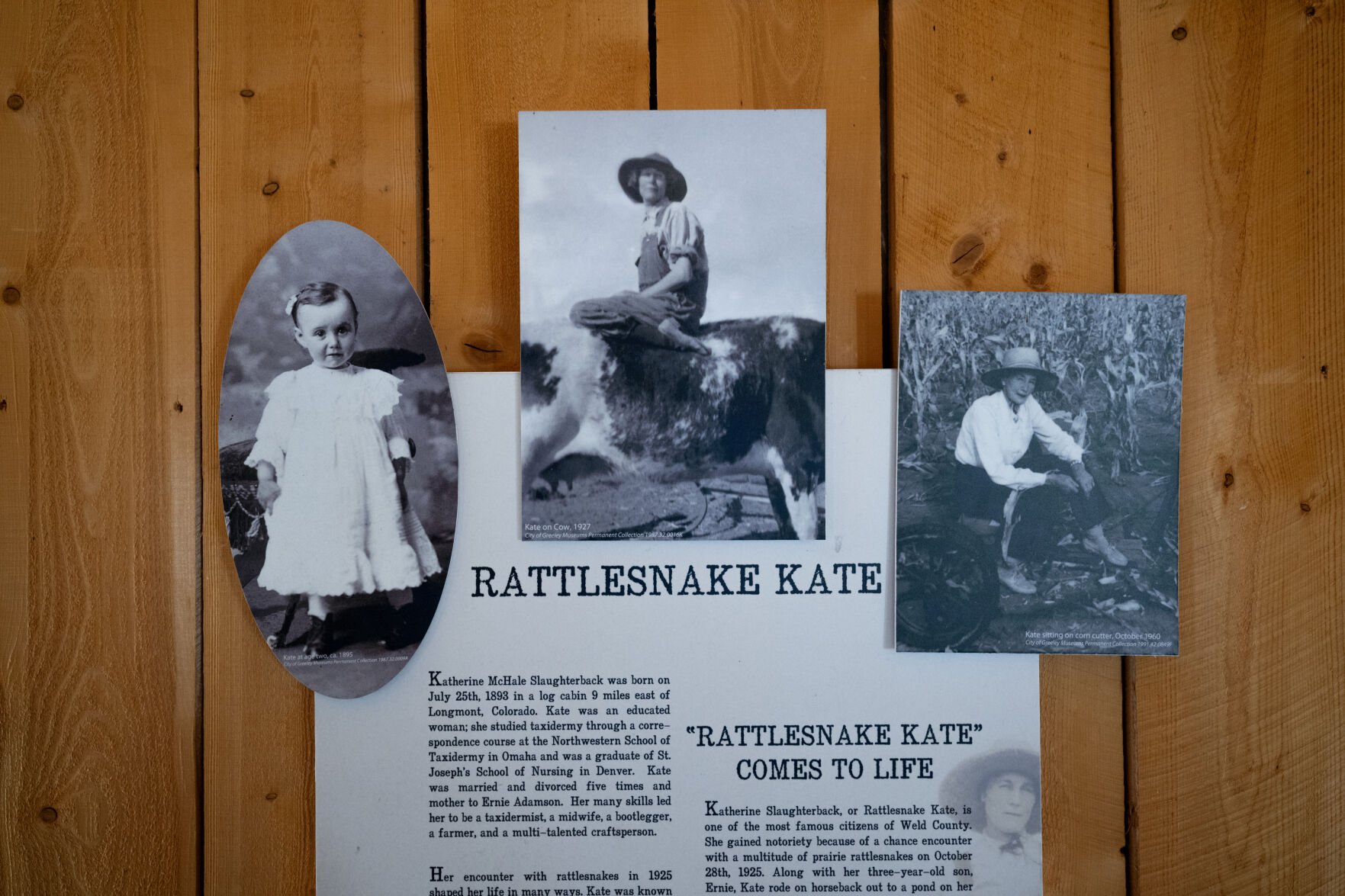
Katherine McHale was born in 1893 outside Longmont. Her mom died when she was young. She was left with her father and two brothers, before she was said to have run away with some food and her brother’s clothes — off for the adventure of her dreams.
She would end up on a farm near Hudson and live in a home without running water, lit by kerosene lamps and heated by coal. The events that brought her there aren’t entirely clear.
What’s clear: She blazed her own path, however circuitous.
She married and divorced men along the way. She possibly bootlegged. She possibly worked as a nurse — she claimed she was working as one during World War II when she parachuted out of a plane — and she clearly took a liking to taxidermy. Another uncertain matter: whether Ernie was adopted, as she said, or born to her (a photo of her in Wyoming appears to show her pregnant).
Just as she did her horses — even after one kicked her and broke her arm and collarbone — Kate wrote adoringly of Ernie.
“Definitely, fundamentally, he was her son. She raised him,” Rudnick says.
This strikes Bowles, the Greeley museum manager.
“The fact that she’s a single mom for a lot of that time,” he says. “She was trying to do men’s work in a man’s world as a single mom.”
She didn’t need a man, didn’t need anyone’s help. She was not known to hire anyone to help around the farm. “She didn’t trust anyone to do the job well enough,” Rudnick says.
She was known to run a harvesting machine that was built to be operated by two men and a mule before it was recalled for massive, dangerous blades. “She would run this thing by herself when she was into her 60s,” Rudnick says.
She was known to love her chickens as much as her horses. She caught a rustler once, a story goes. He punched her, “and she still chased after him with a gun,” Rudnick says.
She was struck by lightning, another story goes. A stroke left her arm limp before she regained strength by pumping cast iron, another story goes.
And then there’s the most famous story. Rattlesnake Kate took advantage of the fame, selling taxidermied rattlesnake souvenirs. She sold rattlesnake venom to scientists in California before ending her careful practice of extraction.
“She got tired of that,” Rudnick says, “so she chopped the heads off the snakes and sent the heads to the scientists and told them they needed to do it themselves.”
Much of what’s known or believed about Kate comes from a long, curious string of correspondence.
On and off for decades from the 1930s through the ’60s, she exchanged letters with a man who fancied himself the “Poet of the Plains.” He was an Iowa man who called himself Buckskin Bill.
These were decades after industrialization, after the railroads and automobile boom and rise of cities, after the Dust Bowl blew in, obscuring whatever vision people had of that old frontier.
“It’s kind of a sense of lost innocence,” Bowles says. “This idea that America was brand-new, and it could be conquered.”
Men had conquered — men with names like Buckskin Bill. “I think he wanted her to play a part in his story,” Rudnick says.
And maybe she was happy to do so.
“The need to create a tall tale about yourself, a legend about yourself,” Bowles says. “We kind of have a feeling her correspondence with this guy was about that.”
Maybe there was more to it, Pekarek thought as she read the letters and went on to craft her album. As she said on the ”Lost Highways” podcast: “He sort of glamorized a lot of those qualities in her of being strong, and being brave …”
Young Katherine McHale would be the strong, brave woman she never read about in those old dime novels. She would die at the age of 76 in 1969. The Wild West was like a distant dream by then, along with any idea of a life of adventure and innocence.
Katherine McHale Slaughterback would be buried on these plains, out at the Platteville cemetery. Her tombstone would be unremarkable, much like the others, were it not for the inscribed name she requested: “Rattlesnake Kate.”

Get OutThere
Signup today for free and be the first to get notified on new updates.
PREV
PREVIOUS
House Republican says Trump ushering in ‘new era’ for US energy
Rep. August Pfluger (R-TX) expressed enthusiasm for President Donald Trump prioritizing U.S. energy, arguing that the president is working to cut “red tape” hampering the energy industry. The president just signed Pfluger’s Congressional Review Act that sought to reverse former President Joe Biden’s natural gas tax, which Pfluger argued is the first step that is […]

Top concerts coming to Colorado this summer
With summertime fast approaching, you can almost hear music in the air. As the temperature begins to rise, Colorado’s summer concert lineup is heating up with popular artists like Coldplay, Post Malone and The Weeknd. And with iconic outdoor venues like Red Rocks Amphitheatre and Fiddler’s Green Amphitheater, music lovers have plenty to look forward […]