





The allure of climbing a Colorado peak that’s claimed more than 70 lives

While Colorado is filled with mountain peaks, one in particular seems to have captured the widespread allure of sightseers and adventurers, alike – 14,259-foot Longs Peak.
The only mountain in Rocky Mountain National Park that reaches an elevation of more than 14,000 feet above sea level, Longs Peak is known for its beauty, but its beauty isn’t what made it famous, or in the words of some, infamous. Not only is Longs Peak the “14er with the highest failure rate” among those who attempt the climb, it’s also often considered the deadliest peak in Colorado based on death toll.
If you pay attention to outdoor recreation-related news that comes out of the Centennial State, you’re likely quite familiar with headlines that pop up seemingly year-round about people who have gone missing or have died on the Longs Peak. While some of these cases result in rescue, many instances end with someone dead on the mountain.
In 2018, there was the case of Jens Yambert, who went missing following an attempted summit during strong winds and winter weather. His body was later recovered at the bottom of a 200-foot fall.
Later that year, Micah Tice and Ryan Albert went missing on Longs Peak. While search parties were promptly launched in each case, initial rescue efforts were eventually called off due to the massive risk that comes with sending search crews up on the peak amid hazards posed by winter weather. The bodies of both of those men were recovered months later.
Unfortunately, the list goes on.
Between 1915 and 2017, it’s been determined that 374 visitors to Rocky Mountain National Park have died while they’re there. Of those 374 deaths, 67 have been associated with Longs Peak, 70% of which were the result of a fall, with other reasons including hypothermia, cardiac events, lightning, and exhaustion. Keep in mind that this number doesn’t include deaths that occurred during the deadly summer of 2018 or later.
Before we take a look at why Longs Peak is so deadly, let’s take a brief look at the history of the mountain.
The History of Climbing Longs Peak
Named after explorer Stephen Harriman Long, Longs Peak is the tallest mountain in Rocky Mountain National Park. It reaches a maximum elevation of 14,259 feet, which makes it the 15th-highest peak in the Centennial State.
Prior to its history as Longs Peak, the mountain was known as Neníisótoyóú’u by Indigenous peoples of the region, specifically the Arapaho. This has been translated in various ways that generally reference the number ‘two’ – one translation being ‘Two Guides,’ an apparent reference to Longs Peak and adjacent Mount Meeker.
The first recorded summit of Longs Peak took place in August of 1868, when a party led by John Wesley Powell summited via the south side of the mountain.
Since that summit, the peak has become one of the most popular mountains to scale in the state. The most recent data from Colorado 14ers Initiative indicates that between 7,000 and 10,000 people were hiking on Longs Peak in 2024 – and that’s low compared to some prior years. It’s not the 30,000 that attempt to tackle some of Colorado’s most popular mountains – Quandary Peak and Mount Bierstadt, for example – but it’s significantly higher than most peaks of the same ‘class three’ technical nature, which tend to attract 3,000 annual climbers or less.
That being said, more than half of the climbers who attempt Longs Peak turn around before reaching the summit, making Longs Peak the fourteener that’s typically said to have the highest failure rate.
This high failure rate is likely a factor of the peak’s popularity, its difficulty, and its ease of access. Many people who end up turning around likely “bite off more than they can chew” in a sense, realizing this at some point during the hike and deciding to head back to the trailhead. Keep in mind that no fourteener that’s as difficult to summit as Longs is tops it in popularity.
Now that we’ve taken a look at a few of the numbers behind the peak, let’s get into what makes the standard route to the summit so dangerous.
What is the climb like?
Compared to climbing many other fourteeners around Colorado, Longs Peak is tricky, but it’s far from impossible. In terms of difficulty, it probably ranks somewhere in the range of 12th to 15th in terms of difficulty on a list of 58 14,000-plus-foot peaks.
It’s definitely not the hardest climb, but it’s an entirely different experience compared to the easiest routes on the state’s fourteener list, mostly thanks to its lengthy “Class 3” segments which mean slow-moving rock scrambling amid extreme terrain.
With a standard route to the summit that requires no additional safety or climbing equipment for the brave and experienced, Longs Peak has a high appeal among seasoned hikers. The normal high-elevation hiking set-up is generally enough to get the job done during the summer and early-fall hiking seasons – as long as one is prepared for incoming weather and exposure risks.
The main route, called the Keyhole route, is extremely long and physically taxing, covering about 15 miles of distance round-trip with more than 5,000 feet of vertical gain. Aside from being a strenuous endeavor, certain sections feature loose rock, deadly drops, and frequent ice (hikers should always bring traction, just in case). Storms are also a big risk on this peak, with the weather that lies ahead covered by the towering landscape for a majority of the approach. That hidden weather is also known for changing quickly, frequently dropping hail and bringing deadly lightning down on the mountainside.
Because the hike is so long and because afternoon storms tend to be such a risk factor, most hikers start the trek up Longs Peak at about two or three in the morning. Hopefully, those hikers get some good rest the night before, too, or they’ll be hiking tired and potentially subject to greater risks associated with fatigue and elevation sickness.
Leaving the trailhead behind, the route first winds uphill through dense forest for several miles. Most navigate this stretch by starlight and headlamps given the early recommended start time.
Despite a lack of visibility, the transition into the next phase of this trek is quite apparent when the woods open up to a wind-scraped mountainside. Even if hikers can‘t see that they’re above treeline, whipping gusts tend to make it very obvious. This mountain is known for its extreme wind.
Once above treeline, the approach toward Longs Peak continues for several more miles, seemingly getting steeper by the step. Hikers continue up switchbacks that get more rugged with each foot of elevation gained. Though this portion of the hike is enough to have many headed back to the vehicle, the most extreme portion of Longs Peak is yet to come.
Following the series of switchbacks, hikers enter a massive boulder field, greeted by a sign that reads: “A trip, slip, or fall could be fatal. Rescue is difficult and could take hours or days. Self-reliance is essential.”
The sign is morbid, but the description it gives of what lies ahead is spot on.
At first, scrambling through the boulder field is relatively easy for those blessed with sturdy knees and ankles, but that doesn’t last for long. Boulders get larger and larger, quickly turning this part of the route into a whole body effort.
During my own hike to the Longs Peak summit, this is where the sun made its first appearance of the day, illuminating a massive several-hundred-foot-tall rock face beneath the summit in a pinkish orange hue. Catch it in the same light, and it’s impossible to not be a bit enchanted in the moment. Among the 40-plus unique fourteeners I’ve summited and the 100-plus times I’ve made it to the top of a 14,000-foot-peak, this view from my lone climb to the Longs Peak summit remains etched in my mind.
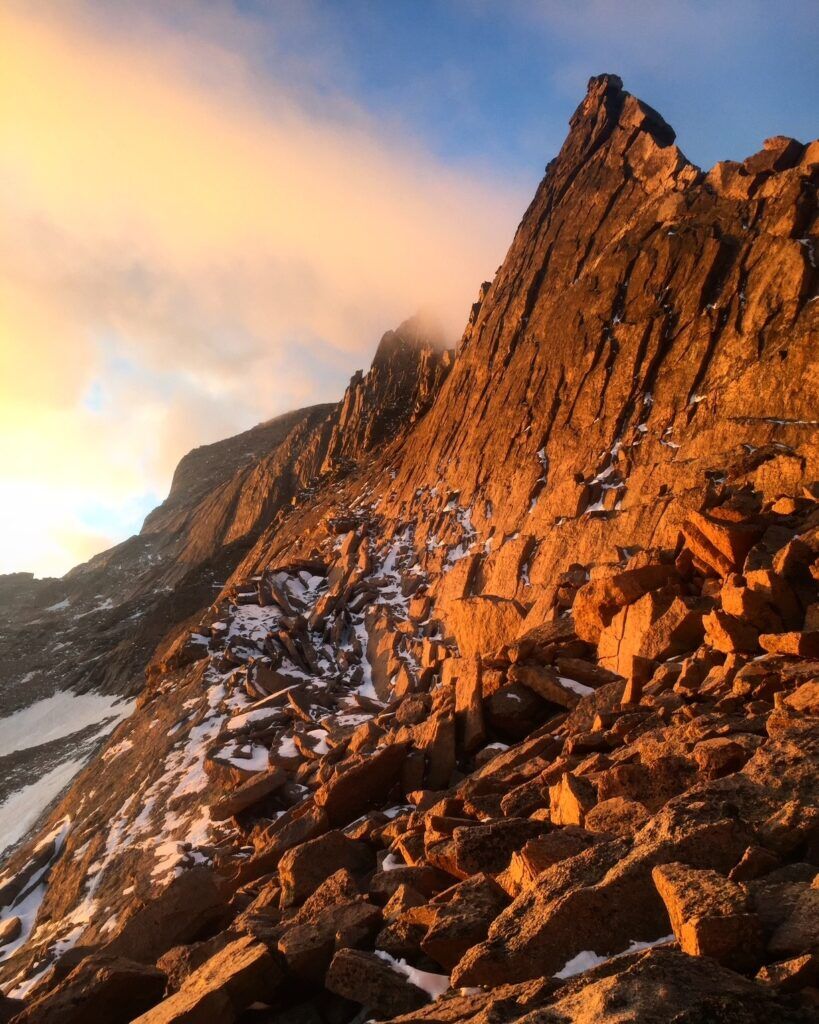
While in the boulder field, hikers are able to easily see the “keyhole” feature on the ridgeline that lies ahead. The “keyhole” is the namesake for the standard route and is perhaps the most crucial spot of the climb, for only after passing through the keyhole is one able to see what weather likely lies ahead for the rest of the day.
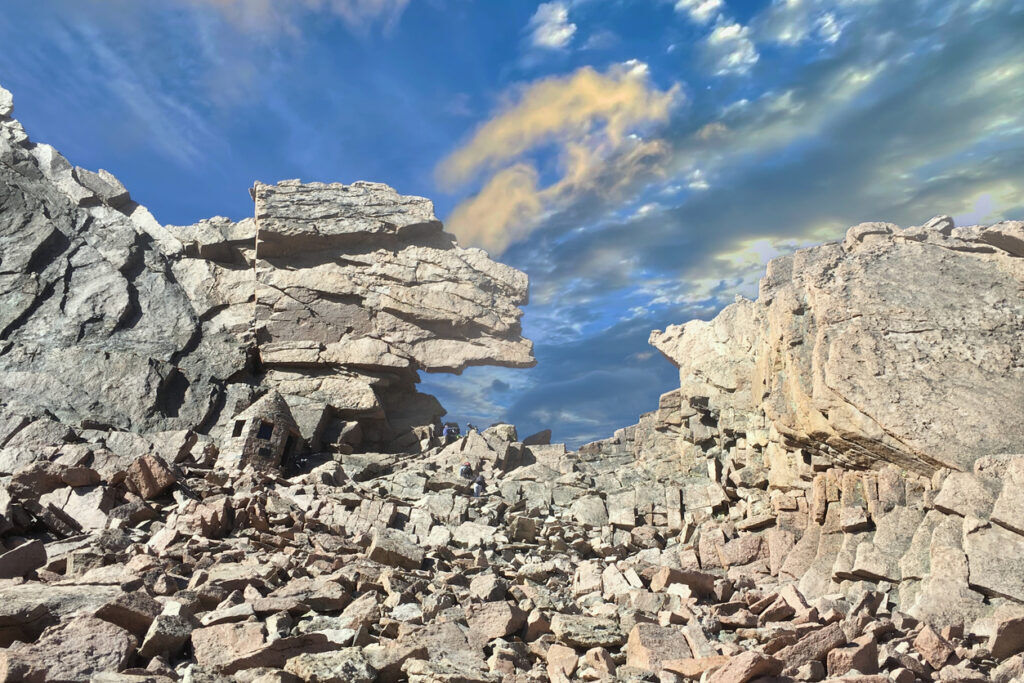
The keyhole opens up into a massive mountain bowl that often collects early morning clouds. From here on out, it’s quite exposed with no cover over a long and steady grind through rocky terrain that only gets more and more difficult. Pushing past this point means accepting the commitment of the hike, as quickly evacuating from this area would be a tricky feat. After the keyhole is where the costliest accidents occur. After the keyhole is where people are most likely to die along the standard route.
The next stretch of the route consists of a traverse across boulders. Tiny red and yellow circles mark the path, though these can be easy to miss, especially in the case of ice or snow coverage. Hikers should remember that even a small flurry of sudden snow could make these markers impossible to find.
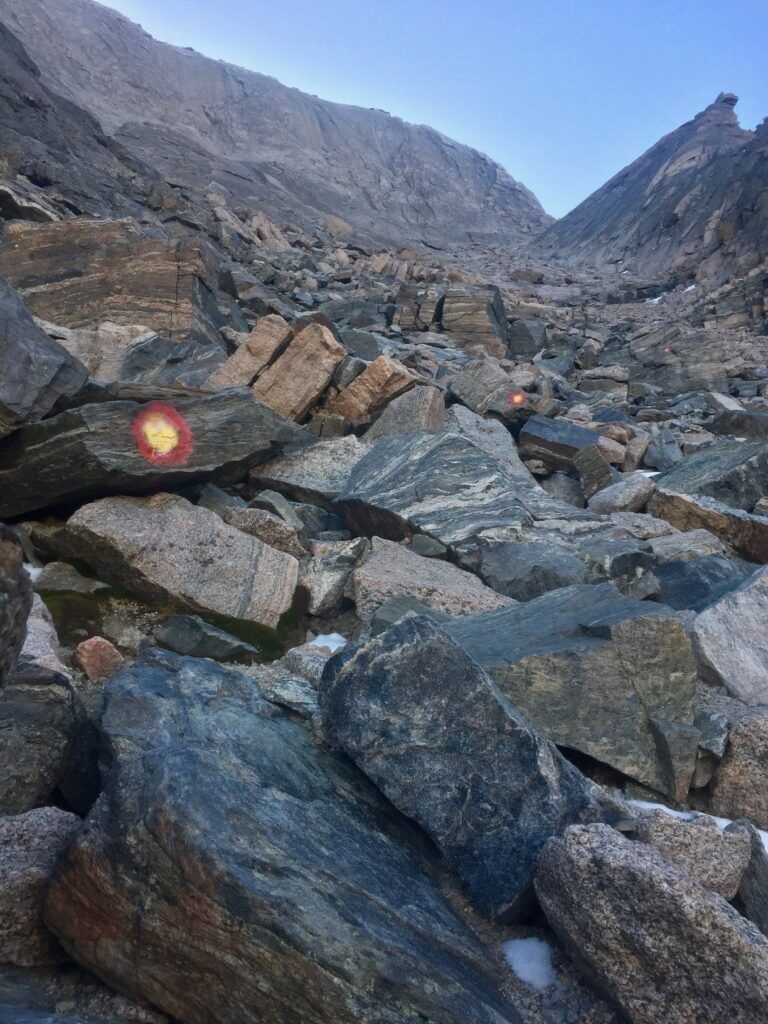
Eventually, this leg of the journey leads to a section called “The Trough”, a rocky gully that’s filled with loose rock, climbing about 600 vertical feet. Ice in this section can be an extreme hazard, as well as debris falling from climbers above.
Things don’t get easier after “the Trough” either, as this section quickly transitions into the most infamous portion of the climb – The Narrows.
The Narrows consists of a cliffside traverse where hikers have just enough space to walk alongside a deadly drop. The wind whips hard here, often at a high enough speed to blow a person off balance and potentially down the side of the mountain with a single gust. This portion isn’t exactly simple either, as some badly positioned rocks put hikers at a massive exposure risk. The uneven wall on climbers’ left side also poses the threat of bumping one off their balance in a misstep – watch out for turning and twisting with backpacks on.
Once climbers make it past The Narrows, there’s one final portion that leads to the summit. It’s called the Homestretch. During my hike up the summit, I actually felt like this section was the most exposed – more-so than the Narrows, though this was also where my party started to encounter early-morning ice, which added another layer of difficulty and risk (thankfully, that had melted by the descent).
The Homestretch consists of steep rock slabs with limited handholds and footholds that climb approximately 300 feet up the mountainside. There are several vertical cracks in the middle of the slabs found on this portion of the hike, making it possible for hikers to use these for support. That being said, the steep, relatively smooth nature of this portion would mean serious consequences should a fall occur.
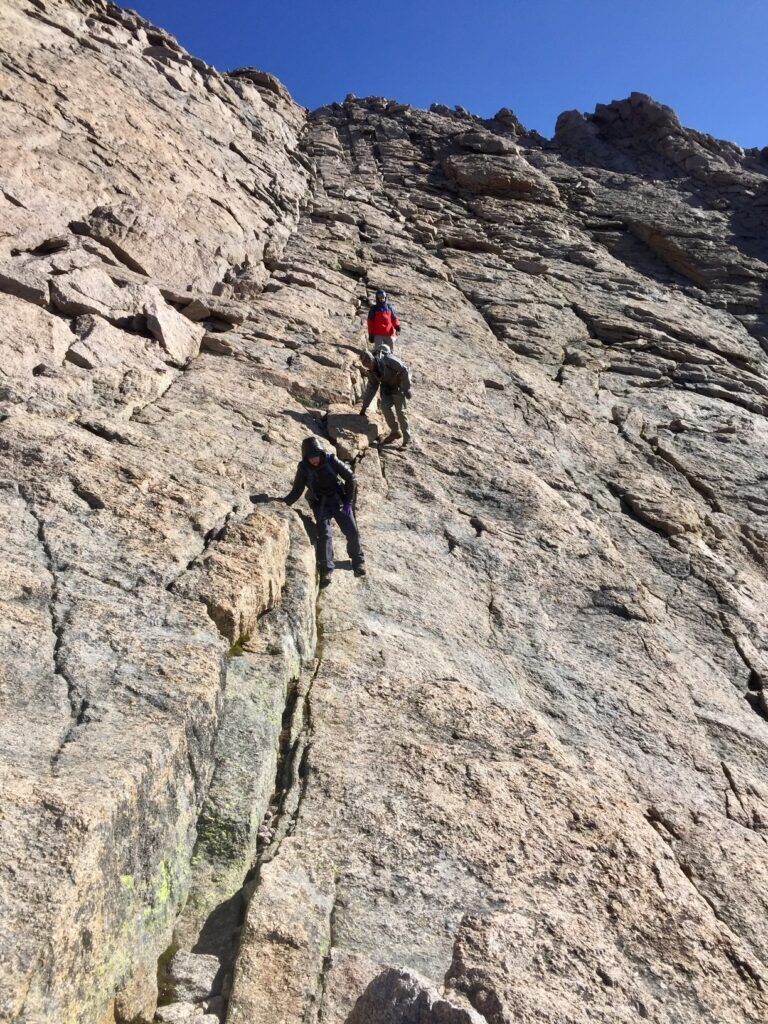
After the ‘Homestretch,’ the summit awaits. It’s wide and flat, making for a perfect place to momentarily relax before making the return trip down the same route, encountering the same risks.
Most people looking at the description could start to guess why this mountain is so deadly, but let’s take a deeper look at a few of the factors that seem to contribute to most of the deaths.
Why is Longs Peak so deadly?
The biggest safety concern with Longs Peak seems to often be a lack of experience and preparation among those who attempt the climb.
The trailhead for the main route is easy to find in one of the country’s most iconic (and crowded) national parks. This aspect, alone, tends to attract a wide range of skill levels to the trail, from seasoned climbers with the proper gear to people that will start the approach in sandals and without water. Most fourteeners are far less accessible, working to weed out the novice hiker in a way.
This convenient location at a popular tourist destination also poses another threat to experienced hikers who may be visiting from out-of-state. While the long route and elevation gain might not typically be an issue for these hikers on the trails around their love-elevation hometown, Colorado’s extremely high elevation makes altitude sickness a deadly threat. Altitude sickness is something that can impact anyone, regardless of age or physical fitness, tending to impact those not acclimated to elevation – i.e. on a quick trip to Rocky Mountain National Park – the most. Many experienced out-of-state hikers assume this is not the case given their experience or athletic abilities, though they can be dangerously wrong. Tempted by the convenient chance to ‘bag’ such an iconic peak, many long-time hikers still tend to ignore the risks of the high elevation.
Another big issue with Longs Peak is found in the weather of the area. First, the weather here seems to change quickly, capable of bringing strong winds, blizzard conditions, and deadly lightning throughout many months of the year – even on a warm summer day. Sure, weather around the entire state of Colorado can seem to change in an instant, but in the terrain of Longs Peak, that flip can pose big problems.
Second, the weather that hikers encounter during the most dangerous portion of the hike is hidden along much of the route – until the Keyhole feature. This means that bad weather can sneak up on hikers. These hikers are then faced with the decision to turn back or to push on, and many choose to take the risk due to their desire to complete their mission – summit fever, as it’s often called. It’s important to remember that it’s always acceptable to turn back and try again on another day – and this is what many people choose to do.
The other risk factor that seems to be most prevalent on Longs Peak is the extreme nature of the terrain. Just like it says on the aforementioned mid-route warning sign, the terrain is unforgiving. A simple mistake can lead to dire consequences. And given the peak’s popularity, that risk can be amplified by other traffic on the mountain – people tend to kick down rocks when they’re climbing while other hikers are located downslope, for example.
Not only is much of the route exposed, it’s also a long trip to safety with not much cover along terrain that’s so rugged you’re forced to travel at a slow pace. Running isn’t an option. Hiding isn’t an option. The only option is a long, slow walk on a fixed route that’s dangerous amid even the most perfect weather conditions.
For those who have ample experience navigating Colorado’s high-elevation ‘class three’ terrain, the risks might not seem like much. But for those who are only used to hiking an established trail at the local park, even the most standard route up Longs Peak can seem like any entirely different world.
Tips for climbing Longs Peak
Even though Longs Peak is dangerous, people will continue to climb it. To those who are considering this endeavor, it’s important to understand the risks associated with the mountain.
First, watch the weather. Being aware of what storms might be blowing in and adjusting your plans accordingly can mean the difference between life and death. Know that afternoon lightning and hail are common, and also that the winter weather will hit at that higher altitude earlier in the fall and can stick around later in the spring. The weather at 9,000 feet of elevation is often quite different compared to that at 14,000 feet. It’s also crucial to stress that the seasons completely change the difficulty of this climb.
Aside from watching the weather, one crucial tip is to start early. Aim to be above treeline before sunrise, and far past that if possible. The recommended start time is two to three in the morning. Starting this early is important because it helps you avoid frequent afternoon storms.
What you’re bringing with you up the mountain is also important. Make sure you’ve got the right gear and that you know how to use it (learn about the 10 essentials here). Always bring extra water and make sure you’ve got extra layers, including something waterproof. Carry a paper map and a compass you’re familiar with so that you can use them in case your technology fails.
One final tip is to never forget that it’s always acceptable to turn back. Stubbornly charging into a storm on Longs Peak is dangerous and it’s something that can get you killed. Ignoring signs of dehydration or altitude sickness can turn deadly in such extreme terrain. Pushing through injury is never a good idea either. The mountain will be there the next day, do you best to make sure you are, too.
In Closing
A natural feature so iconic in the Centennial State that it’s on the country’s Colorado-themed quarter, Longs Peak is a mountain known far and wide. It towers over the Front Range in a way that beckons the city dwellers below to visit its vast hillsides full of risk and awe. Many dream of climbing it, far fewer attempt it, and less than half of those hopeful people will reach the summit. A force of nature to be approached with respect, Longs Peak is exactly what a mountain should be.
STAY INFORMED: Get free Colorado news with our daily newsletter (Click here)
Get OutThere
Signup today for free and be the first to get notified on new updates.

PREV
PREVIOUS

Denver’s Elitch Gardens theme park holiday event has new name, more rides
One of Denver’s popular holiday events is returning this year under a new name at Elitch Gardens Theme & Water Park. Out with “Luminova Holidays” and in with “Elitch Holidays,” a name change the downtown Denver amusement park is calling “a fresh take on a beloved tradition.” From Santa’s workshop, roller coasters, hot cocoa and […]

Denver leads major U.S. cities in share of homes that have LOST value year-over-year
Zillow recently released a report on how the housing markets in major American cities are doing year-over-year and data is shocking. While roughly 53% of homes in the U.S. have actually lost value in the past year – the most since 2012 – Denver tops the list in terms of how many properties are worth […]