





Here’s when Colorado drivers need to use tire chains to avoid a fine (and other traction laws to know)
As snow starts to hit the state more consistently, it’s important for all Colorado drivers to be aware of what requirements exist related to vehicle traction.
Most people know that commercial vehicles, like semi-trucks, are required to carry traction chains or alternate traction devices (ATD) on various roads throughout winter – but not many Coloradans are aware that ‘chain or ATD’ requirements apply to some passenger vehicles, too.
A key piece of context related to this topic is that the Colorado Department of Transportation is able to implement traction laws during periods of winter weather (or expected winter weather). As far as passenger vehicles go, there’s a ‘traction law’ and a ‘chain law’ in addition to standard vehicle equipment that’s required to travel some roads.
When a ‘passenger vehicle traction law‘ is implemented on any road around the state, it means that all vehicles need to have adequate traction to legally be on the road. While those with four-wheel drive or all-wheel drive vehicles can utilize all-weather tires, winter, or mud-and-snow tires provided those tires have a tread depth of at least 3/16 inches to satisfy the requirement, those traveling in two-wheel drive vehicles are required to affix chains or approved alternate traction devices (ATD) to two or more drive tires when this restriction is in place.
The ‘passenger vehicle chain law’ restriction is even more restrictive, and when it’s activated it means that all passenger vehicles – 2WD, AWD, and 4WD – must utilize chains or ATDs on two or more drive tires. In that scenario, simply having adequate tires on a AWD or 4WD vehicle isn’t enough to be compliant.
In addition to being prepared for the aforementioned restrictions to get implemented at any time and with little notice, all passenger vehicles traveling I-70 between Morrison (mile marker 259) and Dotsero (mile marker 133) between September 1 and May 31 are required to have one of the following regardless of the conditions, per Colorado State Patrol:
- Tire chains for two or more drive tires
- Approved ATDs for two or more tires
- Manufacture-rated all-weather, winter, or mud-and-snow tires with a tread depth of at least 3/16 of an inch
It’s also worth emphasizing that traction laws don’t just apply to I-70, as the state is able to implement traction and chain laws on I-25 and state highways, too.
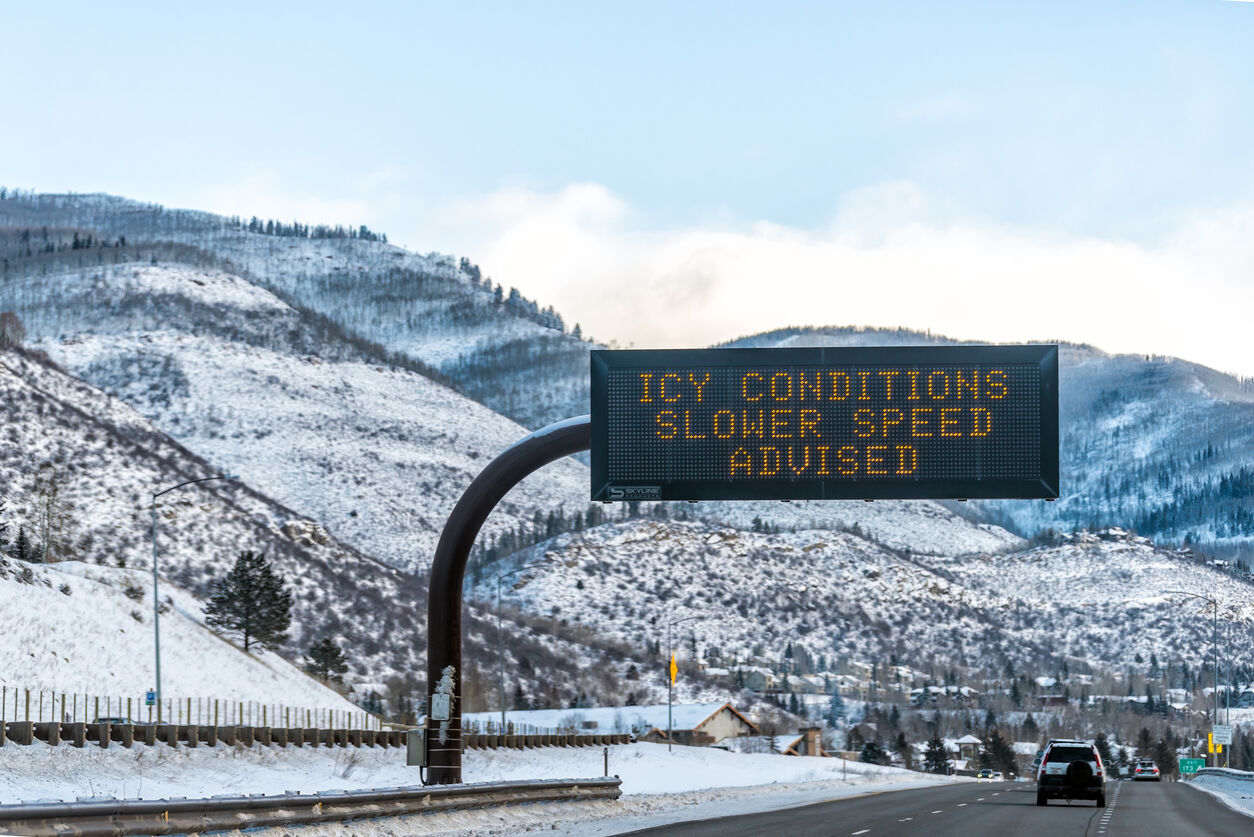
While various traction restrictions may be announced beforehand if severe winter weather is imminent, the minimum for notification is on-road notifications in the form of electronic road signs. Other options that CDOT may utilize include the CDOT travel website, a phone messaging system, email, text, or other automated personal notification systems.
Per a spokesperson from CDOT, drivers of passenger vehicles who are caught breaking traction laws are subject to a non-compliance fine of $50 plus a $17 surcharge. It’s also worth noting that based on past years, other fines or citations may apply depending on the circumstance – when an crash or blocked lane occurs resulting from a lack of traction, for example.
RELATED: Sign up for our free daily newsletter to get top headlines in your inbox
Get OutThere
Signup today for free and be the first to get notified on new updates.

PREV
PREVIOUS
From tiny towns to major metros, here are 34 places in Colorado worth a weekend trip
One great aspect of living in or visiting Colorado is that finding a completely new and worthwhile experience is often just a town away. Here’s a quick description of 34 of the many cities and towns worth checking out in the Centennial State: STAY INFORMED: Get free Colorado news with our daily newsletter (Click here)

Fact or Fiction: Did 'notorious' hunter Sir St. George Gore really kill 1,000s of animals across the American West?
Last week, I wrote an article about the legend of Sir St. George Gore, the namesake of Colorado’s Gore Range and Gore Pass, along with several other well-known landmarks. While these spots bear his name, Gore is perhaps best-known for his notorious hunting expedition in which he is often blamed for slaughtering 1,000s of animals […]