





28% of county in heart of Colorado’s ski country experiencing “exceptional drought”
It’s no secret that Colorado’s snowpack is low – at about 56 percent of the norm for January 22 and the lowest its been for the date since records started in 1987. As might be expected, the lack of snow in Colorado seems to be having a noticeable impact on the state’s drought levels, too.
The U.S. Drought Monitor produces a weekly report for Colorado that’s released each Thursday utilizing data collected two days prior. It classifies conditions on five tiers – ‘abnormal dryness’ followed by drought stages one through four.
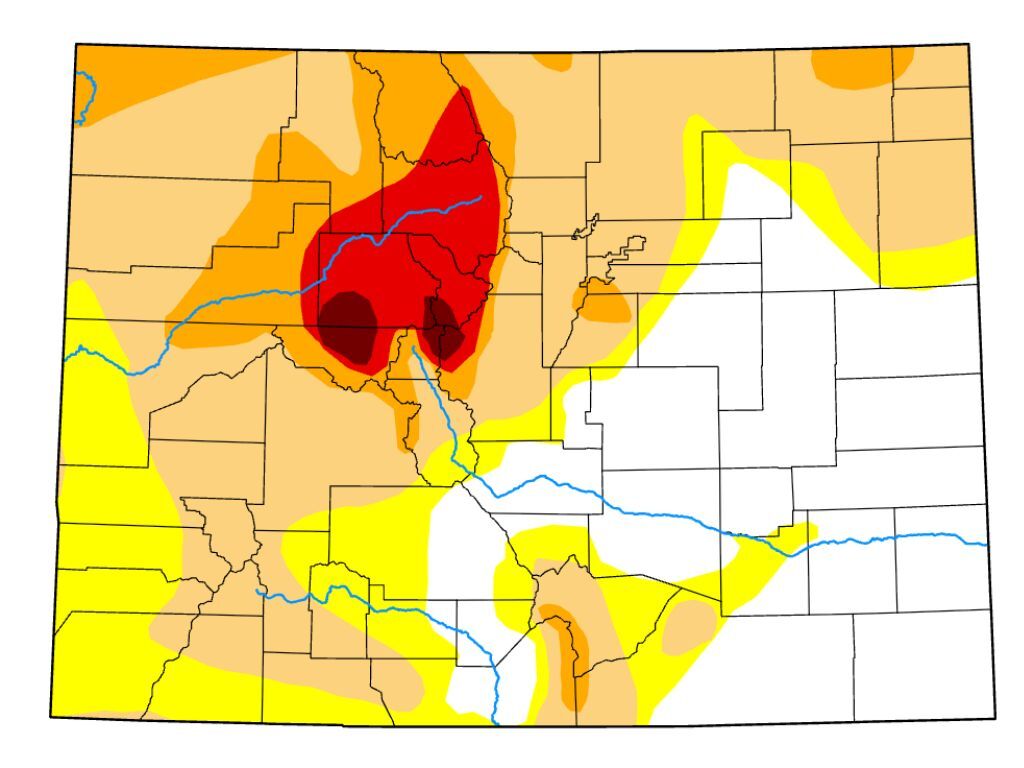
Data valid as of January 20 indicates that roughly 51 percent of the state is in one of the aforementioned four stages of drought, with another 17 percent of the state considered ‘abnormally dry.’ What’s more notable, perhaps, is how serious levels of drought seem to be on the rise in recent weeks.
Just under five percent of the state qualifies as ‘drought stage three,’ with one percent of the state now at drought stage four – the maximum tier of drought on the report, and a stage that can result in risks of large agricultural and recreational economic losses, as well as widespread dust storms and topsoil removal.
To help put these numbers into perspective, about 14 percent of Colorado was experiencing drought last January compared to 51 percent this year. It’s also important to keep in mind that 2025 was notably wet – until winter hit.
The most severe drought is currently found in the heart of ski country including counties of Pitkin, Eagle, Summit, Park, and Lake. In Pitkin County, for example, 28 percent of the acreage is at drought stage four. In Eagle County, 19.4 percent.
It’s not uncommon for drought stage four to be reached throughout the year, though it’s less common in January. It’s occurred during this first month of the year just under 20 percent of the time since 2000, more frequently in years since 2013.
That said, there is a silver-lining – despite record-setting snowpack lows, several recent years have had worse drought in January comparatively – as recently as January 2021, the portion of the state at drought stage four climbed to 27.6 percent. Thus, while drought conditions are indeed present in much of Colorado, it’s not as bad as it’s been before.
A significant snowstorm is expected to roll through the state this weekend, bringing 12-plus inches of snow to many of the state’s peaks. Meanwhile, a turnaround toward more precipitation is expected in mid-February.
Explore the U.S. Drought Monitor website here.
STAY INFORMED: Get free Colorado news with our daily newsletter (Click here)
Get OutThere
Signup today for free and be the first to get notified on new updates.

PREV
PREVIOUS
Often-overlooked 'Little Rocky Mountain National Park' a 70,000-acre hidden gem known for moose
Sometimes referred to as ‘Little Rocky Mountain National Park,’ Colorado’s largest state park spans 70,932 acres. This means that while it’s just over a quarter of the size of its nickname’s namesake (265,807 acres), it’s larger than both Mesa Verde National Park (52,485 acres) and Black Canyon of the Gunnison National Park (30,750 acres). Even […]

America's 'most popular' disc golf course is located right here in Colorado
In a state where there are so many activities that make for a great way to spend a sunny day, it’s easy to overlook some of the niche sports. That said, if you haven’t tried disc golf yet in Colorado, this is your sign! Relatively cheap to get into and often taking place amid stunning […]