




35 takeaways from Colorado’s annual wolf report: Population grows, high death rate, livestock killings, and more
Colorado Parks and Wildlife has released its Gray Wolf Annual Report for the biological year of 2025 to 2026, accounting for the date range of April 1, 2025 to March 31, 2026. It includes a lot of interesting information related to how the reintroduction effort is going and what’s being done to mitigation livestock depredation.
Here are a few key takeaways related to population numbers, wolf deaths, distribution of wolves, depredation, and management:
Population Numbers:
- There are a minimum of 32 gray wolves known to be in Colorado
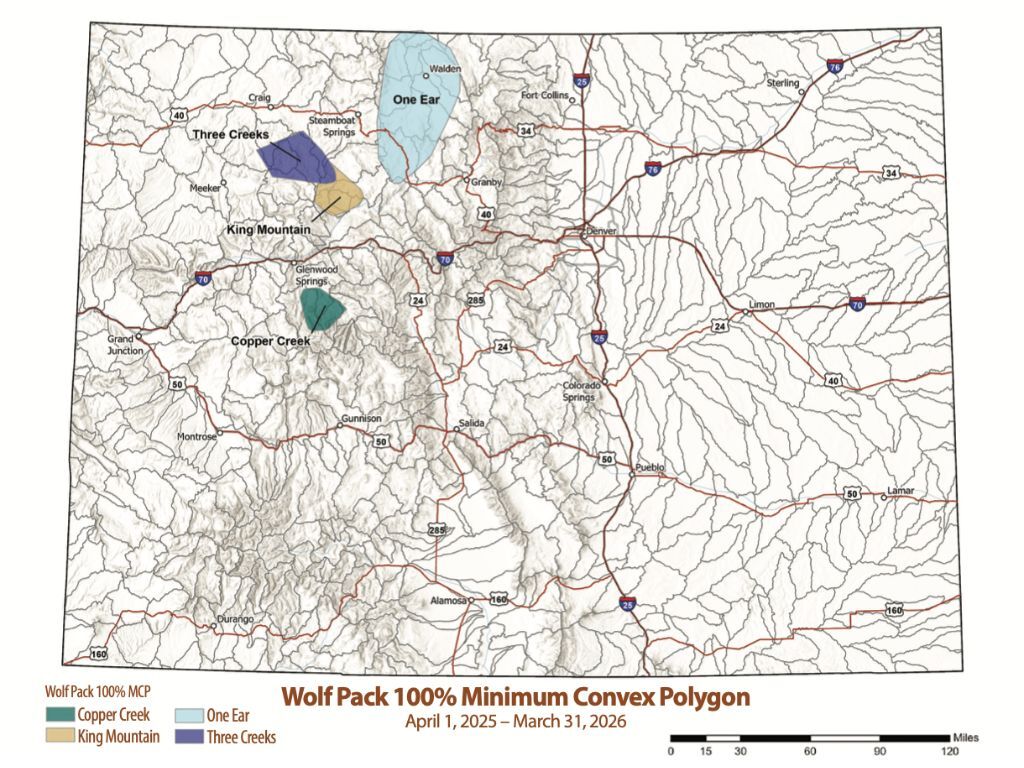
- 24 of the 32 wolves are in established packs (9 in One Ear pack, 4 in King Mountain pack, 6 in Copper Creek pack, and 5 in Three Creeks pack)
- Mapping of pack locations can be found in the ‘distribution of wolves’ section below
- 14 of the wolves in established packs are pups (5 in One Ear pack, 4 in King Mountain pack, 2 in Copper Creek pack, and 3 in Three Creeks pack)
- The King Mountain pack is the only pack without adult wolves accounted for in the winter count, consisting solely of four pups
- One adult died due to capture-related complications on 1/28/26
- The other adult died on 3/10/26 with that death still under investigation
- The winter count more than doubled year-over-year, from 15 in 2024 to 32 in 2025. The 2024 count took place prior to the translocation of 15 wolves from British Columbia, which took place later that biological year
- No additional wolves were introduced into the state during the spring of 2026
- These numbers are considered the ‘minimum’ count – or in other words, numbers may be higher, but these numbers are what’s confirmed
Wolf Deaths:
- 10 wolves died during the last biological year, with three of those deaths still under investigation
- Two wolves were killed via ‘legal anthropogenic’ efforts that took place outside of Colorado (4/9/2025, 7/23/25)
- One wolf was killed by entrapment (5/14/25)
- One wolf was killed by a mountain lion (4/19/25)
- One wolf died during a capture effort (1/28/26)
- One wolf was killed during control measures (5/29/25)
- This killing was due to depredation in Pitkin County by members of the Copper Creek pack
- An attempt was made to kill a second wolf after depredations continued, but this was not successful
- One wolf was killed via a vehicle strike (5/31/25)
- An investigation is still underway in regard to the deaths of three wolves (10/31/25, 1/16/26, 3/10/26)
- The adult wolf survival rate was 61 percent
- A survival rate of less than 70 percent prompts a review of the capture, transport, and release protocols
- It was concluded that deaths were not due to capture, transport, and release protocols, thus the review was concluded without further action
Distribution of Wolves:
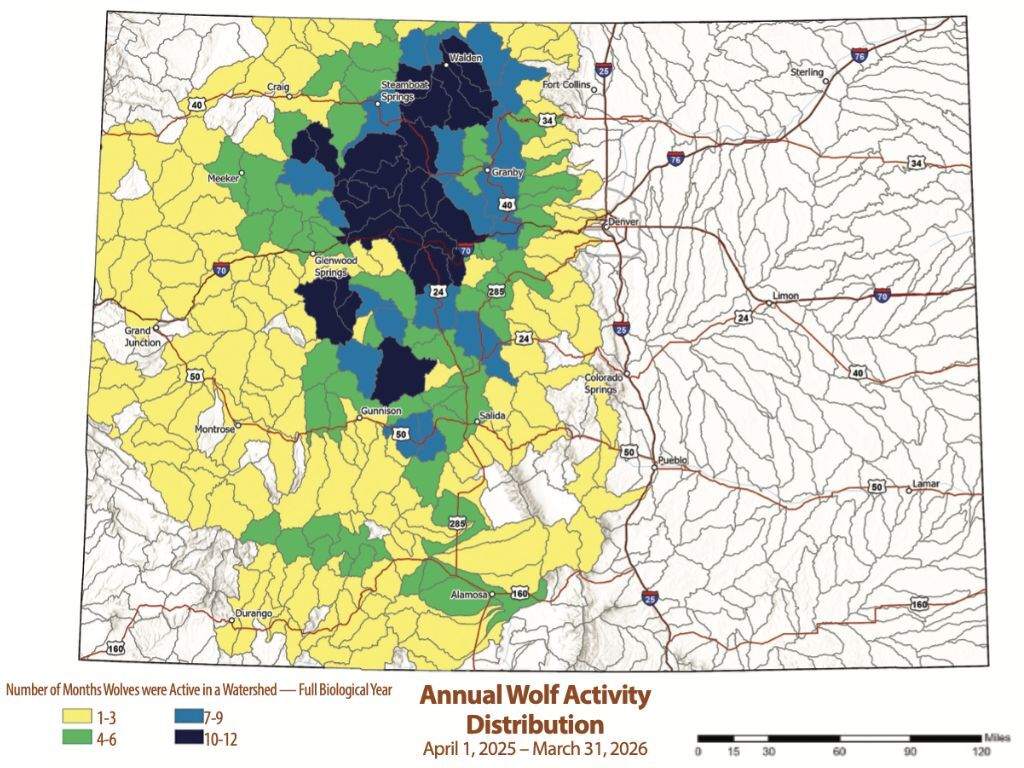
- Wolves have been most active in northwest Colorado, including the wild terrain between Steamboat Springs and Breckenridge. Other places with similar activity include the Aspen area and terrain northeast of Gunnison (see map below):
The map below shows the distribution of Colorado’s established packs, all of which are found in the state’s northwest quadrant.
Depredation:
- A total of 43 wolf depredations occurred in the biological year: 19 cattle, 1 working dog, and 23 sheep
- A total of $43,275.06 was paid in compensation with an additional $709,629.05 approved by CPW for compensation related to missing livestock, decreased conception rates, and decreased weights across five claims
- Five depredation claims remain open at time of report, including one that involves 11 sheep and another that involves the working dog.
- The most expensive depredation claim to be paid was $3,500 for a single head of cattle
- One wolf from the Copper Creek pack was killed due to repeated depredation in Pitkin County
- An attempt was made to remove a second wolf after depredations continued, but that was not successful
- Attempts were made to remove an uncollared wolf after Rio Blanco County depredations. This was not successful and the efforts were eventually called off
- No formal investigation took place regarding wolf predation on wild ungulate populations, but some elk and mule deer in high-intensity monitoring areas have been fitted with collars to monitor survival and cause-specific mortality in years to come
Management:
- Various conflict minimization tools and tactics were utilized to reduce depredation events
- A total of 13.75 miles of fladry was deployed across 15 locations in Pitkin, Grand, Routt, Garfield, and Jackson counties
- Colorado Parks and Wildlife estimates that an average of 200 pairs of cattle were protected in each of these locations for a duration of 45 to 73 days
- No livestock was lost during calving season in places where fladry was deployed
- Colorado Parks and Wildlife conducted 78 site assessments to protect against depredation, bringing the total since 2022 to 282.
- CPW conducted 12 night watch events
- CPW deployed 61 scare devices
- Range riders were also heavily utilized, with 11 range riders used by a total of 34 livestock producers. These range riders rode a total of 4,324 hours, traveling a total of 14,800 miles.
- Looking ahead to next year, Colorado Parks and Wildlife has an inventory of 45 miles of fladry and 500-plus scare devices (Foxlights, Critter Gitters, motion activated alarms, propane cannons, and airhorns) that will be used and will continue accumulate in upcoming years
Find the full report here.
STAY INFORMED: Get free Colorado news with our daily newsletter (Click here)
Get OutThere
Signup today for free and be the first to get notified on new updates.
PREV
PREVIOUS

Visiting Buena Vista: Massive mountains, summer festivals, ghost towns, and more
Renowned for summer festivals, whitewater rafting, and fourteeners, Buena Vista is an iconic town in Colorado, and it offers an excellent escape from citylife. History: Like many of Colorado’s mountain towns, Buena Vista began as a mining town. According to Western Mining History, the area was first occupied by Utes. Spanish and Anglo explorers began […]

It's now illegal to block bike lanes statewide in Colorado thanks to bill signed by Polis
In case you missed it, House Bill 26-1237 has been working its way through the legislative process since it was introduced in February – and it deals with various modifications to law related to transportation safety. While parts of the bill addressed traction devices, clarifications in moving vehicles that impede traffic or maintenance operations, and […]