




When will snowpack be gone in Colorado? Despite recent boost, models show early melt still expected
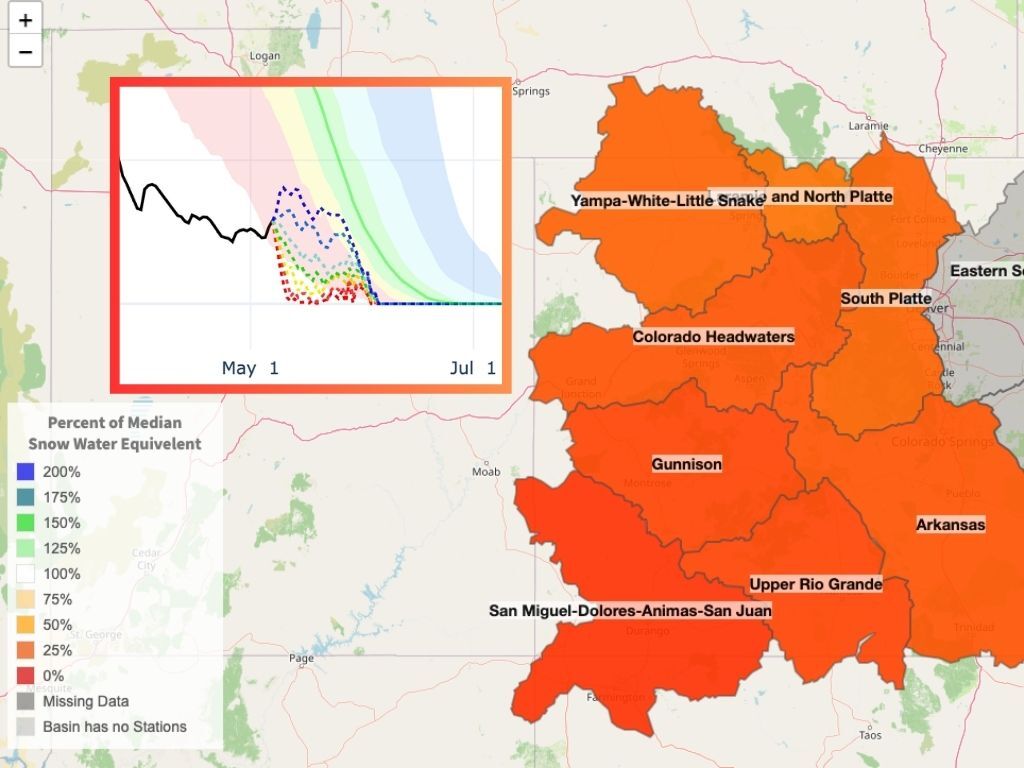
While big snow that hit Colorado this week (dropping more than 33 inches in one mountain town) managed to pull the statewide snowpack above record lows for the first time since February 26, an early snowmelt is still expected.
Per reporting from the USDA, the statewide snow-water equivalent is now at 2.9 inches – above the record low for May 7 of 2.0 inches and on par with what’s typical around May 31. While the bump of roughly 0.6 inches of snow-water equivalent from the recent storm is nice, snowpack is still at 25 percent of the norm for the date and it’s still likely to be absent from the state’s highest peaks in a matter of weeks.
Projections from the USDA indicate that snowpack will be completely gone at some point between May 12 and June 5 – during the normal year, snowpack fully depletes by about June 24. Exactly when that occurs in 2026 will be largely dependent on whether or not more snow falls and how hot temperatures are during upcoming days and weeks.
Per reporting from the NOAA, wetter-than-normal conditions that have been recently present in Colorado are expected to stick around for the most part through the end of May. While that bodes well for potential snow, warmer-than-normal temperatures are also expected from May 12 through May 20, and that could contribute to less snow and a faster melt. After that, there are equal chances of warmer-than-normal or colder-than-normal temperatures through the end of the month.
As might be expected, the recent round of snow boosted snowpack the most in northern Colorado – 33.8 inches of snow did land in Estes Park, after all. The Laramie and North Platte River Basin (in the area of the Rawah Wilderness and Arapahoe National Wildlife Refuge) is the best off in terms of snowpack compared to norm – it’s at about 37 percent of the long-term median (remember, statewide we’re at about 25 percent). This compares to southwest Colorado’s San Miguel-Dolores-Animas-San Juan River Basin at just 15 percent of the norm for the date as the river basin that’s the farthest behind statewide.
It’s also worth noting that recent moisture has helped the state out in terms of drought. Per data from May 5, 96 percent of the state is experiencing drought compared to 100 percent the prior week – but keep in mind that this doesn’t include the impact of the storm that hit from Tuesday night into Wednesday.
STAY INFORMED: Get free Colorado news with our daily newsletter (Click here)
Get OutThere
Signup today for free and be the first to get notified on new updates.
PREV
PREVIOUS

It's now illegal to block bike lanes statewide in Colorado thanks to bill signed by Polis
In case you missed it, House Bill 26-1237 has been working its way through the legislative process since it was introduced in February – and it deals with various modifications to law related to transportation safety. While parts of the bill addressed traction devices, clarifications in moving vehicles that impede traffic or maintenance operations, and […]

Colorado's cutest species?: This pint-sized owl found in Colorado is so tiny it could fit in your palm
Is Colorado’s cutest animal that pika? What about the black-footed ferret? The ermine? Or the yellow-bellied marmot? Or moose calves? Baby deer? Wolf pups? All of these creatures are undoubtedly ‘cute,’ but in this writer’s opinion, the cutest animal is one most Coloradans probably haven’t heard of yet – the flammulated owl. Known for its […]