Palmer called his city Colorado Springs — but why aren’t there any springs?
Where, oh where, are the springs Colorado Springs was named for? A local history trivia question for sure and one visitors frequently ask.
The answer: there really is one spring — just one — but you can no longer get a sip of the natural water from it. All those many familiar artesian springs were and are in the aquifer beneath Manitou Springs.
First, the history: Gen. William Jackson Palmer, our city’s founder, had been in the area of Monument and Fountain creeks in the 1860s planning railroad routes west. Finding an ideal spot with creeks and the mountains just beyond, he set out planning his own “Little London,” perfect for future residents from England and the East Coast elite. It became his Colorado Springs of 1871.
Palmer’s original plans for the new city were for plentiful parks, for which he had deeded more than 2,000 acres to remain parkland in perpetuity. The deed wouldn’t allow for ever breaking up the parks into parcels. The treasure was Monument Valley Park near downtown and the new North End mansions. It ran two miles along Monument Creek, 164,52 acres with more than 8 miles of gravel walkways.
There were well-known landscape experts chosen to create what engineer Edmond Van Diest was quoted in history accounts as a park “in the tradition of an English landscape” with areas that included formal gardens with Palmer’s favorite flowers, lilacs. There were areas of recreation including the first public swimming pool, lakes, pedestrian bridges, areas for social occasions and a natural site to just enjoy the outdoors.
And there was a natural spring flowing in from the west. It was appealing for health reasons and it spurred the dreams of helping this area develop into a possible resort destination.
Residents made regular, sometimes daily, visits to the spring. A bridge linked it to the downtown area.
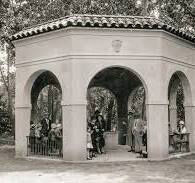
Palmer created a Parks Commission to continue his work and in 1926 the commission worked with architect Elmer Nieman for an artistically impressive Spanish Colonial Revival pavilion around the spring.
Plaques were created for the pavilion honoring Tahama, Pike and Palmer.
Long before Palmer had chosen to name the spring Tahama in honor of the Mdewakanton Dakota Sioux guide and scout who is documented in journals as having fought alongside American soldiers in the War of 1812. Tahama was the guide for longtime friend Zebulon Pike’s 1805-1806 expedition when Pike first recorded seeing Pikes Peak. Tahama was also called Tamahay, Tamaha and was teased with a French nickname, L’Original Leve (Rising Moose).
In her column “A Peek into the Past” in the Gazette Telegraph, local native Dorothy Aldridge wrote about the sign-of-the-times dedication of the octagonal pavilion during Colorado’s 50th statehood celebration. There was a dance pageant at the park’s lake by “Madmoiselle Eveschka and her Russian School of Dancing” called “Undine,” meaning water spirit. At Tahama Spring there was music and a story about the spring and Tahama followed by soprano solos.
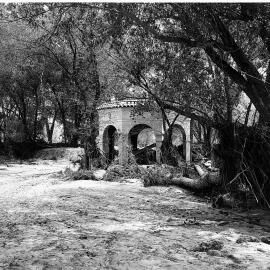
It was noted that the spring and its pavilion were popular places for nine years until the devastating Memorial Day Flood of 1935 roared down Monument Creek. After a winter of drought, two days of rain caused the creek to immediately overflow, covering 200 square blocks of the city. Bridges washed away, trees were torn out by the roots, four people died, mud covered and damaged everything including Tahama Spring and the pavilion.
The Depression-era Works Progress Administration and Civilian Conservation Corps worked until 1952 creating a new channel for Monument Creek, building steep banks, adding stone retaining walls, repairing some of the Monument Valley Park recreation areas and playing fields, and repairing the water damage and sidewalks. Tahama Spring and the pavilion were repaired.
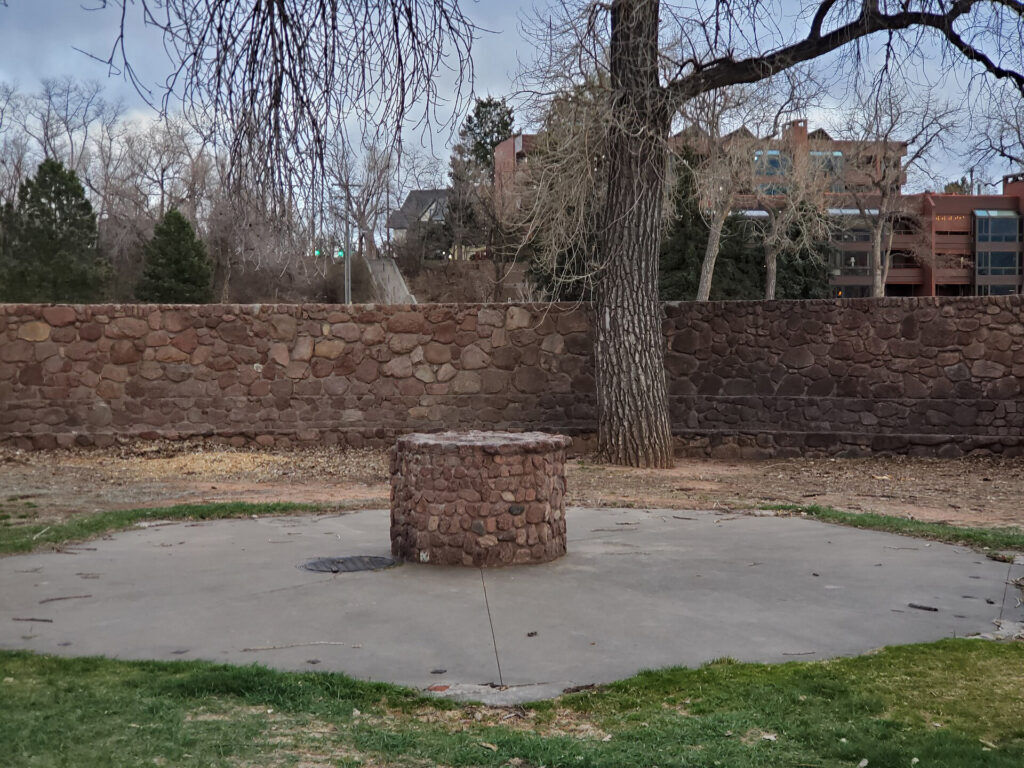
Then came 1965 and the violent Monument and Fountain creeks floods, undoing a number of the earlier rehabilitation programs and there were many new ones necessitated for recovery. Little Tahama Spring was capped. Its pavilion was damaged so heavily this time it was torn down and that page in history closed.
Enter 2018 and the Historical Preservation Alliance of Colorado Springs members with possible plans for the lone trademark natural spring in the city’s name. A possible 501(c)(3), a tahamaspring.org and opening of Tahama Spring were the hope once again for the city.
A 2014 test had shown the spring was still flowing with 2 1/2 gallons of flow per minute. Over the years it had been safely covered with a stone cairn by itself in landscaping in the park on Mesa Road. The natural water could have been made potable, HPA learned.
Beautiful design plans were completed that look much like the original park, recreating the area with its pedestrian bridges and lilac gardens.
However, there could be some change restrictions because now there are history designations and accompanying restrictions. It is now on the State Register of Historic Properties as well as other designations.
Then, said HPA president William Boddington, “the magnitude of the cost” of the history restoration special project hit $2 million. Too much for “the dreamers,” he said, and Tahama Spring “will remain just a nice part of our history.”