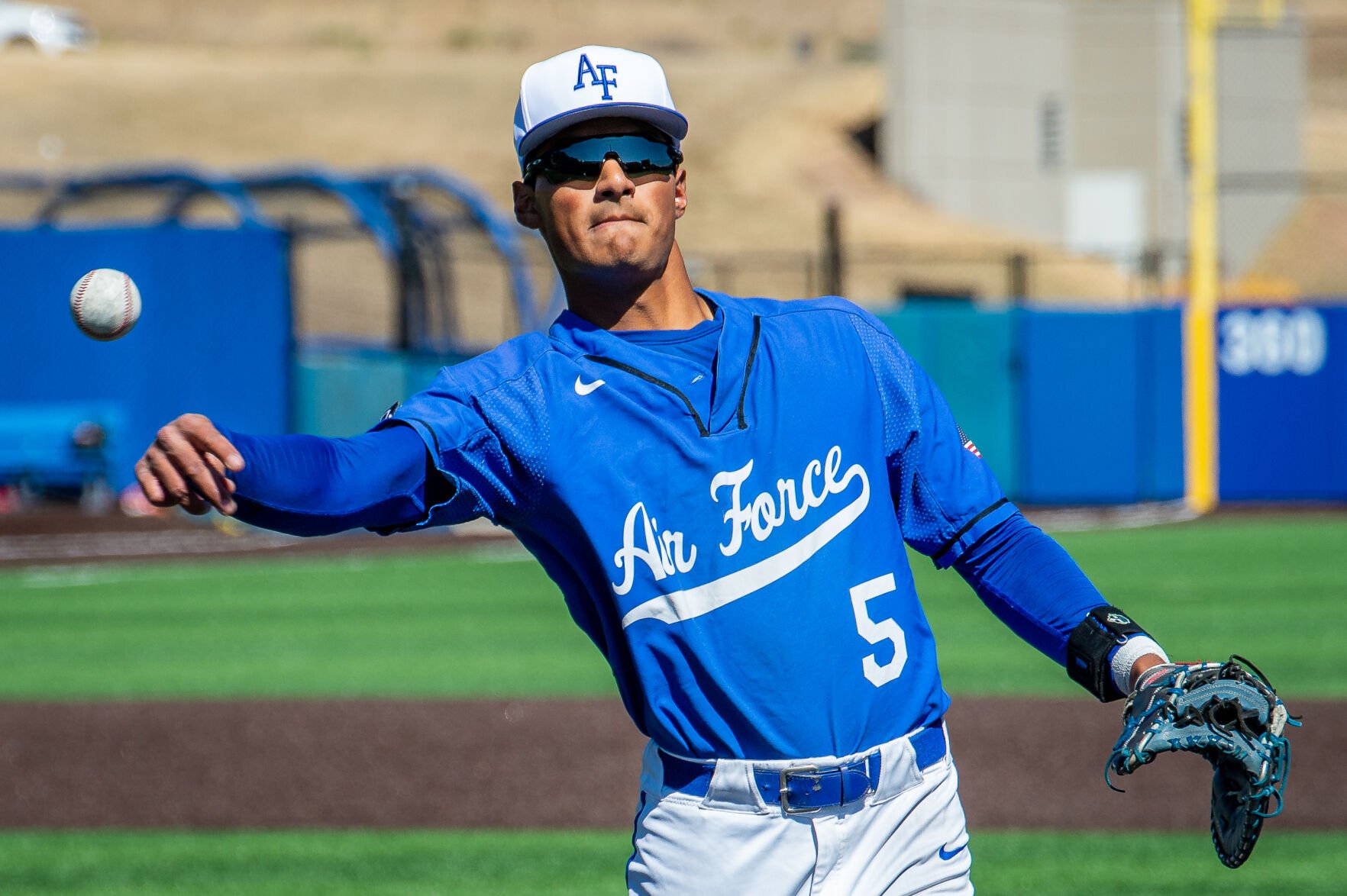
Air Force has equipped Sam Kulasingam to handle the major decisions baseball will present
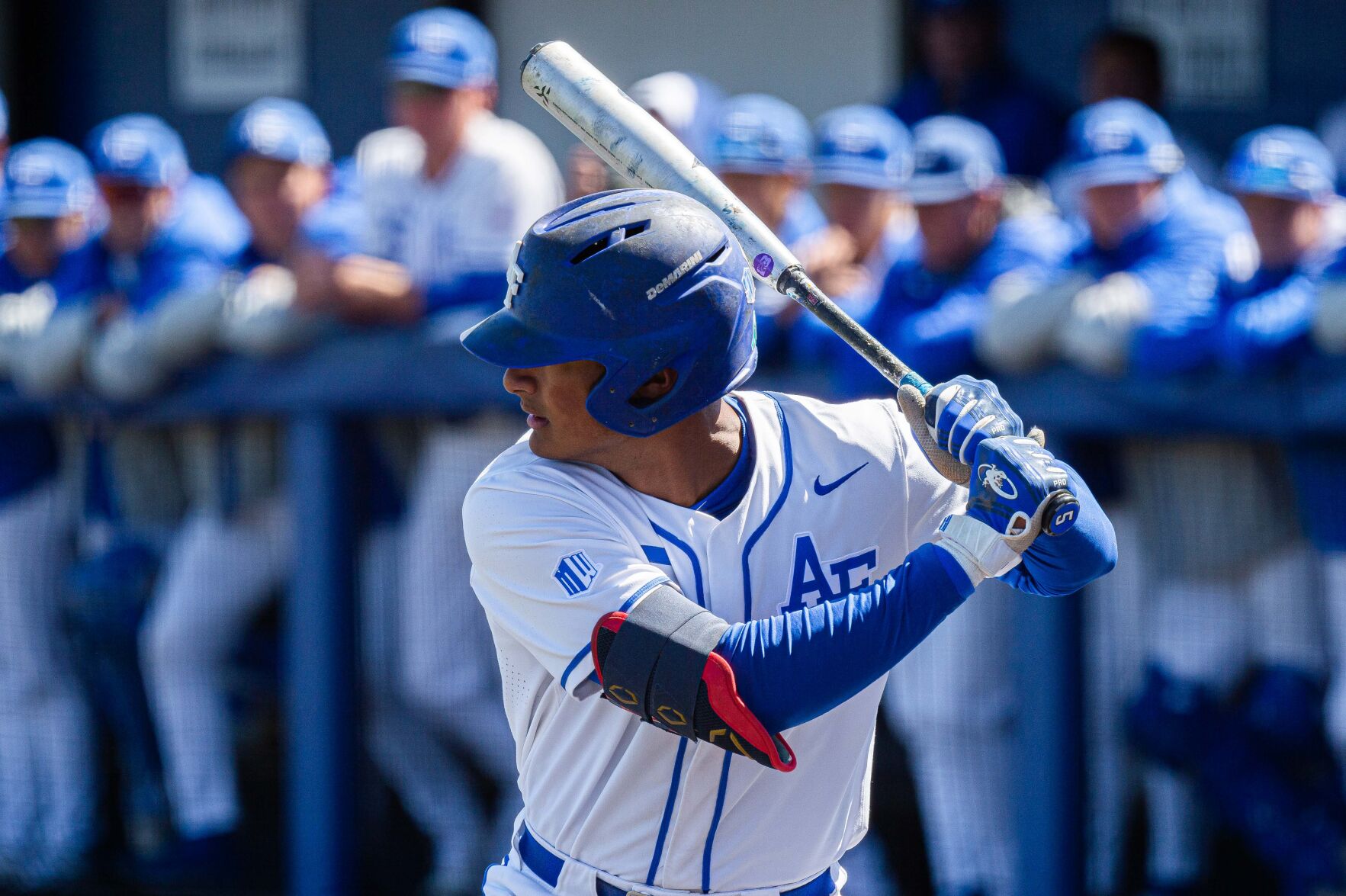
Long before he was a back-to-back Tony Gwynn Award winner, an MLB Draft selection and entrusted with upholding the Air Force Academy’s honor code, Sam Kulasingam was a dejected 17-year-old ballplayer.
“I talked to one pro scout when I was in high school,” said the Falcons All-American first baseman. “He told me, ‘You can hit a little bit, but I don’t think you have a ton of tools.’”
College coaches would reach out, mostly from smaller schools, but few scholarship offers materialized.
“For me, it was kind of a slap in the face. Like, ‘We kind of like you, but you’re not good enough,’” Kulasingam said.
It’s important to establish this background to fully grasp the spectacular nature of what has followed. The decisions Kulasingam has already made at 22, and will make in the next four and a half months, are ones that will have lifelong repercussions. He also feels that the academy has left him uniquely equipped to make these decisions.
First baseball postseason up next for Minnesota Twins reliever, Air Force grad Griffin Jax
But he didn’t ask for this. His development thrust it upon him.
“It’s tough,” he said, recalling his headspace as a teen. “As a high school kid you put a lot of your identity into sports, as if how good you are at sports determines you as a person. As I’ve grown up I’ve realized that’s not how life is, but it was tough to hear that. I kind of showed up at Air Force thinking I’m going to be the best baseball player I can be, get a degree from a great school and hopefully go fly.
“And then here we are …”
***
Major League Baseball teams leave little to chance in the early rounds of the draft. Prior to making a selection, teams will make contact to gain an understanding of a player’s bonus demands and then move forward accordingly.
That’s how last July’s draft went for Kulasingam. A few teams reached out in the top 10 rounds and gave Kulasingam their offer, generally well below that pick’s assigned slot value because of the unique circumstances of drafting a junior from a service academy. Kulasingam didn’t feel those numbers made sense for his situation, so the teams moved on.
That’s what made his out-of-the-blue selection on Day 3 of the draft so surprising. Kulasingam was on the field with his summer ball team in Newport, R.I., when his Air Force teammate Jay Thomason called with congratulations.
“He was like, ‘Congrats, you got drafted by the Blue Jays,” Kulasingam said. “I was like, ‘I didn’t even know. I probably better go talk to some people.’”
Rather than contacting him before the selection, Toronto simply told him after the fact that, “We’re going to try our best to make this work.”
There is a 14-day window following the draft for players to sign. The Blue Jays and Kulasingam took it to the wire before he opted not to sign. Only six of the 30 players drafted in the 17th round did not reach an agreement. Most accepted a $150,000 signing bonus (the allowed amount for rounds 11-20 before teams must dip into their allotted slot pool or pay penalties for exceeding bonus limits). The highest bonus in the 17th round was $197,500 for Duke pitcher Luke Fox from the Los Angeles Dodgers. Two players signed for as low as $50,000.
Had Kulasingam signed, he would have returned to Air Force for his senior year but would not have been eligible to play baseball. Because he is part of the last class grandfathered in under the previous pro policy, he would have been able to apply to then play professionally immediately following graduation and delay commissioning until after his baseball career or a time determined by the Air Force.
For the Blue Jays, they would have entered into the agreement knowing Kulasingam would have had only a brief time, if any, to play in the minor leagues last summer and would have missed this spring training, not reporting until late May.
“Believe me, I’m ecstatic,” said Air Force coach Mike Kazlausky, who admitted to being on “pins and needles” during Kulasingam’s negotiations. “It’s awesome for us, but I want the best for Sammy. If he would have signed, I would have said I’m perfectly happy because I’m a Sammy Kulasingam fan, and I always will be.”
Kulasingam had to weigh multiple variables.
There was the matter of the six-figure signing bonus, though he declined to give the exact amount offered by Toronto. Knowing he will graduate as a 2nd Lieutenant with a salary around $80,000 lessened the impact of the bonus.
If he regresses or suffers an injury as a senior, there is no guarantee the opportunity to play professionally would ever return.
The biggest variable was the prospect of a lost senior season, which begins Friday with a three-game series at Mississippi State.
“This weekend, instead of going to Starkville, I would be hanging out in my room watching Netflix,” said Kulasingam, who leaned on his parents and an outside advisor when considering his options. “That’s what pushed me over the edge in not wanting to sign.”
He had asked enough people to contrast the experience of college and pro baseball, and the answers consistently came back to the time spent as part of a team. He didn’t want to forfeit that.
“The time spent with the fellas, that’s the best part of college baseball,” Kulasingam said. “When you look back in 25 years you’re not going to remember your win/loss record, you’re not going to remember your batting average, home runs you hit. … You’re going to remember guys’ weddings you’re at and that kind of stuff.”
***
The toughest decisions Kulasingam has made haven’t involved his own future, but those of his fellow cadets.
As the honor group chairman, he oversees the process of honor code cases. The academy’s code states, “We will not lie, steal, or cheat, nor tolerate among us anyone who does.” The board run by Kulasingam enforces that standard for 1,000 cadets.
In essence, the process is run like a courtroom with a board sitting as a jury. Kulasingam’s role is like that a judge, running the proceedings and having the final say, with a small group of others, on the punishment.
“He has to make sure it’s done correctly,” Kazlausky said. “He has to dot the I’s and cross the T’s.”
Without going into detail, Kulasingam said at least two cases came down to excruciating decisions. But he takes comfort in knowing there is a legitimate purpose to the cause.
“I love this school and I think this school gives amazing opportunities,” Kulasingam said. “Obviously I want everyone to come here, stay here and be successful here. But there are things that, when they’re done at such a late stage in your time here – junior or senior year – it’s tough to keep that person at this school. At the end of the day, that’s going to be my copilot or my back-seater. You have to be able to trust those people. That’s the whole point of the honor code, that when you commission as an officer, all of us already have this trust and this bond that we know in warfare and times of true struggle that we can lean on each other.”
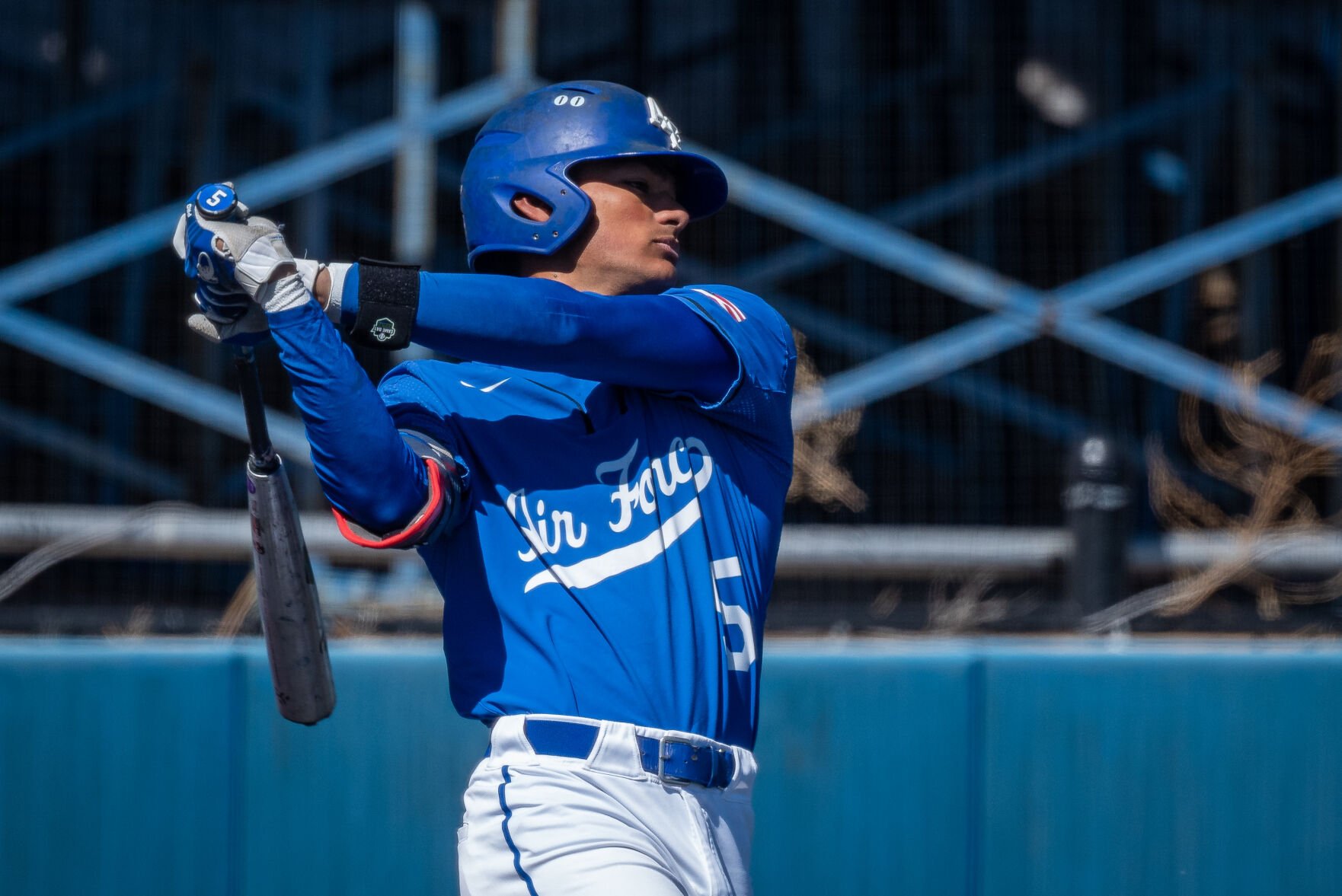
This kind of leadership is what truly excites Kazlausky, who graduated from the academy and served as a pilot before returning as the program’s most successful baseball coach in history.
“He’s the whole package,” Kazlausky said of Kulasingam. “There’s not many kids who have ever donned an Air Force baseball uniform who’ve had his type of talent. And he’s a better man than he is a baseball player. He’s a better cadet than he is a baseball player. He is kind of like Captain America up here on the academy grounds, where he should be the poster child of what our expectations are of a cadet.”
Kulasingam carries a 3.85 GPA as a biology major. Medical school could eventually be in his future, but he was assigned a competitive pilot training slot as his job following graduation.
“He’s the type of kid who will never settle,” Kazlausky said. “He’s always wanted to be the best at everything he’s ever done, and that’s a continuum. That’s why it’s great to have him.”
***
It was really last season that Kulasingam began to understand just how good he could be at baseball.
He won the Tony Gwynn Award as Mountain West Player of the Year as a sophomore. But he figured that could have been a fluke. When he was excelling again as a junior, he knew it was legit.
“I was like, OK, the work is just starting,” he said. “I’ve got to get going.”
He followed a sophomore season when he hit .411/.487/.683 with a junior campaign in which he slashed .426/.537/.655. In those two seasons he has played 120 games with 54 doubles, nine triples, 18 home runs, 115 RBIs, 139 runs, 209 hits, 82 walks and 57 strikeouts.
He won the Tony Gwynn Award again following his junior season, joining C.J. Cron, Mitch Garver and DJ Peterson as two-time winners. Cron and Garver went on to lengthy big league careers. Peterson was a first-round pick who signed for a $2.76 million bonus, but never reached the majors.
There have been no three-time winners, but Kulasingam could become the first this season.
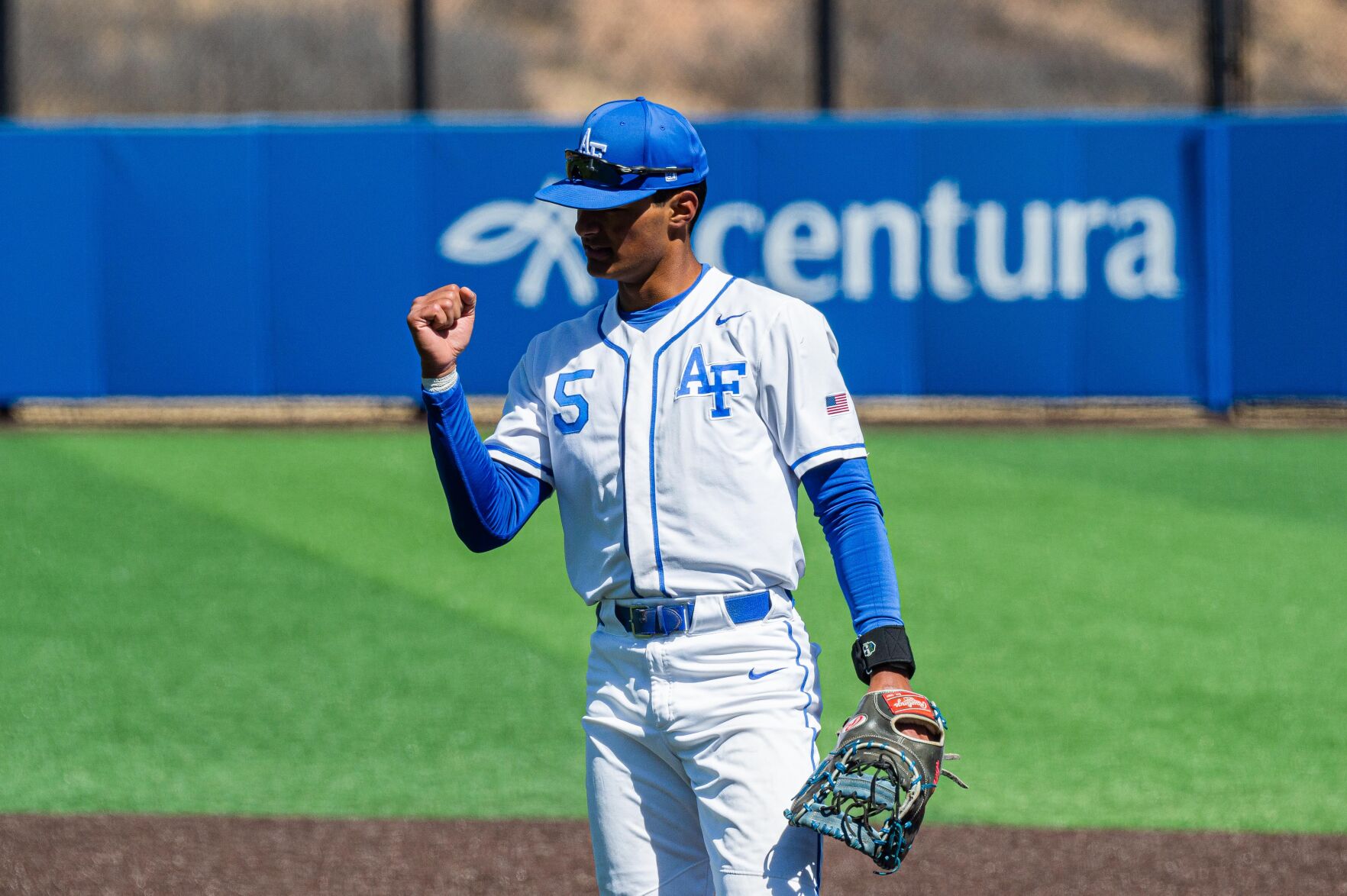
“We don’t mess with the kid,” Kazlausky said. “We don’t work on his swing. We just try to stay out of his way and not screw him up, because he is probably the greatest hitter we’ve ever had at the United States Air Force Academy.”
So, how was that initial scout so wrong?
Kulasingam has grown from about 5-foot-11, 180 pounds in high school to 6-2, 200, that helps. Also, he feels that being placed in an environment of serious-minded and talented teammates and coaches that has allowed his game to take off, even with the Colorado winters that push many drills indoors.
It’s almost incomprehensible that Air Force, in the same recruiting class, landed future No. 1 overall MLB Draft pick Paul Skenes (who transferred to LSU before being picked by Pittsburgh last summer) and Kulasingam in the same class.
Kulasingam said the development of the pair didn’t happen by accident, but by environment.
“Still, at the end of the day, they’re your goals,” Kulasingam said. “You have to go get them.”
***
If all goes to plan, Kulasingam will be drafted again in July.
Last year’s draft dilemma was big, but this one will be even more consequential.
If he is granted the opportunity to defer his time on active duty, he risks forfeiting the chance to become a pilot.
If he chooses the military, that likely ends his promising baseball career.
It will be a major decision, but he’s already tipping his hand to some extent.
Former Air Force Academy baseball player Paul Skenes taken No. 1 overall in MLB Draft
“Teams know that, at the end of the day, I want to go play baseball,” said Kulasingam, who now regularly converses with the kind of pro scouts who ignored him in high school. “That’s my dream. But at the same time, if baseball doesn’t work out I’ve got a career to fall back on, which is a pretty cool career flying jets.”
This wasn’t what he expected. Pro ball was the furthest thing from his mind when he committed to Air Force.
Funny enough, he hadn’t come into his own as a baseball player back when that’s what defined him. It was only by launching himself headfirst into everything the academy has to offer that he gained a new perspective that ultimately allowed him to grow as a player.
“No one’s going to live or die if you strike out,” he said. “It’s not the end of the world.”
Best of the best
Several Air Force programs have featured some of their most accomplished players of all-time competing this school year.
Sam Kulasingam, sr. baseball
A two-time Tony Gwynn Award winner as the Mountain West Player of the Year and an All-America selection from multiple publications.
Wyatt Hendrickson, sr., wrestling
The heavyweight is a champion on the international stage and has twice been honored as the NCAA’s Most Dominant Wrestler.
Trey Taylor, sr. football
The All-American safety became the second Air Force player to earn a major individual award when he won the Jim Thorpe Award as the nation’s top defensive back.
Joi Harvey, sr. volleyball
The middle blocker became the program’s first three-time All-Mountain West selection at the NCAA Division I level.
Luke Rowe, sr., hockey
The defenseman and three-time team captain was included on the ballot for the Hobey Baker Memorial Award, the Heisman Trophy of college hockey.