







Denver school board signs student-designed resolution to implement racially equitable curriculum
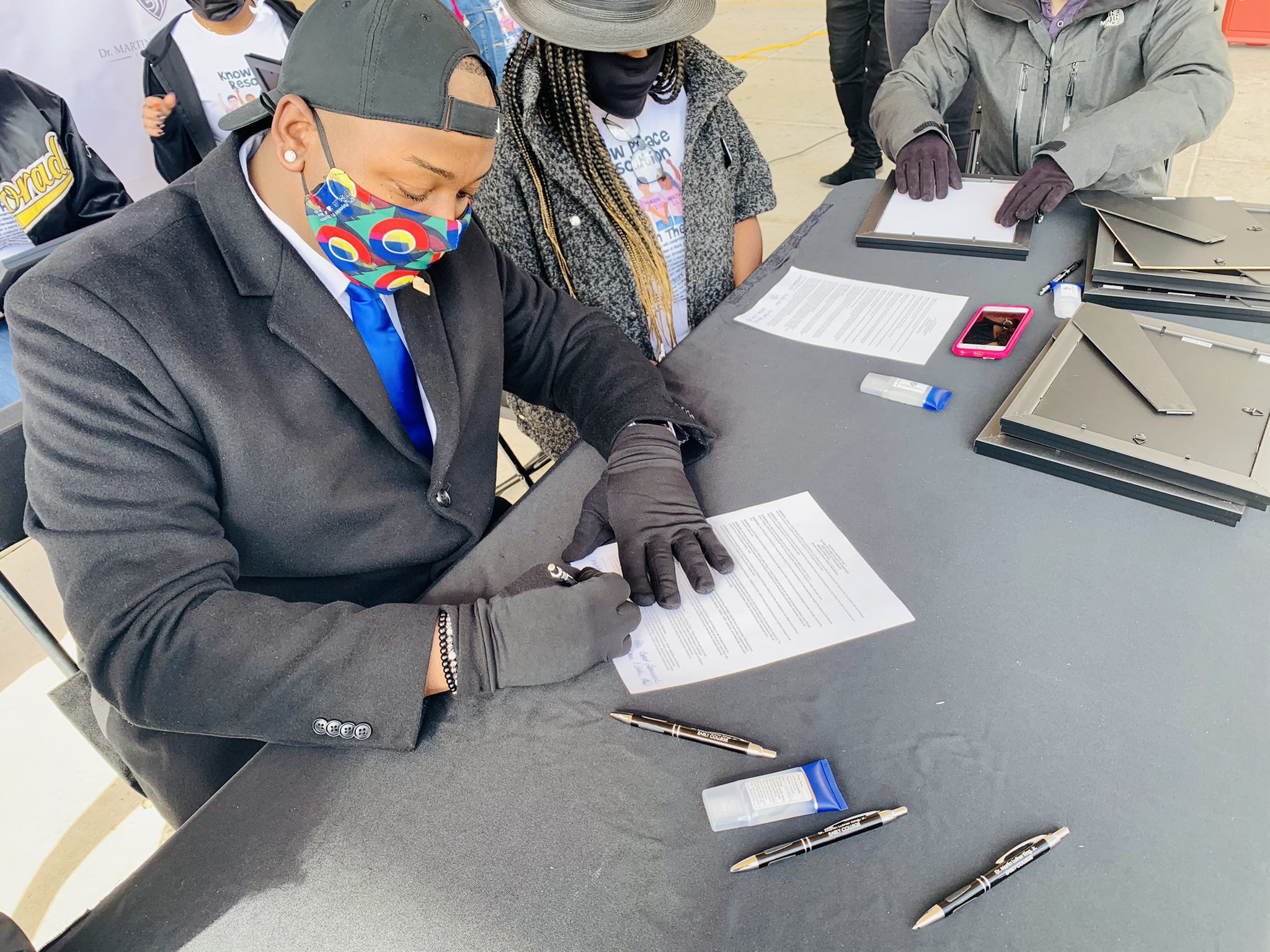
The “Know Justice Know Peace Resolution,” which begins the implementation of Black, Indigenous and Latino history into the Denver Public Schools’ curriculum, was signed Friday by the members of the school board.
The “Know Justice Know Peace Resolution” was developed by Black students at the Dr. Martin Luther King, Jr. Early College.
“I’m sure we can’t even begin to comprehend the impact this will have for the future,” said Jenelle Nangah from “Know Justice Know Peace.”
“The future for all of us as a school, community, district, state and hopefully nation.”
The students, Nangah, Alana Mitchell, Dahni Austin and Kaliah Yizar, began “Know Justice Know Peace” after taking a trip to the National Museum of African American History and Culture in Washington, D.C. in 2019.
For many students, the trip was the first time they learned about Black history and renowned Black figures, and they wanted to bring what they learned back to their peers.
In addition to the resolution, the students also began producing an internationally-renowned podcast to shine a light on the experiences of Black Americans also called Know Justice Know Peace.
“This resolution is a huge step for all of Denver Public Schools,” said Kimberly Grayson, principal of Martin Luther King, Jr. Early College. “These trailblazers have not stopped here.”
The resolution, first announced in September, passed unanimously when voted on by the board.
“We’re now issuing a challenge out to every other district in this state: now, you must follow suit,” said DPS board member Tay Anderson. “Especially districts like Aurora, Colorado, where their school board is majority Black.”
The “Know Justice Know Peace Resolution” declares that “Black and African American, Indigenous and Latino lives and contributions must be infused in all courses and not exclusive to social studies” and that “transformational, humanizing, anti-racist and asset-based” lessons must be created in every subject.
The resolution includes feedback loops between leaders, teachers and students after each unit to determine how classes can further improve. School libraries will also add literature from and about marginalized groups.
Teachers and leaders will receive ongoing training to learn how to implement the new curriculum with sensitivity.
“We are fighting for a more equitable future,” Nangah said. “To know where you are going, you need to know where you have been.”