







Like ‘sandbagging a tsunami’: El Paso County coroner, lead COVID advisor on guiding the county through marathon pandemic’s last leg
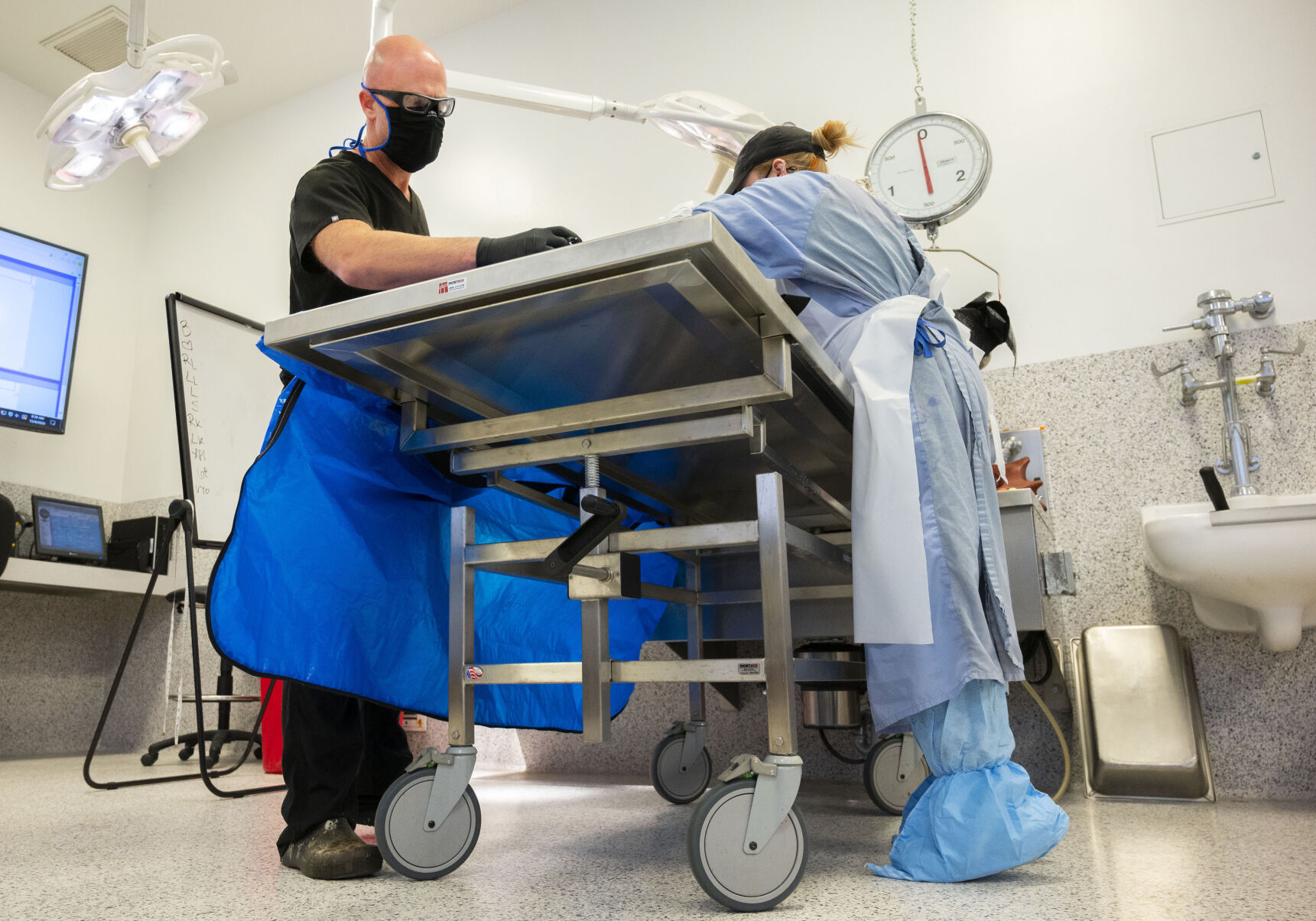
El Paso County Coroner Dr. Leon Kelly, left, and an autopsy technician examine a corpse of a possible COVID-19 casualty, at the El Paso County Coroner’s Office.
The Gazette FILE
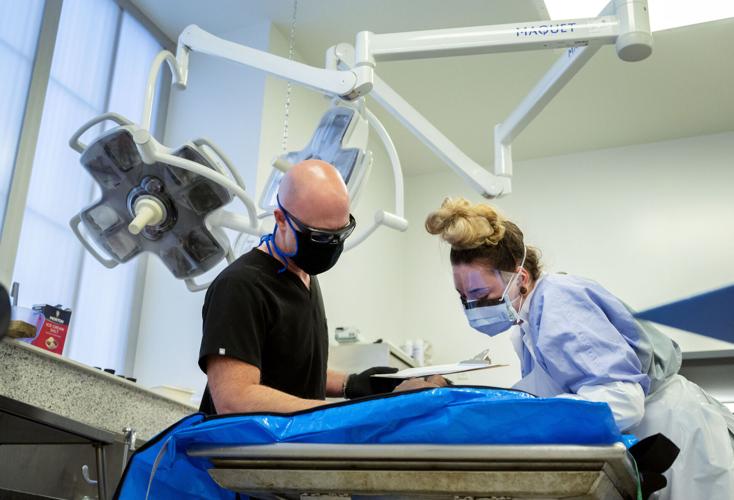
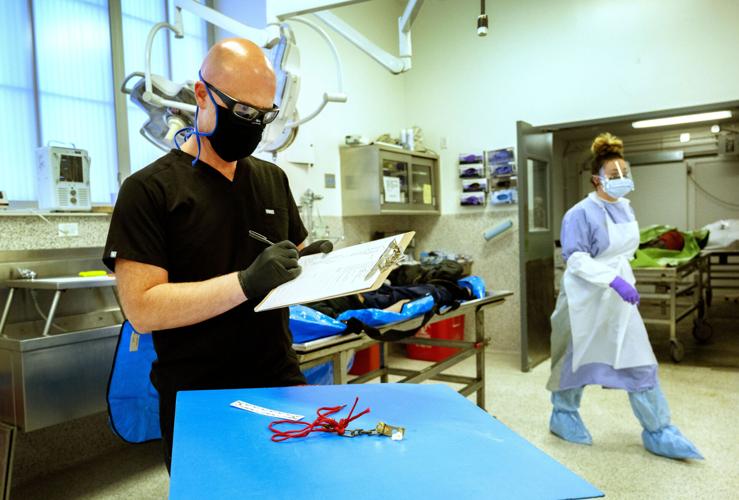
El Paso County Coroner Dr. Leon Kelly should have five morgue techs working for him.
This past week he was down to two. In the middle of a pandemic when he needed them most.
“I’ve had several leave because of the stressful situation,” Kelly said Wednesday. “I’ve got two employees out with COVID. I’m down to minimal staff.
“I’m the elected coroner, and on Monday, I was back there washing pans and cleaning stations just so I had enough workforce to keep cases coming.”
Last year, 4,735 death certificates were filed in El Paso County. So far this year, there have been 5,657, with still the better part of a month left to go, Kelly said, adding, “The pandemic trend of substantial ‘excess death’ appears to be continuing.”
The increased volume of cases runs parallel to what’s being seen in hospitals locally and around the nation, said Kelly, who also serves as the county’s deputy medical director and lead medical adviser on COVID-19 practices.
“The problem is the virus has resulted in massive increases in workload,” both in hospitals and at the morgue, Kelly said. “People get sick. People die. People need help. Cases are being investigated. As it’s doing that, it’s crippling you by taking away your staff. People get sick; people make contact. You have to quarantine. It’s making you do more and more and more.”
Across Colorado on Friday, 1,883 patients were hospitalized with COVID-19 or a suspected case of the virus, and 256 were hospitalized in Colorado Springs.
At UCHealth, doctors and nurses have been reassigned from their regular duties to help care for ever higher numbers of patients, said Dr. David Steinbruner, chief medical officer for UCHealth Memorial Hospital Central and Memorial Hospital North, on Thursday.
He likened the work to dealing with an ongoing mass casualty event, such as a plane crash or an earthquake that just keeps going.
“It’s almost like a mass casualty event in slow motion,” Steinbruner said.
As of Thursday, the county has seen 319 COVID-19 deaths since the beginning of the pandemic — nearly a third of those in the last month. Total deaths in the county account for approximately 12% of the state’s 2,724 deaths so far.
Prior to November, the most COVID deaths the county saw in one day was three. Since November, the county has seen 10 days with five or more deaths each day — and two days with eight deaths each.
The deaths displayed on the county’s COVID-19 dashboard do not account for all COVID deaths that occur in the county, Kelly pointed out.
“I get all death certificates of people who die in El Paso County, whether they’re a resident or not,” he said, adding that he had approximately 38 death certificates sitting on his desk since Nov. 15.
“That’s not everyone dying in our hospitals. People are coming from other communities from Colorado and dying,” though he added those cases comprise “a relatively small fraction of the total.”
It’s because of the interconnectedness of the Pikes Peak region that a move to a lockdown would need to be implemented regionally to be most effective, Kelly said.
“What happens in China affects what happens in America,” he said. “What happens in El Paso County affects what happens in Colorado. From the global perspective, there’s no easy answer. If things go south in other communities, those are still our doctors, nurses, hospital systems being impacted.
“If you don’t have a bed there, you’re going to bring that person here. If we’re full, they’ll keep going up I-25. That’s how it always works.”
The state has not yet moved any of its 64 counties to purple on its COVID restrictions scale after announcing the additional level in November. As of Friday, more than 30 were in red — and the state has refused to say just what might trigger a move.
Kelly said he is unaware of a benchmark the county might meet or surpass that would trigger a move to more restrictions on gatherings and businesses.
“I’m not aware of fixed, hard measurements,” he said. “I think that’s going to be more of a statewide gestalt call. It’s not just, how is UCHealth doing? It’s, how is the entire hospital system across Colorado doing? That takes big players to make that decision.”
Asked if the county would take more proactive steps than those ordered by the state, as Denver and Pueblo counties have, Kelly said only if “we identified something that was clearly an underlying issue,” as Boulder did with transmission among the college-age population, which led to the county temporarily banning gatherings of young adults.
“That’s an area where I feel confident public health would act — a much more focused, surgical decision that would have maximum benefit with minimum negative impact,” he said. “Unfortunately for us, we don’t have anything like that. We’ve been searching for that for nine months now. There are no peaks in any one sector, which makes it really hard to have that kind of approach.”
He drew parallels between lockdowns and chemo, calling the latter a poison.
“It will kill you if you use too much,” he said of the cancer drug, adding that doctors use “enough, but not so much that it has adverse effects on the body.”
Similarly, closing schools and businesses has an adverse effect on the community, he said.
“You want to give the right amount of mitigation. That’s true of any medicine. We are not the police of the virus. That’s never been our role and our goal here.”
As for what the future holds for the county in regards to the virus, only a couple things seem certain, according to Kelly: The holidays are “the huge elephant in the room,” and “the cavalry is on the way” — in the form of a vaccine.
On Friday the state health department announced that it ordered approximately 46,800 doses of the Pfizer vaccine from the U.S. Centers for Disease Control and Prevention in anticipation of the Food and Drug Administration’s Emergency Use Authorization. But it will take several months to vaccinate every willing Coloradan, officials cautioned.
“I think we’ll see over the next seven to 10 days what the impact of Thanksgiving was,” Kelly said. “If we can keep (the curve) flat, we can sustain this for a while. Hospitals are in a a difficult place, but they’ll survive.
“If we get a huge bump post Thanksgiving, in the next seven days, it’s a very bad sign for what the future holds for us.”
If El Paso County residents can take precautions and “just hold out for one more month, a couple more months, we can start to make significant gains on this,” he said. “The war is being fought in the community by the community.”
“By spring break our community will look different, and by summer, we’ll be in a completely different world,” he added, referencing schools. “We’ve got one semester in the bunkers to survive this thing and make the most of it, and then we start to move on with our lives.”
He wishes the public would realize that public health is attempting to be “focused and surgical” and “avoid catastrophes,” not to clamp down on freedoms.
“You should never look at public health as the enemy of functional society,” he said. “We’re trying to keep us open to the greatest degree possible.”
It’s a fine line to walk — especially in the face of an invisible, formidable foe that’s become so pervasive, with an estimated one in 40 Coloradans to be infectious.
“It does feel, at times, like you’re standing on a beach, sandbagging a tsunami,” he said. “But we never see the outbreaks prevented.”
The Gazette’s Mary Shinn and David Mullen contributed to this report.