







GUEST COLUMN: Space Command in Colorado Springs strengthens national security
Throughout my career I often found myself “captured” in a 15-minute meeting that went on for an hour. The problem wasn’t that the content of the meeting wasn’t important, rather that all that needed to be said and heard was done in the first quarter hour. The extension of the discussion was generally summed up by the expression, “everything that needed to be said was said in the first 15 minutes….it just hadn’t been said by everyone in attendance”. My personal rule was to pass on making non-valued-added comments when it was my turn to speak in an effort to shorten the discussion. So it is with some trepidation that I put pen to paper to pile on to the terrific articles and points made by Mayor John Suthers and General Willie Shelton in previous Op Eds on the topic of where USSPACECOM should be permanently located.
Hopefully, I can bring a somewhat unique perspective to the topic since I served in Air Force Space Command Headquarters in 1998, when the original USSPACECOM existed and was located just down the street on Peterson Air Force Base. Later, I had the wonderful opportunity to command Air Force Space Command in 2006-2007, and following that to command US Strategic Command in Omaha Neb, which had picked up the USSPACECOM mission when the original USSPACECOM closed in 2002. Consequently, I got to see the benefits of the co-location of Air Force Space Command (now re-branded as the Space Operations Command) and USSPACECOM and also the downside of the physical separation of the two commands.
In 1998, North Korea launched their first long range missile called Taepo Dong 1 which exploded late in the missile’s launch trajectory. Immediately thereafter began a debate within the US intelligence community as to the North Koreans’ intent. North Korea said they were trying to put a satellite into orbit but our intelligence community thought they were testing an InterContinental Ballistic Missile. The pressure was on USSPACECOM to give their independent assessment. What I witnessed was the close teaming between USSPACECOM and the staff at Air Force Space command located less than a mile down the road. Leveraging the expertise of the Air Force Space Command staff, US Space Command was able to make the correct assessment of the North Korean launch. I am certain that the correct assessment would not have been made were it not for the trust between the two staffs that had been built on the day-to-day personal contact in both professional and social occasions. This is not an empirical metric that can be quantified, but it is a reality of human personal relationships.
As the commander of Air force Space Command in 2006-2007, I benefited from the incredible support we received from the Command’s Civil Servants and the contractor expertise we had (and still have) in Colorado Springs. There was never enough uniformed expertise in the command to answer the key questions that faced us, but we were blessed to have in-depth support from our Civil Servants (many of whom were former military) and both large and small companies in the local area.
When I moved to Offutt Air Force Base to command US Strategic Command I found similar expertise and support for our Strategic Deterrent Nuclear mission, which had been resident there throughout the Cold War, but I did not find the same support for the space mission we had inherited in 2002. Why? The fault was not to be found in Omaha, but to the flawed assumption that when the USSPACECOM mission moved to Offutt in 2002, the civil service and civilian contractor work force in Colorado Springs would follow…..they didn’t.
Some might say the reason they didn’t leave was because Colorado Springs is a fabulous place to live and work and raise a family and, as Mayor Suthers so aptly described, they would be partially right. But there is another important and less understood factor. It is encapsulated in the old saw, “follow the money.”
The mission of Air Force Space Command then, and now of the newly created Space Force Space Operations Command, is to Organize, Train and Equip the men and women who will execute the orders of USSPACECOM to operate our space assets, deter aggression against them and if necessary defeat any adversary who would challenge us in space. The “Organize, Train and Equip” mission is where most all of the money appropriated by Congress is spent. The Combatant Command, USSPACECOM (or in my case US Strategic Command) requires and receives very little money to do its deterrence/warfighting mission. When the warfighting mission moved to Offutt AFB and the “Organize, Train and Equip” mission remained at Peterson AFB, the vast majority of our nation’s space expertise remained in Colorado Springs.
What I’ve described is what happened. But some may ask, if there is not a big economic advantage to Colorado Springs associated with the decision where to locate USSPACECOM headquarters, why should we care? The answer is straightforward; it is what is best for our nation. There is not enough expertise today to properly support a disaggregated solution and a disaggregate solution, as General Shelton so accurately described, will take excessive time and money, neither of which our nation can afford.
As impossible at it may seem, we are behind both the Russians and the Chinese when it comes to being prepared for conflict in space, and time is not on our side. And when it comes to budgetary considerations, we would be foolish to add to the debt when we not only don’t have to, but also when contemplating an alternative solution is operationally suboptimal.
Colorado Springs is a fabulous place to live and its citizens are incredibly supportive of our military families. And permanently assigning USSPACECOM headquarters makes sense for maximizing synergies between the Organize, Train and Equip mission of the Space Operations Command and the warfighting duties of USSPACECOM. But most importantly, in my view, is that it is the right thing to do for the national security of the citizens of the United States … the ultimate customer of these two great organizations.
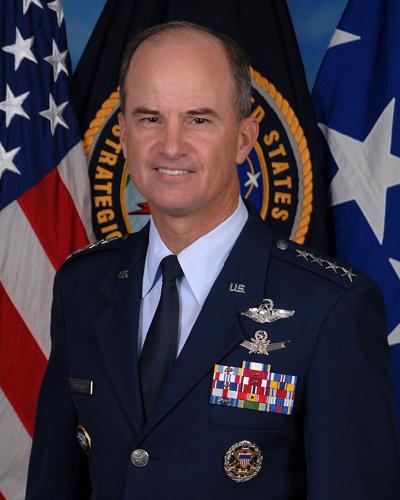
Gen. (retired) Kevin Chilton is a former astronaut and former commander of both AF Space Command and US Strategic Command.
Gen. (retired) Kevin Chilton is a former astronaut and former commander of both AF Space Command and US Strategic Command.