








Denver to respond to homeless camp calls with intervention team instead of police

9News
Denver launched a new partnership Monday between 311 and the Early Intervention Team to change the way the city responds to homeless encampments.
Beginning Monday, Denver will now direct calls about unsanctioned homeless encampments to 311 instead of the Denver Police Department. From there, the EIT will respond to the encampments in place of officers.
Denver Mayor Michael Hancock said the new approach will provide a more efficient and effective response to non-criminal calls about homeless encampments.
Denver City Council approves contract for extension of sanctioned homeless campsites
“Our first priority is to connect our unhoused neighbors with safer, healthier and more stable options than living on the streets,” Hancock said. “That means a human services response and not a public safety response.”
When responding to unsanctioned encampments, the EIT will be tasked with connecting homeless residents to appropriate shelter, housing, treatment and care options.
Officials estimate that the EIT will handle around 25 cases per day, though calls are much more frequent since multiple calls are often made about the same encampment.
Police will still handle reports of crimes being committed in and around homeless encampments. Police will also still be involved in large-scale cleanups of encampments that present public health or safety concerns, officials said.
Advocates of STAR program look to ways of evaluating its long-term success
“We don’t need police officers being the first responders for routine calls about encampments,” Hancock said. “(This) is another step towards delivering a non-law enforcement response to calls about people experiencing homelessness.”
The EIT was launched late last year by Hancock’s administration as part of an effort to implement alternative response policies to police.
Hancock also began Denver’s STAR program in 2018, deploying mental health clinicians and paramedics to handle low-level mental health episodes instead of police. The STAR pilot has run successfully since it was launched in June 2020.
Denver has also recently begun exploring alternative housing solutions, including establishing sanctioned campsites for residents experiencing homelessness during the COVID-19 pandemic.


18 dogs seized from Colorado property after execution of warrant in animal cruelty case
Spencer McKee
spencer@outtherecolorado.com
Updated 21 minutes ago
An investigation into animal cruelty and neglect resulted in 18 dogs being seized from a residence in Erie, Colorado on January 8. According to a report from the town’s police department, an initial response took place on January 5 on...

Spencer McKee
Reporter

Red Carpet Reception proves new home’s a winner for Coors Western Art Exhibit & Sale | NONPROFIT REGISTER
Joanne Davidson Special to Colorado Politics
joanne-davidson-special-to-colorado-politics@denvergazette.com
Updated 33 minutes ago
NATIONAL WESTERN STOCK SHOW News: It wasn’t just the art that people were talking about at Thursday night’s Red Carpet Reception for the 34th Coors Western Art Exhibit & Sale. A good number of the 1,000-plus guests were on their first visit to the show’s spacious new location on the...


Colorado lift ticket add-on includes line-skipping, valet parking, and more – for $400 per weekend day
Spencer McKee
spencer@outtherecolorado.com
Updated 1 hour ago
It’s no secret that Colorado’s resorts seem to feel a bit crowded in recent years, and multiple spots around the state are starting to offer premium passes to help remove some of the headaches that come with that. After all,...
Spencer McKee
Reporter

Former DU lacrosse coach Bill Tierney to be honored by Denver City Lax | Colorado Sunshine
Chris Schmaedeke
chris.schmaedeke@denvergazette.com
Updated 1 day ago
Where good news shines Former University of Denver men’s lacrosse head coach Bill Tierney will be honored by Denver City Lax at its annual gala on Feb. 18. The event will take place at 6 p.m. at Empower Field at Mile...

Chris Schmaedeke
Reporter

NASA taps Colorado companies to lead development on telescope searching for life on other planet
Alexander Edwards
alexander-edwards@denvergazette.com
Updated 19 minutes ago
NASA has selected two Colorado companies to help develop a future NASA space telescope that will look for signs of life on other planets. The flagship project, called the Habitable Worlds Observatory, will be the first space telescope purpose built...

Alexander Edwards
Reporter
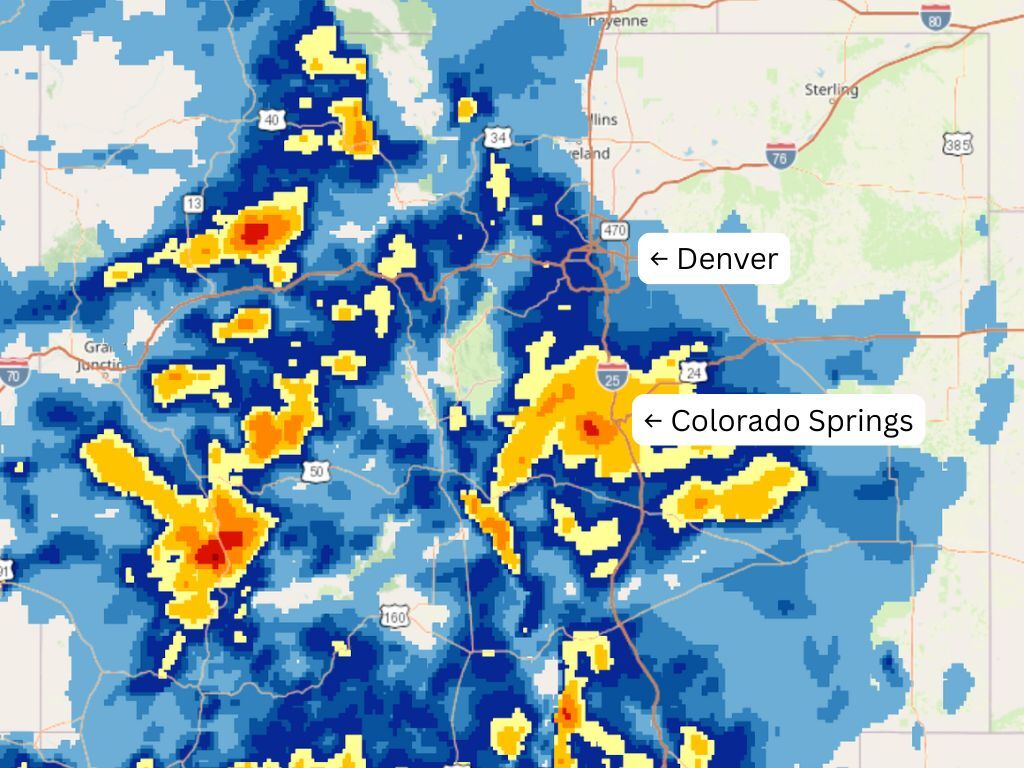
Colorado town gets 18 inches of snow, major city gets 13
Spencer McKee
spencer@outtherecolorado.com
Updated 2 hours ago
Big snow has hit Colorado in recent hours, favoring parts of the state that have been somewhat skipped by many of the rolling waves of powder thus far this season – specifically the Pikes Peak region and parts of the...
Spencer McKee
Reporter

Salman Rushdie pulls up a chair
The Washington Examiner
the-washington-examiner@denvergazette.com
Updated 2 hours ago
By Gustav Jönsson Special to Washington Examiner When S.M. Arthur, an honorary fellow of the University of Cambridge, wakes up to the realisation that he’s dead, as he does in “Late,” one of five stories collected in Salman Rushdie’s The...

The Washington Examiner
Reporter

Colorado snow totals for Jan. 8-9, 2026 storm
Daniel Boniface
dan.boniface@denvergazette.com
Updated 3 hours ago
The following Colorado snow totals have been reported across the state by the National Weather Service for the Jan. 8-9, 2026 storm as of 11 a.m. Alamosa — 6 inchesArvada — 5.3 inchesAurora — 1.5 inchesBailey — 6 inchesBerthoud —...

Daniel Boniface
Reporter

Historic ski area once sold by Colorado mountain town for $100
Spencer McKee
spencer@outtherecolorado.com
Updated 3 hours ago
On heels of the news that the Town of Nederland approved the purchase of Eldora Mountain Resort at a price tag likely to be in the ballpark of $120 million (final sale still pending), let’s take a look back at...
Spencer McKee
Reporter

Jared Bednar proves why he’s still going strong behind Avalanche bench with Landeskog, Olympics decision | Evan’s take
Evan Rawal
evan-rawal@denvergazette.com
Updated 4 hours ago
The next time Gabriel Landeskog plays hockey, he might be donning the Tre Kronor. If that’s the case, the Colorado Avalanche are perfectly OK with it. Ahead of Colorado’s win over the Ottawa Senators on Thursday, Avalanche coach Jared Bednar...

Evan Rawal
Reporter