







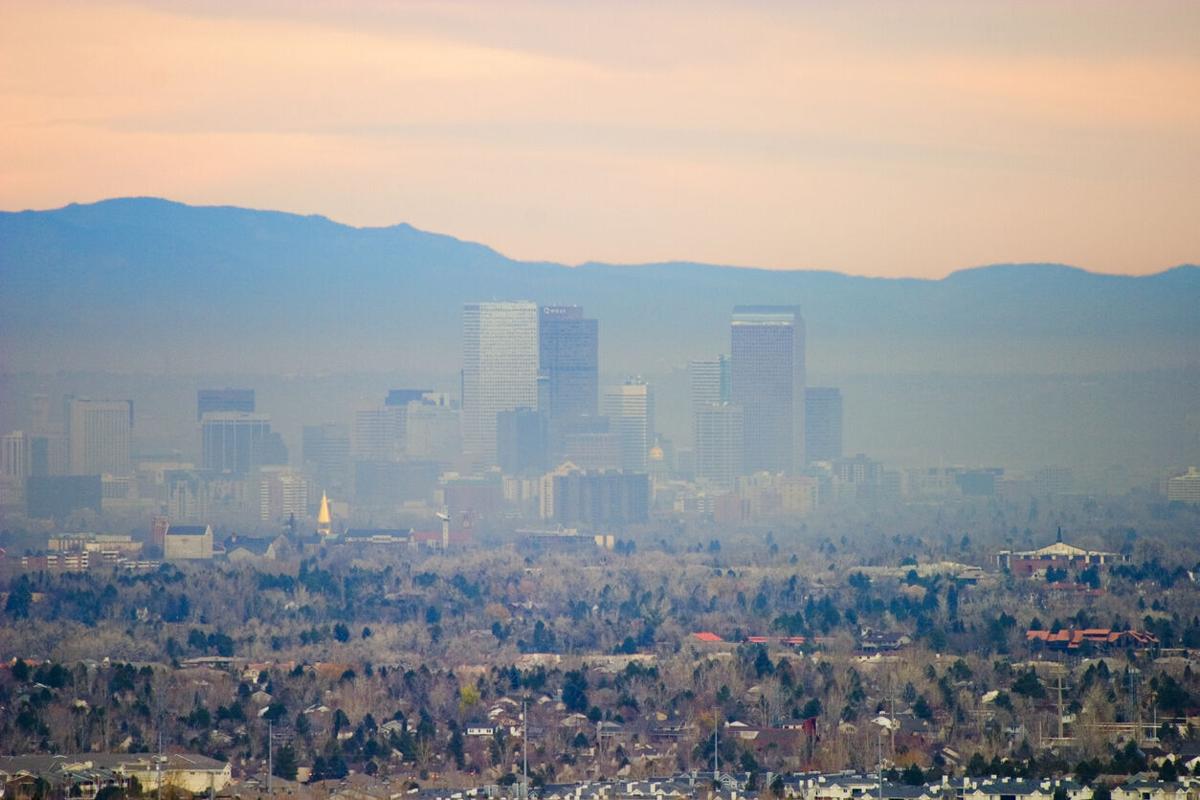
The Brown Cloud: Denver air quality concerns date back to 1800s
SWKrullImaging
Denver became known for its problematic air more than a century ago. In 1889, The Denver Times reported that “disease had started to spread to the entire population” and “bad air was hurting the city’s reputation.”
By the mid-1950s, health officials “really became concerned about air quality,” said Lisa Devore, an environmental engineer at CDPHE. Denver logged 1,250 air pollution complaints in 1956 from residents concerned about excessive smoke and other problems in the air.
Public pressure led to action at both the state and federal level. The Colorado legislature adopted the Air Pollution Control Act in 1970. That same year, Congress amended the Clean Air Act, which authorized the EPA to establish new national standards on air pollution from vehicles and factories.
Not long after this time, Denver’s looming air pollution came to be known as the “brown cloud.”
The brown cloud peaked in the 1970s and ‘80s before cleaner fuel and sustainable emissions technology had been fully utilized. Although pollution in the air has improved, environmental experts say it still poses a threat as more people, and their cars, continue to make Denver home.
“It’s worse in the winter because of something called temperature inversion,” Devore explained, when cold air gets trapped under a layer of warmer air.
“In Denver, because we’re actually in somewhat of a bowl, where we’re bounded on one side by the mountains and the Platte River Valley on the other side, which actually rises up a little bit, so we become trapped.”
Those inversions can last between a day, sometimes even a couple of weeks, she said, and when those happen, the air is stagnant.
“You don’t have much wind, and the air is circulating within our bowl … and people continue to operate as usual, so they drive their cars, companies operate as they always would, and all of that pushes stuff inside the bowl until we see a change in weather conditions,” Devore said.
The term describes the dark haze that hovers over Denver as a result of a mix of various fine particulates and gases. Two types of particles can create haze: primary particles — think organic and soot particles in smoke plumes or soil dust — and secondary particles, such as sulfates and nitrates.
Haze was historically worse in the wintertime due to wood-burning and road sanding during construction, as well as in summer, because of road sanding and forest fires.
Usually the haze is local, particularly in winter, although for other seasons it can depend on meteorology and regional weather patterns.
In 1987, CDPHE began implementing a high pollution advisory “action day” program for the Denver metro area during the winter months between Oct. 31 and March 31.
“The primary goal of the advisory program is to provide useful information on air quality to area residents during the high pollution season,” according to the department.
“Action days” were issued when air quality conditions could lead to air pollution levels above federal and/or state standards. Those days trigger mandatory burning restrictions and voluntary driving reductions. CDPHE also implemented in 1990 visibility metrics directly correlated with the brown cloud.
Data shows that frequency of exceedances over the urban visibility standard are decreasing. From the early 1990s to the early 2000s, exceedances decreased from 70% to about 50%.
In recent years, data from the transmissometer, which had begun being used in the 1990s to monitor visibility metrics, is no longer being tracked “due to technical issues,” according to CDPHE, but the Continuous Air Monitoring Program has since been adopted as a substitute.
Since the late 1990s, there has been an approximate 33% decrease in particulate matter in Denver’s air, the department reports.
The improvements reflect control strategies that state and local health departments have established to clean up Denver’s air, including reducing street sanding by half, implementing restrictions and standards on wood-burning, installing low-nitrogen oxide burners at power plants, expanding the bus system and more.
Denver’s brown cloud issue hasn’t gone away, experts say, but rather evolved into a thick smog that’s seen when ozone levels spike.
In December 2019, the EPA announced it was changing the Denver area’s classification from “Moderate” to “Serious” under the Clean Air Act for failing to meet federal 2008 ozone standards in a “timely” manner.
In 2018, the Denver metro area logged 131 days of degraded air quality, meaning half or more of its monitoring stations reported elevated levels of PM 2.5 and/or elevated ozone.
“We know as ozone levels increase, so does the risk for worsening of asthma and our respiratory diseases,” said Lisa McKenzie, the researcher from the University of Colorado Denver.
While still an issue, ozone from vehicles has primarily decreased due to new technology and cleaner fuel standards, transportation experts say.
“Even though more people are driving in our region, emissions from vehicles keep going down,” said Robert Spotts, the transportation planning supervisor for the Denver Regional Council of Governments. “We estimate that, even though we’ve had a lot of population growth over the last 10 years, our emissions have reduced by about 50% of what they were in 2010.
“And we anticipate them to continue to decrease all the way up to 2040, which is our current planning horizon here.”
Hancock plans to transition Denver to 100% renewable energy by 2030. Colorado Gov. Jared Polis aims to get the entire state there by 2040.
Air pollution experts agree that we have a ways to go on both the federal and local level.
“I don’t think it’s a problem that’s ever going to be fully solved as long as we’re an industrial society,” CDPHE’s Devore said, “but we continue to make improvements.”
OTC Editor’s Note: This article was originally written in May 2020 as part of a larger piece about the impact of the pandemic on Denver’s air quality. Read that here.