







Colorado line-of-duty widows: Their presence alone is a ‘gift’
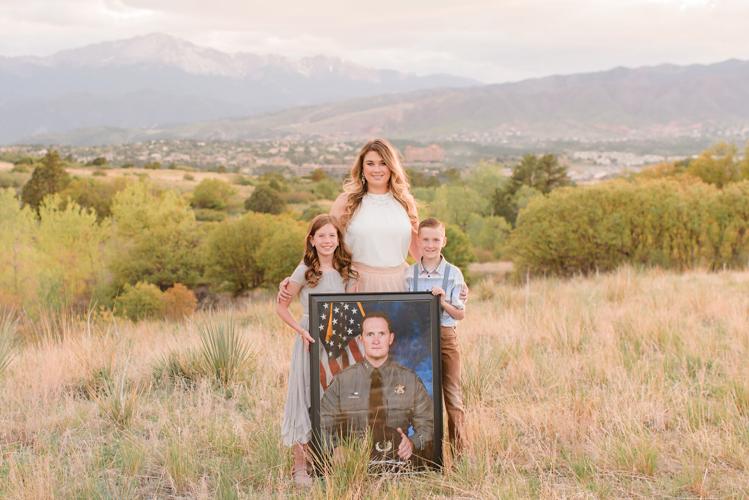
Rachael Flick and her twins hold a photo of fallen El Paso County Sheriff’s Deputy Micah Flick.
Courtesy of Lindsay Schmidt Photography
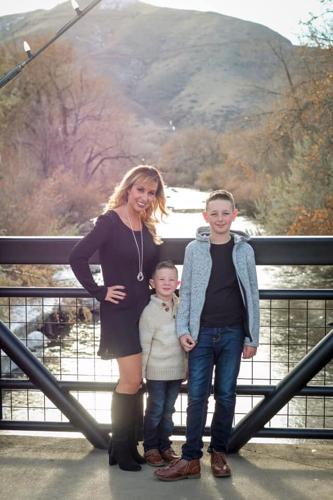
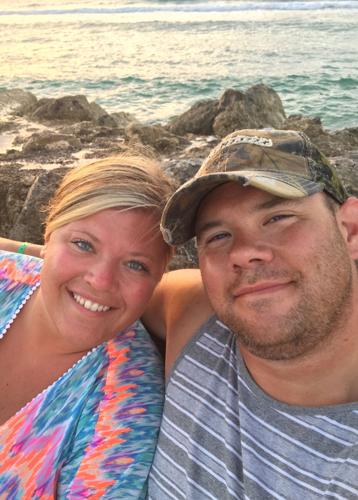
Four women sat close together, held hands and wiped their eyes at the March 30 funeral of fallen Boulder Police Officer Eric Talley.
Three rows back huddled three other members of the line-of-duty widows club, a group no one wants to belong to — but is ever grateful should they happen to need it.
“It’s something you never think you’d be a part of, but once you’re in it, you never can imagine your life without these ladies,” said JoAnna Staples, 40, of Castle Pines.
Her husband, Sgt. Tom Staples of the Douglas County Sheriff’s Office, died by suicide on May 2, 2019, and received line-of-duty honors.
“He wasn’t killed, but, still, his job and position are what took him,” she said.
The line-of-duty group helps Colorado women and men — whose first-responder spouses or partners sustain work-related deaths — move through the grieving process and forward with their lives.
The national database of Concerns of Police Survivors, or C.O.P.S., lists 54 such widows in Colorado, according to spokeswoman Sara Slone, dating back to 1968 as the year of the officer’s death. Fiancées, partners and mothers of the departed also participate in the ad hoc group.
Unfortunately, Staples said, their numbers keep growing.
“I’m thankful we can be there for others,” she said. “We can open our arms and say, ‘I get it.’”
As of last month, the grassroots group has a new member — if she wants to join.
Talley was killed March 22 while responding to a gunman’s attack on the Table Mesa King Soopers in Boulder. In the following week, his wife, Leah, received an invitation in the form of a public letter from Rachael Flick.
“There’s nothing formal — we just love each other and take care of each other,” said 38-year-old Flick. “It’s become a network of support and is therapeutic and meaningful.”
Her husband, Deputy Micah Flick of the El Paso County Sheriff’s Office, died three years ago during a violent shootout in Colorado Springs between authorities and a suspected auto thief.
Rachael Flick first realized there were other spouses who felt the same depth of pain and anguish she was experiencing when on Feb. 5, 2018, she found herself in a trauma bay at Memorial Hospital in Colorado Springs.
A flock of people she had never met crowded into the small room, next to another room where the body of her husband lay.
As Flick was trying to comprehend that her husband had just been pronounced dead, she heard someone say that spouses who had dealt with similar deaths would be ready to talk at any moment — whenever she was.
The scene was overwhelming, Flick said. But she remembered that voice.
“Within 10 days of Micah’s death, I had several widows sitting with me, talking with me, listening to me, inviting me into a relationship,” Flick said.
“They weren’t trying to give me anything — a presentation or a check or a fundraiser or a gift,” she said. “Their presence was the gift.”
‘You always are uplifted’
Flick said she hasn’t received a response from Talley’s widow, Leah, yet. As survivors know, it can take time.
Through the grapevine, Flick heard Leah Talley had seen her letter and “was encouraged by it.”
Even if the grieving spouse doesn’t know that other widows of what’s known as the Blue Family are at their loved one’s funeral, somehow a sense of comfort breaks through and can be felt, Staples said.
Staples didn’t attend Talley’s funeral because she was out of town. But a little over a month after her husband died, Staples went to the funeral of another law enforcement widow, and they’ve become good friends.
Amy Moden’s husband, Colorado State Patrol Master Trooper William Moden, was struck by a truck and killed on June 14, 2019, while he was investigating a crash on Interstate 70.
He’s one of five Colorado State Patrol troopers to die in the past six years.
“I knew how his wife was feeling and was there to offer my support,” Staples said. “Even though they don’t know you’re there, you’re still there.
“Anytime you hear any widow was there to support you, you always are uplifted.”
Moden met Staples a few months later at a softball tournament fundraiser in the name of another Douglas County Sheriff’s Office Deputy, Zack Parrish, who was fatally shot in an ambush in Highlands Ranch on New Year’s Eve in 2017.
“JoAnna had sent me a package and a card in the mail, and being able to hug her and put a face to a name meant a lot to me,” Moden said.
The widows regularly get together for coffee, dinner, barbecues, play dates, events related to the observation of National Police Week and other activities. They also text, call and chat online.
“We can laugh, and we can cry, and everybody understands,” Staples said. “We celebrate victories, even if they’re little. You realize these ladies will be with you through anything.”
For the most part, it’s like any other friends’ circle. They talk about things that crop up in daily life, how to handle their kids, what they’re doing and how they’re coping.
Sometimes the humor turns dark — discussing what type of casseroles they got after the funeral, or unhelpful remarks seemingly well-intentioned people have made — but that’s OK, Staples said. They all need a break from the heartache.
“I look forward to seeing these ladies,” Staples said. “They’re strong, they have to rebuild their lives, they’re resilient.”
Rituals are ‘almost sacred’
While the loss of any loved one is difficult, the sorrow and despair for the widow of a fallen officer, deputy, firefighter, correctional guard, EMT or other first responder is different, the widows say.
Sometimes, Flick said, people say, “That was such a senseless death,” regarding their husbands.
“Their death in the line of duty is never senseless,” she said. “They gave their lives in service to others and to the culture of the ‘thin blue line.’ Without it, there would be anarchy, not peace and justice, in society.”
Flick cites Talley’s response to the active-shooter scene at the Boulder supermarket as “the absolute sacrifice.”
“He ran into the store not taking consideration for his own life in that action, but for the protection of peace and safety.”
The death of an officer or other first responder also is more public than that of the average citizen, Staples said. Hundreds of other law enforcement staff travel from across the nation to pay their respects and support the fallen and their families in processions and solemn parades.
The funeral customs of a 21-gun salute, the draped flag, its folding and presentation, and the last call, when the time and date of death are announced as the deceased’s final watch, are elements that have become “almost sacred,” Flick said.
“There’s not a lot of people, statistically, who can relate to those kinds of funerals,” she said. “It’s brutal and beautiful at the same time.”
The funerals are a reminder, Flick said, not only of sacrifice, but also of encouragement to others to keep putting on their uniforms and badges and continuing the job.
“Hope is not lost in valor,” Flick said.
Freedom to speak out
Moden, who lives in Aurora, mentions the shock of being thrust into the national spotlight by her husband’s death.
“Your life just changes,” she said.
But that also enables survivor widows to build a platform that previously wasn’t available.
As the wife of a law enforcement officer, Flick said she couldn’t speak publicly about her anxieties and worries because it would have been a reflection on the agency.
Now, she has freedom to talk about her experiences, which she does during motivational presentations and other public-speaking engagements.
“Watching my husband do this job, when, in 2016, officers were being shot in the head while sitting in their cars for retaliation for what was going on in the nation — you couldn’t speak out.
“In light of Micah’s death, I have a unique space to be able to speak about the fear I had that my husband was going to be ambushed at work.”
Widows gravitate to causes they’re passionate about.
Moden, 36, testified with other State Patrol widows last spring before the state Senate Transportation Committee on roadside deaths. The speakers advocated for clearer guidelines for speed when motorists drive past roadside hazards and activity, under Colorado’s “Move Over” law. Changes took effect last year.
“It was something we felt we needed to do,” Moden said. “I’m tired of seeing my law enforcement community being hit while trying to serve the public on the side of the road.”
Moden also is a board member of the Colorado State Patrol Family Foundation, which supports the agency and its families, including creating a line-of-duty death benefit guide.
Staples speaks out about death by suicide of law enforcement. Already this year, 46 officers and other first responders have taken their lives, according to Blue H.E.L.P. Last year, there were 171 suicide deaths among law enforcers and 238 in 2019.
Staples said her husband didn’t seem to let his job bother him and never reached out for help or said he was struggling. She believes he was so compassionate in his work that he didn’t take the time to focus on his own needs.
Moden, who also attended Talley’s funeral last month, hopes Leah Talley knows she’s not alone.
“Her husband’s funeral was very emotional for me and the trauma I experienced with William’s death, but as much as it was hard, it was very beautiful to see the law enforcement community come together,” Moden said. “There’s nothing else like it when you feel that camaraderie and the brotherhood and sisterhood that is unspoken and very deep.”
Moden said fellow widows have empowered her to heal and give more of herself to others.
“They inspire me to do things, to be brave enough to testify (before state lawmakers),” she said. “I don’t think I’d be in that place to do that emotionally if it wasn’t for the support of my peers.”
Moden lives by this motto: that in the midst of trauma, sadness, pain, loss and heartache, is good.
“You just have to look for it,” she said. “For me, it’s been the people God has placed in my life, these women and men who walk this path with me.
“I hope Leah Talley knows she’s loved, she’s supported, she’s seen by so many.”
Contact the writer: 719-476-1656.