







District 49 proposal would ban teaching of ‘critical race theory’
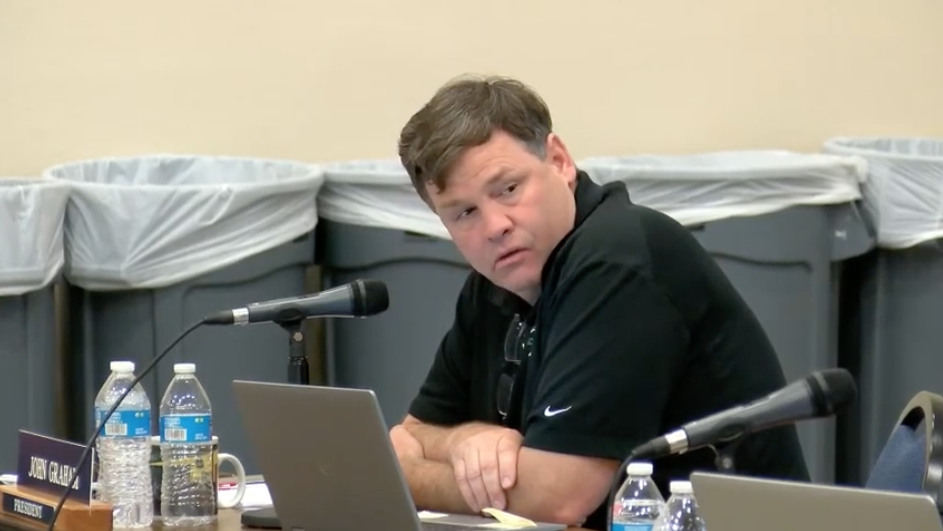
A battle over “critical race theory” is raging at school boards across the nation and in Colorado Springs, where one board member this month asked a question on many minds: What is it?
District 49’s Board of Education recently voted to draft a resolution that would ban teaching the theory in its classrooms.
The June 10 meeting covered topics ranging from improving teacher pay to bolstering security for a district charter school. But the most spirited conversation, which was livestreamed on YouTube, revolved around critical race theory and its role in public schools.
The issue has become the subject of heated public discussion, debate and several recent state laws. Lawmakers in Idaho, Iowa, Oklahoma, Tennessee and Texas passed bills banning critical race theory from public schools, with similar proposals on the table in several other states.
D-49’s board president, John Graham, proposed forming a committee to develop a resolution of the board’s intent to prohibit the teaching of the theory, and to present it for a later vote.
“Everyone here, on this team, is worried about divisiveness,” Graham said, adding that critical race theory “runs counter to our district cultural compass.”
Robert Loevy, an emeritus political science professor at Colorado College, said critical race theory has been around for decades, and that it only recently morphed from an academic movement into a political wedge issue.
“What started as an idea on college campuses has overflowed into the national media and the political arena,” said Loevy, who taught political science for more than half a century. “It was only a matter of time before the issue — which was born in higher education — would make its way into local districts.”
Dave Cruson, the lone dissenter of the four board members present (vice president Kevin Butcher was not at the meeting), said a more thorough understanding of what critical race theory is, and how it is taught, is necessary before moving forward with a resolution.
“I understand that this is a hot-button issue, but what does (critical race theory) mean?” Cruson asked. “I need further understanding. I think we all do.”
Manya Whitaker, an associate professor of education at Colorado College, said critical race theory is not an academic subject like history or math that can be taught in K-12 classrooms.
“Critical race theory is just that — it’s a theory,” said Whitaker, who specializes in political and social issues in education. “It is not content itself.”
Whitaker acknowledged that institutional racism can be a heavy topic to introduce to younger students, but said some of the tenets of critical race theory are crucial in understanding how America’s past connects to its present.
“For instance, I have a student who is a high school economics and social studies teacher,” Whitaker said. “She can’t teach about voting rights without also teaching her kids about the history of who was denied voting rights and how that influences current voting patterns and practices.”
“It’s about power: Who has the power, how did they get it, how do they use it and who is affected by the way it is used,” Whitaker added. “That is part of what (critical race theory) asks us to examine.”
Opponents of the theory say it teaches that all white people are oppressors and that America is a racist country. This is not true, Whitaker contends. Instead, it encourages a thorough, unvarnished approach to teaching and learning American history, including its less-flattering chapters.
“The phrase ‘critical race theory’ is evoking emotions that are making people defensive,” she explained. “No one is singling out a particular white person, or even talking about white people in general. We’re talking about the structures of this country that create a racial hierarchy.”
Whitaker said that while a resolution banning critical race theory might be satisfying to the more conservative members of the District 49 board, it would be virtually impossible to enforce.
“No matter what laws you pass, if a teacher is actually educated in (critical race theory), they can teach through a lens of (the theory) all the time and you would never know,” she said.
The District 49 board resolved to work with the district’s Equity Leadership Advisory Council, administrators and legal personnel to draft the proposed resolution by Aug. 31.
The district’s chief education officer, Peter Hilts, cautioned against drafting a resolution without the input of the district’s Equity Leadership Advisory Council, which is expected to reconvene in August.
Board member Rick Van Wieren said the proposal was partly in response to growing concern among parents and other District 49 constituents, and that a resolution would serve as the district’s final word on a topic that comes up in nearly every board meeting.
“We need to do something very specific to keep critical race theory out of our schools,” Van Wieren said. “A simple resolution saying we’re not going to do it, I think, makes it clear and concise for everybody and avoids confusion going forward.”
Board member Ivy Liu echoed Van Wieren’s assertion that critical race theory has no place in public schools.
“We need to come to terms with what (the theory) stands for, how it affects our district and what it is telling our people and our students,” she said, adding that she believes the theory relieves students of personal responsibility, fosters divisiveness and teaches that America only offers opportunities to a select few.
“I’m an immigrant,” Liu said. “We came to this land of opportunity. Do not tell me this country’s horrible for people who are looking for opportunities.”