







The big, colorful life of Ted Newman, Pikes Peak region’s beloved cowboy singer
Christian Murdock/The Gazette
In a dirt road town west of Colorado Springs, under a lime-green canopy and beside a glistening stream, Ted Newman begins his routine.
“Good morning, everybody, and welcome to Green Mountain Falls,” he says to his audience eating breakfast at the Pantry Restaurant.
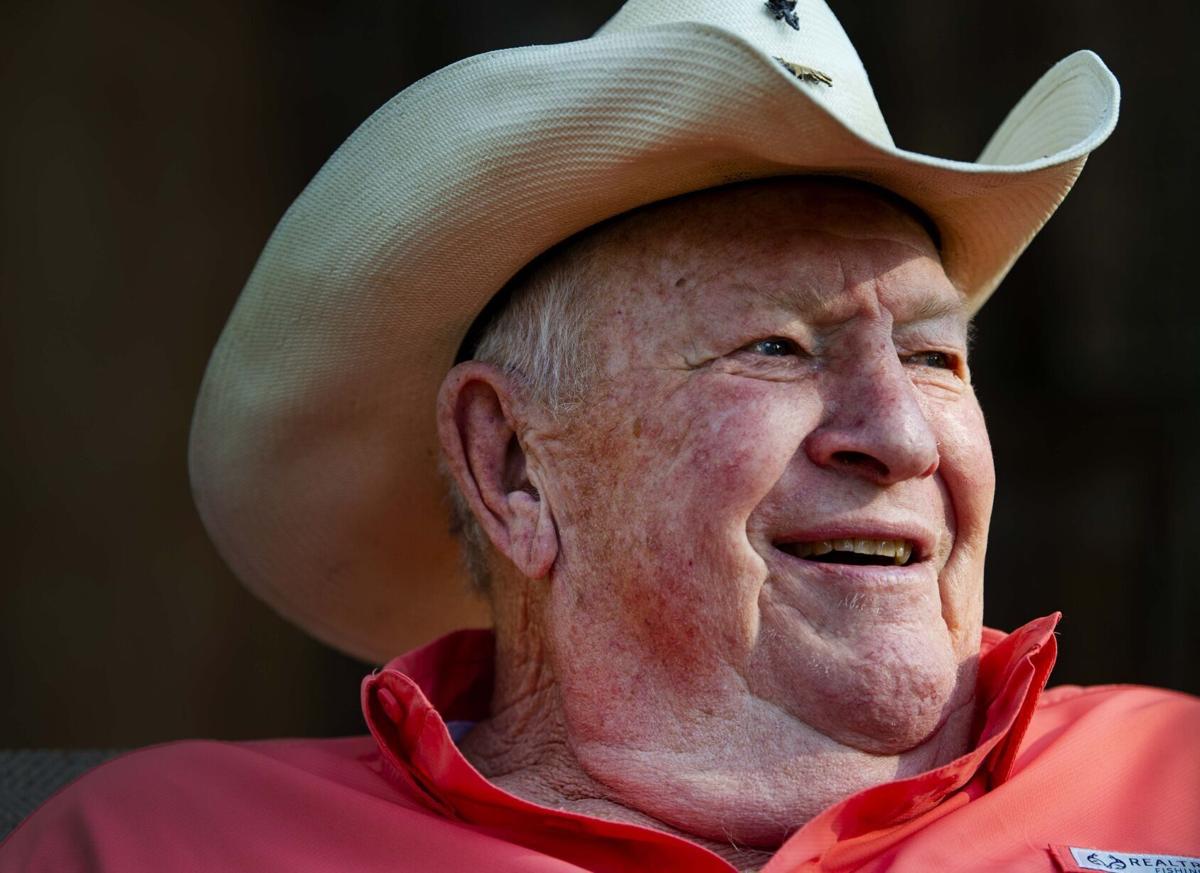
He’s got Aspen the yellow Lab at his feet, Pepsi at his side, guitar in hand. Locals and returning vacationers have come to expect the show; Newman is a fixture with his cowboy hat and canine companion. His country songs go with the morning like biscuits go with gravy.
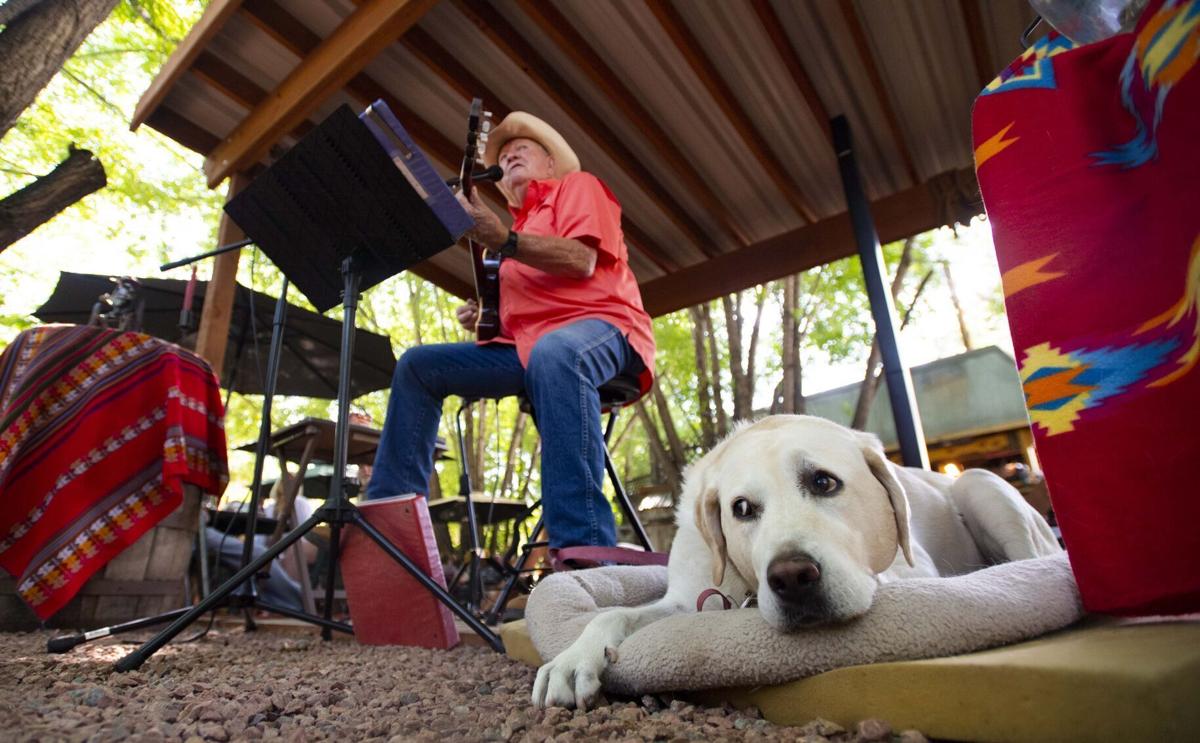
Ted Newman performs while his dog Aspen lies at his feet at the Pantry Restaurant in Green Mountain Falls. Newman spends the summer entertaining at the Pantry; this is his 17th year performing at the restaurant.
photos by Christian Murdock, The Gazette

Ted Newman performs while his dog Aspen lies at his feet at the Pantry Restaurant in Green Mountain Falls. Newman spends the summer entertaining at the Pantry; this is his 17th year performing at the restaurant.
This is a summer tradition lasting the better part of two decades. The folksy, down-home Newman serenades and charms, cracking jokes along the way.
He starts with the usual line: “My only promise is I will never play a song that I don’t know.”
It’s rare he doesn’t know a request. It’s common for requests to be Johnny Cash or John Denver, and those he knows intimately. He shared stages with the two legends. They are but anecdotes in a big, colorful life story.
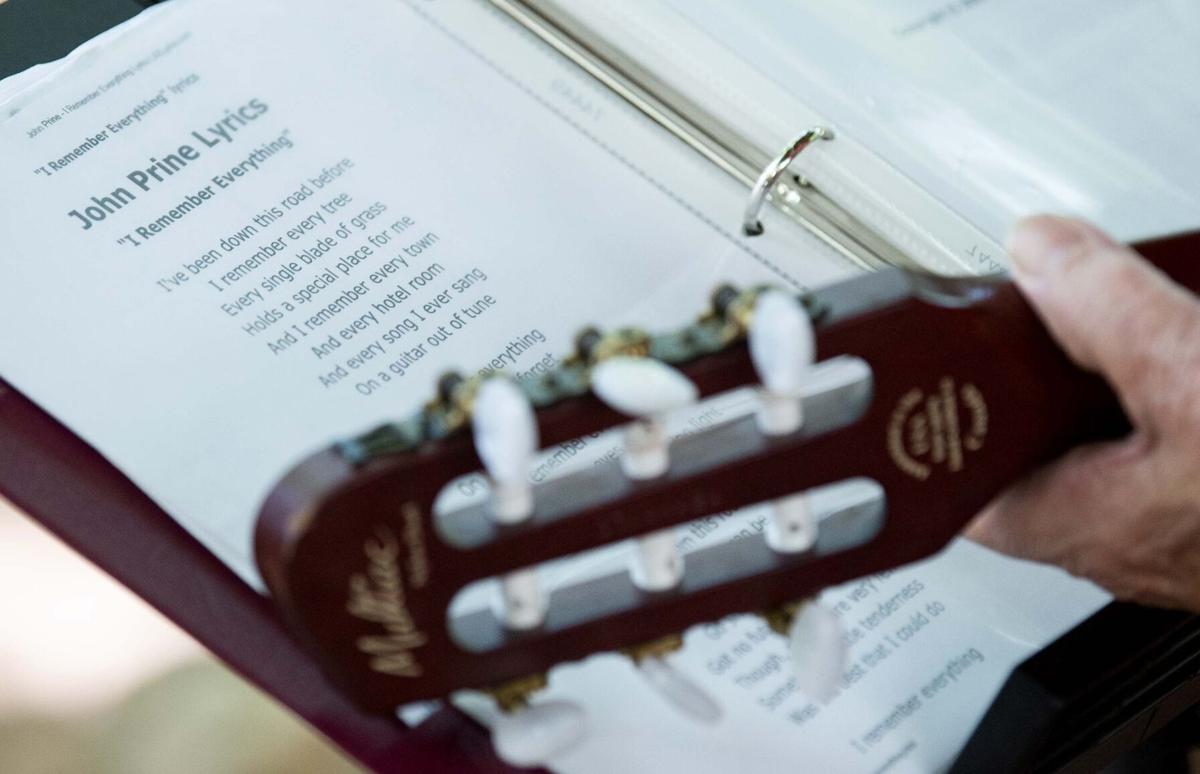
Ted Newman plays a John Prime song while performing at the Pantry Restaurant in Green Mountain Falls. Newman has written more than 1,500 songs of his own.
Christian Murdock/The Gazette

Ted Newman plays a John Prime song while performing at the Pantry Restaurant in Green Mountain Falls. Newman has written more than 1,500 songs of his own.
Just as Newman can recall some 500 songs he’s written and some 1,500 more, so he can recall the years that saw him playing football, digging ditches, oiling roads, breaking horses, flying helicopters, scuba diving and teaching kids how to sing and grown men how to dance, among other things.
Into his 80s, Newman’s memory is clear as the creek here at the Pantry.
“I don’t know how he can keep track of it all,” marvels his wife, Rosemary.
The Arizona couple spends summers in Woodland Park, in a tiny cabin more than a century old. Here, Newman has recently been jotting down notes from his life — something for his kids, grandkids and great grandkids, he says. He’s been listing jobs he’s held.
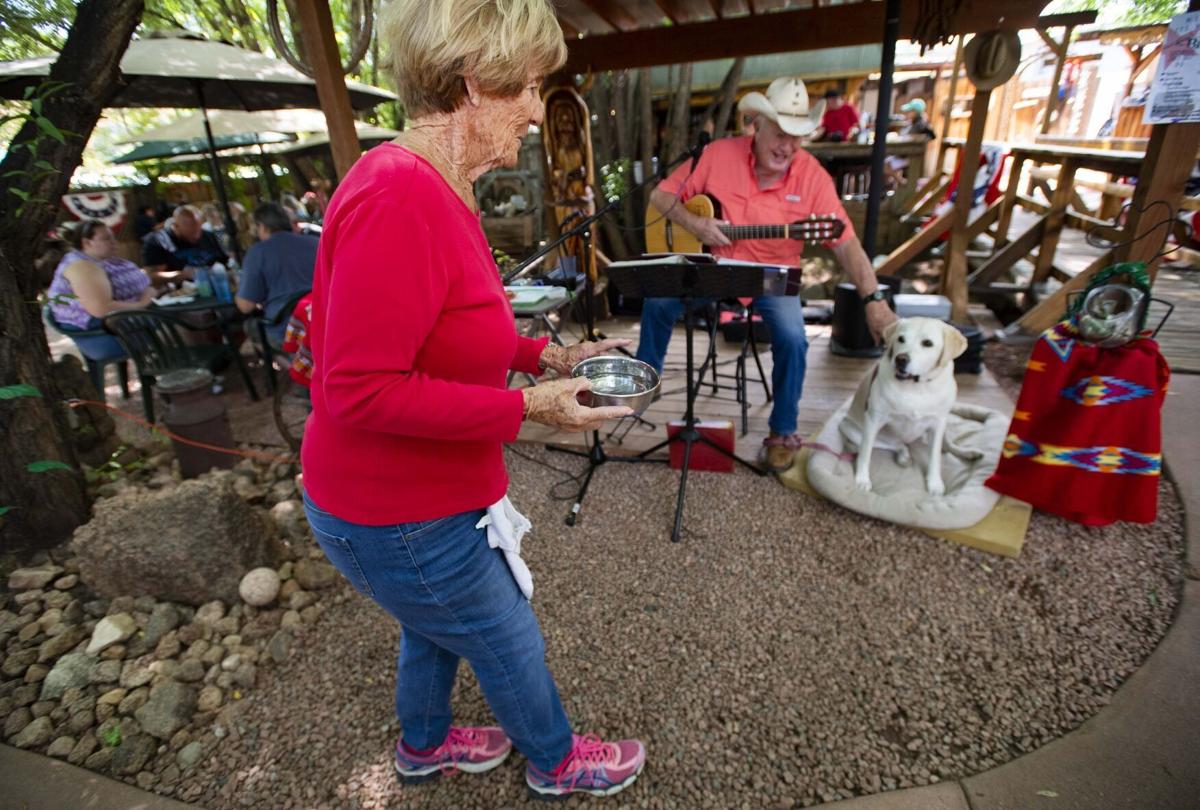
Ted Newman’s wife, Rosemary, brings water to their yellow Lab Aspen, between sets on a recent Friday, at the Pantry Restaurant in Green Mountain Falls. The couple, who went to the same high school in Arizona, were reunited after first marriages ended for both. They were married in 1991.
photos by Christian Murdock, The Gazette

Ted Newman’s wife, Rosemary, brings water to their yellow Lab Aspen, between sets on a recent Friday, at the Pantry Restaurant in Green Mountain Falls. The couple, who went to the same high school in Arizona, were reunited after first marriages ended for both. They were married in 1991.
“I think it’s somewhere between 150 and 175,” he says.
He adds with a wink: “They say, ‘What are you gonna do when you grow up?’ I haven’t grown up yet.”
The jobs date back to the 1950s, when young Newman saved earnings from a newspaper route to buy a trumpet. The family didn’t have much, a fact that only occurred to Newman as he grew older, as he realized other families had cars and televisions, for example.
“But the family was strong,” Newman says. “And we had music.”
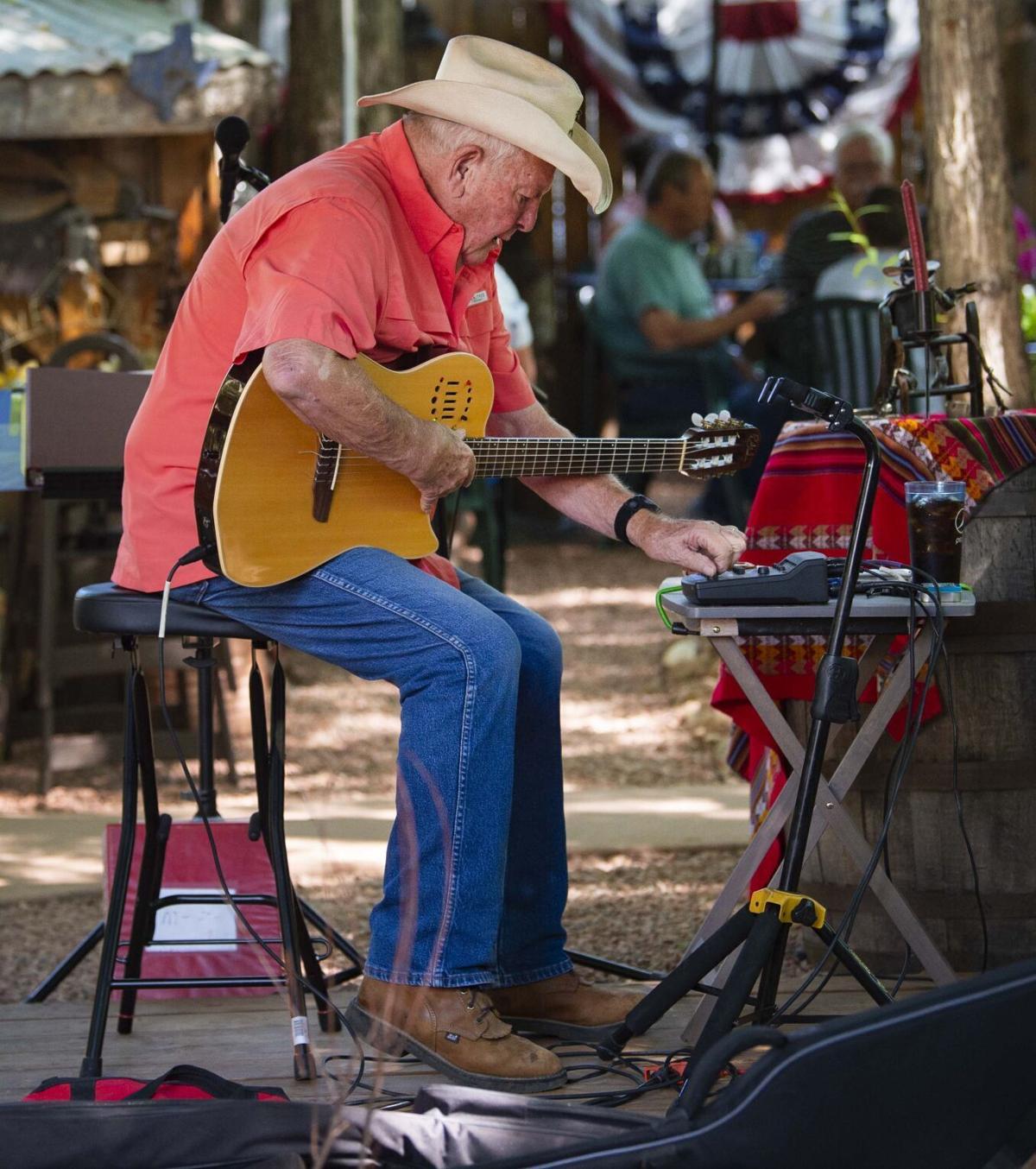
Ted Newman sets up his stage before entertaining on a recent Friday at the Pantry Restaurant in Green Mountain Falls. Newman has played at the restaurant for the past 17 years.
Christian Murdock, The Gazette

Ted Newman sets up his stage before entertaining on a recent Friday at the Pantry Restaurant in Green Mountain Falls. Newman has played at the restaurant for the past 17 years.
His dad worked for the U.S. Forest Service, teaching him what he needed to know about nature, while his mother taught him harmonies, what would be another lifelong passion. Same for his sister, a singer whose voice was recorded in a Phoenix studio for commercials.
In 1957, an engineer from that studio tapped a teenaged Newman to work on a song called “Plaything.” This coincided with Newman getting a scholarship to play football at Arizona State University.
The song was a hit — a hit worthy of opening for Johnny Cash and his band.
“Arizona State fullback is also a singing star,” read the headline in The Arizona Republic.
Newman recalls being whisked to 17 cities in 12 days. He recalls the “fiasco” that ensued: contractual disagreements and promotional commitments he couldn’t meet.
“Everybody has their 15 minutes of fame, and I had mine before I hit 19,” Newman says. “I had everything, then I had nothing.”
He was naive to the music business, as he was to the rule in collegiate athletics forbidding him to make money as he did (it was enough to get his parents a car and TV, he says). He lost the scholarship but gained essential wisdom from a coach, Dan Devine.
“One day out on a campus visit, he told me, ‘Football’s great, and it’s a good way to get somewhere, but the most important thing is getting an education, so you can have an appreciation for life,’” Newman says. “I carried that with me.”
Where Newman couldn’t afford to get an education from a school, he’d get it from working and traveling. He’d work on a ranch and work construction. He’d lead kids on horseback rides and hikes. He’d leave Phoenix for Colorado Springs to teach dance at The Broadmoor for a summer. He’d return to Arizona to sing with a choir.
He was crestfallen from that brief stint with Cash. But no, Newman didn’t lose his love for music. He formed a folk group with friends.
“Then we got the wild hair to go to Europe,” Newman says.
They performed where they could, made money, ate and slept where they could. It was 1961.
“I was in Berlin a week after they built the wall,” Newman says. “I went over to the eastern sector, and it was really quite an eye-opener. Plus, we’d been in Spain, where (Francisco) Franco was in power. He was a very firm dictator. I also went to Dachau.”
It all made him think about freedom and the fight for it. He joined the Army as a pilot. After two years of active duty, he went on to serve the Arizona National Guard through the ’60s and ’70s, on occasion rescuing people from floods.
All the while, he tried to maintain a music career. He gigged around and started a family with a woman he married.
A familiar name was signed into his daughter’s baby book: John Deutschendorf, better known as John Denver.
Newman played bass alongside Denver for weeks of shows in Arizona. Newman doesn’t talk publicly about his time with the stars — “I respect people’s privacy,” he says — but it’s obvious Cash and Denver left him feeling the opposite of envy.
With Denver, “there again, you get so big and so busy,” Newman says, “and everyone wants a piece of you, and you forget who you are and where you’re from. I realized how many people there were on the periphery who shouldn’t be there.”
He got to thinking he should be elsewhere, too. Tired of singing and playing guitar six nights a week, he took a construction job in New Mexico, where he later worked in a green chile processing plant. Here he also embarked on a new career as a school teacher, what would be his life’s proudest work.
But there was also a deep grief in New Mexico. “That’s where the marriage kind of fell apart,” Newman says.
Back in Arizona, a woman from his high school days was encouraged to give him a call. She was feeling lonely after her divorce.
“We both said we’d never get married again,” Rosemary says.
And Newman said he’d never dive deep into music again. And yet there was Rosemary, telling him he couldn’t possibly quit.
He wrote her a song: “I love you cuz you love to take a walk out in the rain. I love you cuz you’re not afraid to cry when you feel pain. … You’re not afraid to love me, that’s why I love you.”
They married in 1991. They pursued what made them happy, like scuba diving along the coasts of Hawaii and Mexico.
Newman moved back to Arizona, where he integrated his songs into the classroom. The kids repeated after him: “There’s no one in the world quite like me. … It’s best, you see, that I become the very best me. … The best thing for the world, you see, is to be the very best me.”
For the past 20 years, his voice has been heard all around the Pikes Peak region, his and Rosemary’s home away from home. After entertaining at several local clubs and ranches, the little Pantry, he says, is his final stop.
“This is my 17th summer here,” he says. “Pretty soon, I’m gonna run out of summers.”
He says this to be funny, not grim. He has the perspective of death as simply part of life — the perspective of someone who spends a lot of time around death.
He and Rosemary are longtime hospice volunteers. She comforts in the way she knows how, while he does the same in the way he knows how, through song. He sings patients their favorite song.
“Working with hospice people, you get a whole different view on death and dying,” he says. “I by no means have a death wish, but I’m not worried about it.”
No need to worry, he says. No need to linger on the future. That’s the message of his opening song at the Pantry this morning.
“Live today, love today,” he sings. “Do all you can to make your way, so when it’s over you can say, I really lived my life today, I really lived my life today…”