







China and US allies agree: ‘Risk of gunfire’ over Taiwan is on the rise
Chinese strategists and officials across the Indo-Pacific see a heightened risk of an accident that triggers a conflict between the communist regime and the United States, due in part to Beijing’s intensifying military pressure on Taiwan.
The shadow of a conflict has grown of late, as Chinese General Secretary Xi Jinping has affirmed his intention to bring the island democracy under Beijing’s control and sent an unprecedented number of warplanes in sorties near the island. U.S. forces have surged toward the Indo-Pacific to fortify U.S. allies against Chinese pressure in territorial disputes across the region. At the same time, U.S. and some European officials have expanded their outreach to Taipei — a diplomatic overture that might diminish Beijing’s appetite for a conflict, if it doesn’t induce Chinese officials to take a desperate lunge for the island.
“We consider the risk of miscalculation higher than it was,” Justin Hayhurst, a top official for Indo-Pacific security issues at the Australian Foreign Affairs and Trade Department, told Australian senators this week. “There’s more activity, more pressure — so we are concerned.”
A senior U.S. lawmaker made a similar point but kept an even keel about the relative risk of war.
US AND JAPAN WARN CHINA NOT TO ATTACK TAIWAN
“There is a risk of miscalculation. There’s always been risk of miscalculation, and it isn’t worse or better today, except with the incursions that the Chinese are doing with the flights that the Chinese are doing the flights that they’re taking into near Taiwan,” Idaho Sen. James Risch, the top Republican on the Foreign Relations Committee, told the Washington Examiner. “Admittedly, there’s more of it now.”
The surge in Chinese military flights near Taiwan provided the context for an unusual statement from President Joe Biden, who declared in an unscripted moment that the United States has made “a commitment” to protect Taiwan in a Chinese Communist invasion. Biden’s administration walk backed that pledge — no such commitment exists in the federal law that governs U.S.-Taiwanese relations — but Taiwanese President Tsai Ing-wen has expressed confidence that such help would come.
“This is a very, very dangerous issue and one that requires clear statements of U.S. policy,” the German Marshall Fund’s Bonnie Glaser said after Biden issued his unusual statement last week. She noted that the establishment of diplomatic ties between the United States and the Chinese Communist regime required the abrogation of a defense treaty with Taiwan.
“A return to that kind of a commitment … to Taiwan’s security, I think, would lead the Chinese to conclude that we no longer, perhaps, have a one-China policy [and] maybe we are even moving in the directions of establishing diplomatic relations with the Republic of China,” she said, using the official name for the Taiwanese government. “And that might set in motion a set of actions by China.”
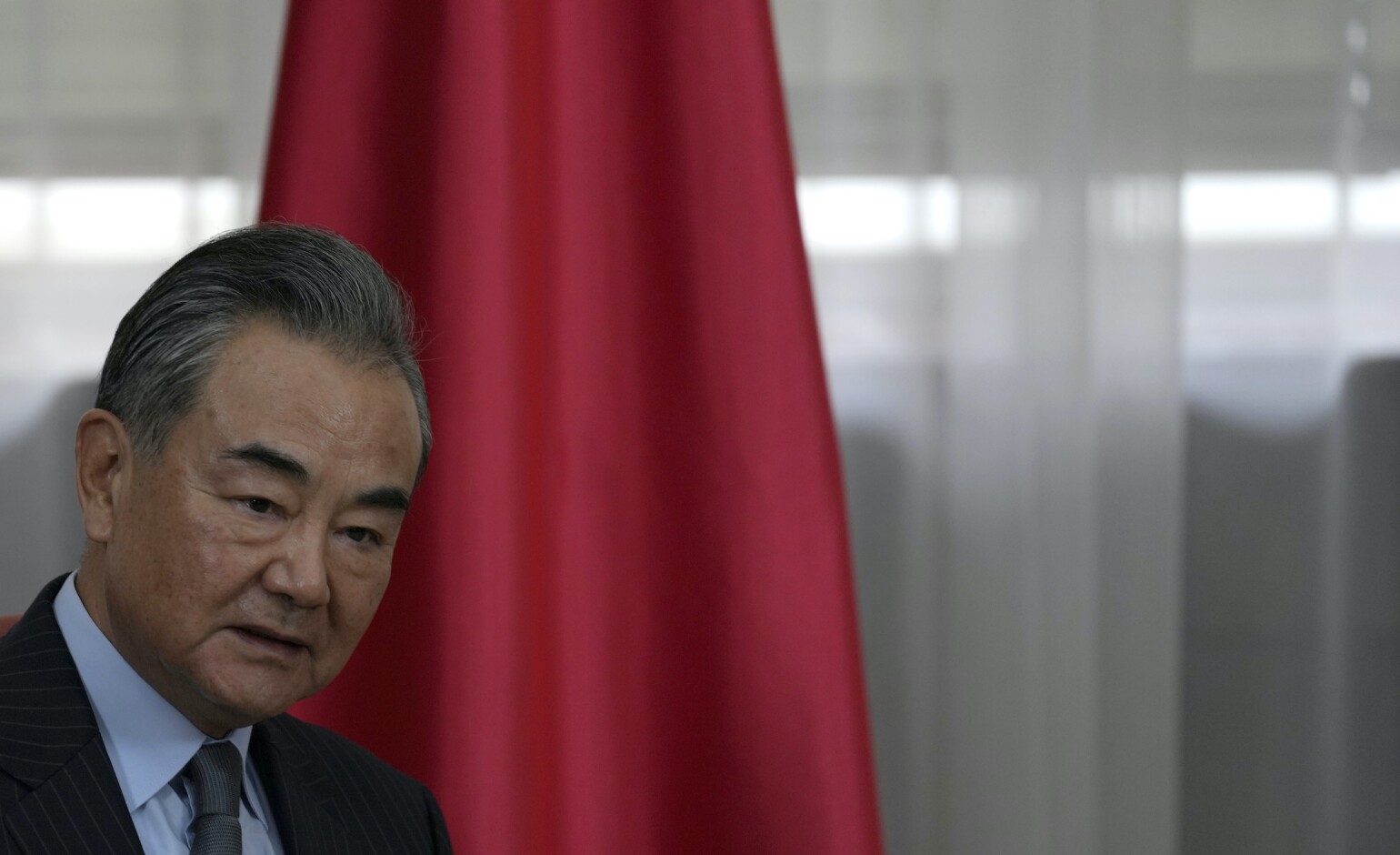
That controversy set the stage for dueling diplomatic tours in Europe this week, where Taiwanese Foreign Minister Joseph Wu held high-profile meetings in two capitals and arranged a secret trip to meet with European Union officials in Brussels. Chinese Foreign Minister Wang Yi, for his part, arrived in Greece with a warning to Europeans who might consider a closer relationship with Taiwan.
“At present, it is especially important to guard against and prevent the attempts of some individual countries to challenge the one-China principle and undermine the political mutual trust between China and Europe,” Wang said.
One of his spokesmen used harsher language to condemn the Czech Republic for hosting the Taiwanese envoy. “The despicable maneuvers by a few individuals in the Czech Republic are doomed to fail,” Chinese Foreign Ministry spokesman Zhao Lijian told reporters Thursday. “We urge them to promptly change course, otherwise they will end up swallowing the bitter fruit themselves. … We will take all necessary measures to crush any ‘Taiwan independence’ plot.”
China, meanwhile, maintains that the U.S. presence in the region is a threat to stability. One analyst affiliated with the Chinese military complained this week that the U.S. has conducted about 2,000 “close reconnaissance” operations.
“The high frequency of such close reconnaissance endangers China’s sovereign security and heightens regional tensions, which will inevitably trigger firm opposition from China and undoubtedly increase the risk of gunfire,” researcher Cao Yanzhong of the Chinese People’s Liberation Army’s Academy of Sciences said at a conference this week. “The most urgent task at the moment is that the U.S. immediately ceases its frequent close reconnaissance to reduce the possibility of misfires.”
Biden’s team, however, has prioritized the continuation of U.S. maritime operations across the Indo-Pacific, with an emphasis on expanding them to include key allies such as the United Kingdom and Japan.
CLICK HERE TO READ MORE FROM THE WASHINGTON EXAMINER
“The Chinese like to keep this idea of miscalculation,” Sen. Dan Sullivan, an Alaska Republican on the Armed Services Committee, told the Washington Examiner. “We need to do what we have been doing for decades — freedom of navigation operations. … These are important to do regularly, professionally, and, importantly, with our allies.”
Original Location: China and US allies agree: ‘Risk of gunfire’ over Taiwan is on the rise
Washington Examiner Videos