







NEA president Becky Pringle talks national ‘joy, justice and excellence’ tour
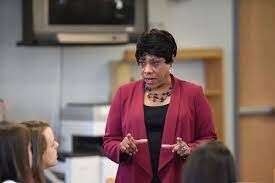
Becky Pringle, President of the National Education Association visited Colorado last week and sat for a press roundtable at the Colorado Education Association headquarters in Denver Wednesday.
Reporters Scott Weiser from The Denver Gazette, Erica Meltzer from Chalkbeat Colorado and Erica Breunlin from the Colorado Sun spoke with Pringle.
Pringle is on what she calls a national “joy, justice and excellence” tour to connect with educators across the country and discover “what they are doing to ensure racial, social, and education justice for their students, for educators, for communities, and highlight the excellence that’s going on in our public schools.”
Pringle was elected as president of the NEA in 2020 and previously served as vice-president and secretary-treasurer and is described by the NEA as a “fierce social justice warrior and defender of educator rights.”
Based in Washington DC, the NEA is the largest labor union in the United States, comprising more than 3 million active and retired educators and support professionals.
Note: This interview has been edited for length.
Erica Meltzer: What brings you to Colorado?
Pringle: “The purpose for my tour was to lift up the incredible work that educators are doing and have been doing…in these last twenty months, to learn about the things that are giving them hope for the future, the things that are making them proud of the work that they are doing with their students and colleagues and communities, and what they are doing to ensure racial, social, and education justice for their students, for educators, for communities, and highlight the excellence that’s going on in our public schools.”
Meltzer: What conversations have you had with teachers?
Pringle: “Yesterday, I went to Fort Collins and met with the Poudre Education Association leaders and members, where we talked about the kinds of challenges that they’re facing, which is similar across the country. Staff shortages, educators leaving the profession, the well-being of educators and students, and the kinds of things that they were concerned about. …”
Scott Weiser: How do you define racial, social, and educational justice?
Pringle: “So, at the beginning of my presidency last year, I shared with members and communities, communities elected leaders, the strategic vision that I have for the NEA, which was to unite just not our members, but our entire nation. To lead a movement to reclaim public education as a common good, as the foundation of this democracy, and then transform it into something it was actually never designed to be, which is a racially and socially just and equitable system, that prepares every student.
“So, when I talk about justice, we all know that we have to ensure that every one of our students has the resources, the opportunity access, the support of all the systems that impact their ability to learn. … So, we’re looking at healthcare, the equity and inequities of the healthcare system, in the economic system, in food insecurity, all of those things that get in the way of our students having access. … We saw the light shining on the inequities of our black, and brown, and indigenous students in terms of access to digital tools and broadband. We saw the lines in schools where students and families were coming just to get one meal a day. …We know kids can’t learn if they’re hungry.”
Erica Breunlin: Can you walk us through the public perception of teachers before the pandemic, throughout the pandemic, through now?
Pringle: “When we talk about school board disruptions, chaos, that’s real and it’s scary for school board members, their families who have been threatened and attacked, for educators, for principals, and parents as well, who have been attacked by people who have been engaging in violence and violence speech. So, it is a real issue. There’s just no question about it. On a national level, we were very encouraged that the Biden administration asked the Department of Justice to investigate those threats because they are real. …We not only saw that the public opinion increased in terms of not only their approval for teachers and other educators, but the union and fighting for the health and safety of the students.”
Weiser: How do you define social emotional learning?
Pringle: “I want to add that we have so much more information now on brain science and how the development and learning of students, so when we talk about social and emotional needs, we now talk about the interconnection between social, and emotional, and academic learning, all three of them. You can’t get to the academics if you aren’t addressing the social and emotional. We have the science, the brain science to support that. Those districts that are really leaning into that in a proper way are seeing great results.”
Weiser: What brain science are you referring to?
Pringle: “I would point you to the work, some of the work really, out of Stanford University. … Linda Darling Hammond has done extensive research on social emotional learning. …
You can also get some more information from CASEL, (Collaborative for Academic, Social, and Emotional Learning). They’ve done years of research on social and emotional learning. …What we’re focused on at the NEA is making sure that our educators are being trained at the front end of the pipeline as their training to become teachers, but also through professional development.”
Weiser: What do you mean by brain science?
Pringle: “They’ve done scans of the human brain. So, for example, when students listen to music, a certain part of their brain lights up. Unfortunately, over the years we didn’t understand that or didn’t pay attention to it. I don’t know, because arts and music, those were the first to go when we’re taking funding from schools, or focus on a single test. … But we know that arts, music, it excites a certain part of the brain. So, when I talk about brain research, that’s what I’m talking about. That allows students, not just students, people to accelerate their learning and make the connections to science and math.”
Weiser: What is critical race theory? Why is it a political issue?
Pringle: “Critical race theory is something that has been around for a very long time, late eighties. A term coined by Kimberlie Crenshaw, a professor, and it was, and is, not was. It still is a way of having conversations at the higher education level, about the impact of race on communities, not only on communities of color, but on white communities, and how the complete history of this country needs to be factored into discussions about how the systems… still have inequities that are built into them based on race.
“It has become this hot button issue politically because those that are talking about it and don’t know what it is and what it isn’t, are using it as a wedge issue to sow fear and discord in communities, to take the attention away from the failures they’ve had in dis-investing in our public schools.
“We, at the NEA, our position is that our educators across the country have been, and we support the continued teaching of the truth about this country, the times when it has lived up to its glorious promise of We the People, all of us, and the times when it’s fallen short. We believe that our students expect that we tell them the truth and deserve that from us because we know. We’re in classrooms every day with them, and we know that if they have the opportunity to engage in these discussions, that they will become those critical thinkers, those problem solvers that we need them to be, so they are the leaders of a just society.”
Weiser: What are the components of critical race theory?
Pringle: “It’s not a thing. That’s part of what there’s a misunderstanding around. It’s not a thing. So, there’s not a doctrine on critical race theory. It is a way of creating an opportunity and environment to discuss the issues that I just said, and promote from a critical, systemic way, a viewpoint so that you are able to look at moments in our history. … How systems were built on that, and how those inequities in those systems impact students, communities, this society, to have those deeper conversations that center on the reality of the disparities that still exist in this country based on race.”