







Douglas County school board members testify as legal battle over superintendent firing begins
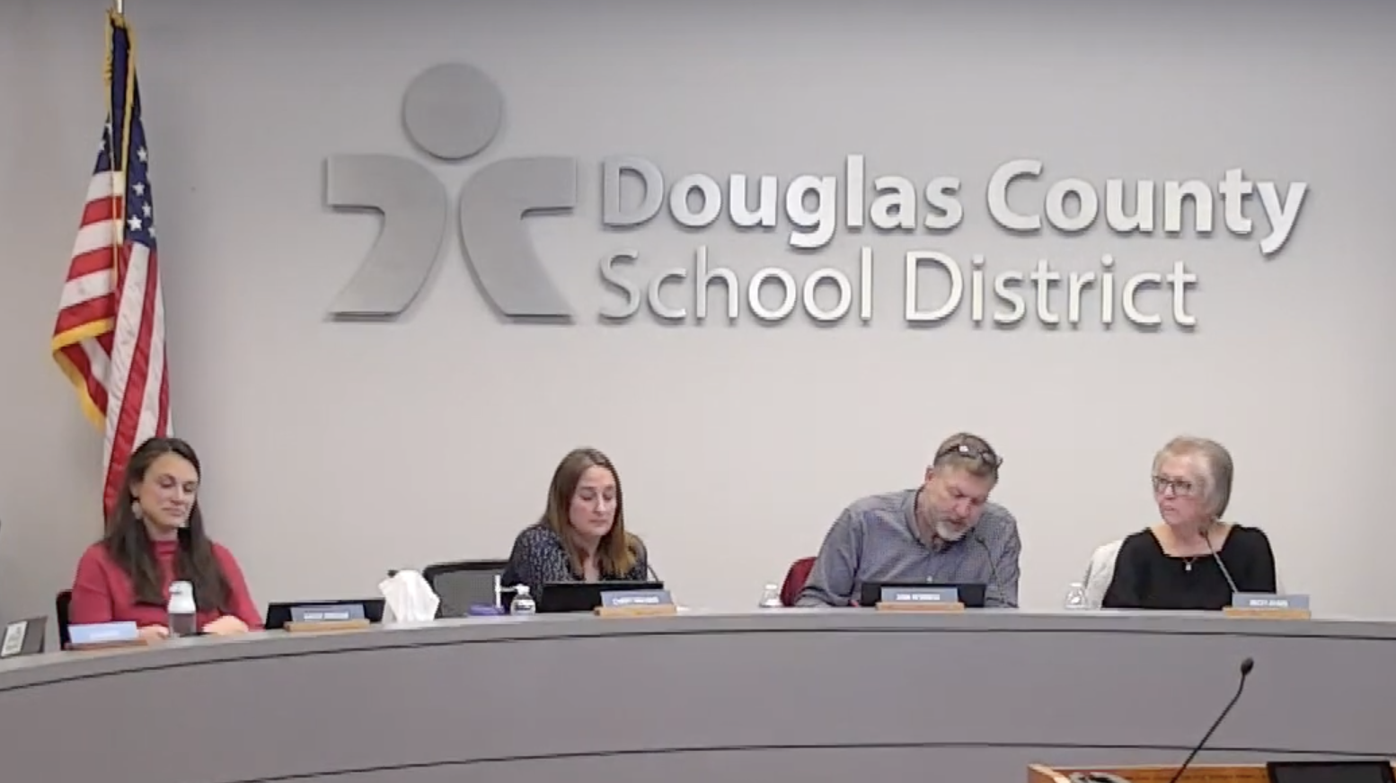
courtesy of Douglas County school district
Four Douglas County school board members testified in district court Friday about whether the board’s leaders broke open meeting laws in the run-up to the dismissal of the district’s superintendent, the first skirmish of what’s set to be a multi-front legal war over that decision.
A Douglas County judge will now decide whether the board’s members should be temporarily barred from communicating in the way its four leaders did about Corey Wise’s future at the end of January. Three of those leaders testified, and their attorneys argued that their individual conversations constituted a “metaphorical temperature” check about Wise’s competency and did not violate the state’s open-meeting laws.
But Steven Zansberg, the attorney representing the Douglas County resident who brought the suit, contended that if those conversations didn’t violate the law, “then we don’t have an open-meeting law.”
Friday’s three-hour hearing is part of a broader lawsuit filed by a county resident challenging the legality of the board’s communications and decision to fire Wise, which also seeks to have Wise reinstated and the actions of the board declared a violation of state law. As that lawsuit begins to unfold, Wise’s attorneys have indicated that they plan to sue the now ex-superintendent’s longtime employer.
At the heart of the dispute is whether the board’s four newly elected leaders broke the law when they discussed Wise’s future in a series of private conversations in January. As Zansberg pointed out Friday, both sides agree that those four members – board president Mike Peterson, vice president Christy Williams, Becky Myers and Kaylee Winegar – talked about Wise among themselves in one-on-on discussions. In court documents filed by the district, Myers and Winegar individually told Peterson they had concerns about Wise, and Peterson then took those comments and relayed them to Williams.
On Jan. 28, Peterson and Williams – unbeknownst to the board’s longer-serving three members – met with Wise and told him he could resign, retire or be fired.
Peterson and the other new members maintain that those conversations were within the bounds of the law and that they were exploring Wise’s options within his contract. Under the Colorado Open Meeting Law, they would’ve had to have their discussions about Wise publicly – if three of them were discussing them together. But that didn’t happen: The conversations leading up to the meeting with Wise were entirely one-on-one, and the decision to fire Wise was not formally made until Feb. 4, when the board voted publicly to dismiss him after a “lengthy” and “rigorous” debate, Peterson testified.
But Zansberg and his client, Robert Marshall, maintain the leaders still violated the open meeting law, which requires any form of gathering to be held in public. They contend that the individual conversations were linked and constituted a gathering, and that the four members had already made a decision to get rid of Wise based on those one-on-on conversations and without having discussed it publicly.
It’s now up to Douglas County District Judge Jeffrey Holmes to determine if the board should be barred from communicating in that way going forward. He said Friday he would issue a written order, though he gave no indication on when. Peterson, Myers and Williams all testified in Holmes’ courtroom, as did Susan Meek, who’s been on the school board since 2019 and has publicly criticized board leadership for how it handled Wise’s dismissal.
Zansberg sought to demonstrate that the board’s leaders communicated via phone in January and on a one-on-one basis to intentionally avoid breaking the letter of the open-meeting laws in order to make a serious decision outside of the public’s awareness.
He pointed to one of the school district’s own court filings: The district’s attorneys wrote that Peterson, after talking individually with Myers and Winegar about Wise, called Williams to “relay” those concerns to her.
That, Zansberg alleged, was “a confession”: The board majority was having a rolling, private deliberation among themselves about a public matter, he said, and Peterson then shared those deliberations with Williams before they met with Wise.
Zansberg played clips from two audio recordings of Peterson and Williams, taken by Meek and another long-serve board member, David Ray, after the board leaders met with Wise and then called Ray and Meek to tell them what had happened. Ray and Meek were not aware of the discussions about Wise until after the board’s leadership met with him.
Neither Peterson nor Williams were aware they were being recorded; after the hearing, Peterson said the decision to secretly record him and Williams was “unfortunate.” Meek testified she recorded Peterson to avoid a he-said, she-said dynamic from developing. In those recordings, Williams and Peterson indicate the four new members – a majority strong enough to vote to oust Wise – wanted a change in leadership and, in Williams telling, were going to push it through.
Williams and Peterson have both consistently maintained, and did so again Friday, that they did not tell Wise to resign, nor did they give him an ultimatum. They say they walked him through three options under his contract: resign, move up his retirement plans, or be fired. Both said they did not completely decide to fire Wise until the formal vote at a public meeting on Feb. 4.
But Zansberg argued that presenting Wise with those options constituted leadership asking him to resign and that Williams’s conversation with Ray made clear that the board’s majority had already made a decision, ahead and outside of any public meeting, to get rid of Wise.
The district’s attorneys disagreed. They noted that board members regularly met with superintendents in a two-on-one capacity, well before the new board members were elected. Attorney Matthew Hegarty argued that none of the board majority had made a decision to fire Wise before the public meeting on Feb. 4. The conversations board members had between themselves were permissible, in plain language, under state law, he added.
He said any order barring the board from communicating in that way again would be “wildly inappropriate.” He argued it would be tantamount to overruling the intent of the state legislature and would grind the district’s ability to operate to a halt. He said board members regularly talk one on one, as other local elected officials do and are allowed to under state law.
But Zansberg said he didn’t want one-on-one conversations to stop. His argument is that the board’s four leaders weren’t really speaking one-on-one but were communicating and making decisions in a train. That’s what he wanted stopped, he said.
If Holmes agrees with Zansberg or Hegarty remains to be seen. After the hearing, Peterson declined to comment on what the judge would do or what an injunction would mean. He said he didn’t regret voting to get rid of Wise, but he said if he could handle the run-up to the vote differently, he would.
“Things got short-circuited with the process” of ousting Wise, he told reporters outside the courtroom.
Marshall, the Douglas County resident who brought the suit, said afterward that it was clear the board leaders’ communications were illegal and that he thought Holmes understood that.
“At the end of the day, it really is just wrong what they did,” he said. They need to admit, he added, “and move on.”


Cherry Creek School District violated disability law, state report finds
Nicholas Fogleman
nicholas.fogleman@denvergazette.com
Updated 4 hours ago
The Colorado Department of Education found that the Cherry Creek School District violated federal law when the district failed to provide sign-language interpreter services to 11 students at the start of the 2025-26 school year. A CDE investigation found that...

Nicholas Fogleman
Reporter

Denver schools’ legal chief appears unsure about ICE warrants as board weighs new immigration policy
Nicole C. Brambila nico.brambila@denvergazette.com
nico.brambila@denvergazette.com
Updated 14 hours ago
Denver’s school board is considering a major policy amendment that would consider all district properties “safe zones” by requiring a judicial warrant for federal immigration agents to interact with students. If passed by the board, Denver Public Schools General Counsel...

Sheridan teachers vote to authorize strike, leaders urge union to bargain
9News
9news@denvergazette.com
Updated 2 days ago
Educators in Sheridan schools have been working without a contract for months. Now, they’ve authorized a strike. Both the district and the union members said their hope is to settle their disagreements with the district before it comes to that....

9News
Reporter

‘Sex and the City’ star to give commencement address at CU Boulder
9News
9news@denvergazette.com
Updated 4 days ago
The Boulder native was selected by the university’s Senior Class Council to give the speech. BOULDER, Colo. — “Sex and the City” star Kristin Davis will give the commencement address at the University of Colorado Boulder this spring, the university announced...
9News
Reporter

Another TABOR fight: Democrats plan to redirect residents’ refunds to K-12 spending
Marianne Goodland
marianne.goodland@coloradopolitics.com
Updated 2 days ago
Colorado voters could decide this fall whether billions of dollars that would otherwise be returned as refunds under the Taxpayer’s Bill of Rights should instead go to public schools under a ballot measure unveiled Thursday by Democrats. Supporters say the...

Marianne Goodland
Reporter

Procedural clash exposes rift on Denver school board
Nicole C. Brambila nico.brambila@denvergazette.com
nico.brambila@denvergazette.com
Updated 5 days ago
The coalition that restored the president’s gavel to Denver school board Director Xóchitl Gaytán showed cracks Thursday, with board members trading accusations during its regular meeting and arguing over procedure while the district’s general counsel flipped through Robert’s Rules of...

DPS board considers policy designating schools as ‘safe zones’ from immigration enforcement
Nicole C. Brambila nico.brambila@denvergazette.com
nico.brambila@denvergazette.com
Updated 3 days ago
The Denver school board discussed a major policy amendment that, if passed, will designate all district properties as “Safe Zones” and “Sensitive Locations.” In practical terms, the proposed policy amendment would restrict federal immigration agents from interacting with students and...

Over 60 Colorado school districts to look for candidates at recruitment fair
Sage Kelley
sage.kelley@denvergazette.com
Updated 6 days ago
Colorado school districts are looking for the next generation of teachers and employees this weekend. The Colorado Educator Recruitment Fair will be held from 8 a.m. to 4 p.m. on Saturday at Frederick High School, 5690 Tipple Parkway, according to...

Sage Kelley
Reporter

Broomfield High School keeps 26 students out after confirmed measles case
Nicole C. Brambila nico.brambila@denvergazette.com
nico.brambila@denvergazette.com
Updated 1 week ago
After state officials confirmed a measles case last week at Broomfield High School, 26 students are not allowed to attend class, the district said Monday. On Friday, school officials requested students who are not vaccinated against measles to not attend...

Jeffco teachers’ unions want guarantees on how mill levy money will be spent
Sage Kelley
sage.kelley@denvergazette.com
Updated 2 weeks ago
Teachers’ unions in Jefferson County won’t back the school district’s mill levy override (MLO) attempts without guarantees on how the money will be spent. During the Jeffco Public Schools’ Board of Education meeting on Feb. 12, union leaders and teachers...
Sage Kelley
Reporter
PREV
PREVIOUS

DPS will use federal funds to avoid layoffs
Facebook Twitter WhatsApp SMS Email Print Copy article link Save Denver Public Schools announced on Thursday that it will use federal funding to keep its schools full and prevent layoffs due to enrollment decline. The district has received $16 million in federal COVID-19 relief for this school year and received an additional $3 million to […]

Longtime Denver educator dies following battle with cancer
Facebook Twitter WhatsApp SMS Email Print Copy article link Save Bernadette Seick, a longtime employee of Denver Public Schools who started as a teacher and later served as the district’s interim superintendent, died Feb. 17 following a two-decade battle with pancreatic cancer, said her husband Roger Seick. She was 77. Education “was very important to her […]