







Colorado Springs duo’s 1916 cross-country bike ride subject of new book

Courtesy photo
In 2016, at his remote abode in the mountains of southern Colorado, Roger Greene was tossing his hometown newspaper, the Colorado Springs Gazette, in his wood stove when something caught his eye.
It was a blurb looking back 100 years. A blurb about two local boys who had ridden their bicycles across the country, from the Springs to New York City.
“I’m like, Oh, gee, I gotta figure out what happened here,” recalls Greene, who in his retirement has stayed busy writing at his base outside La Veta.
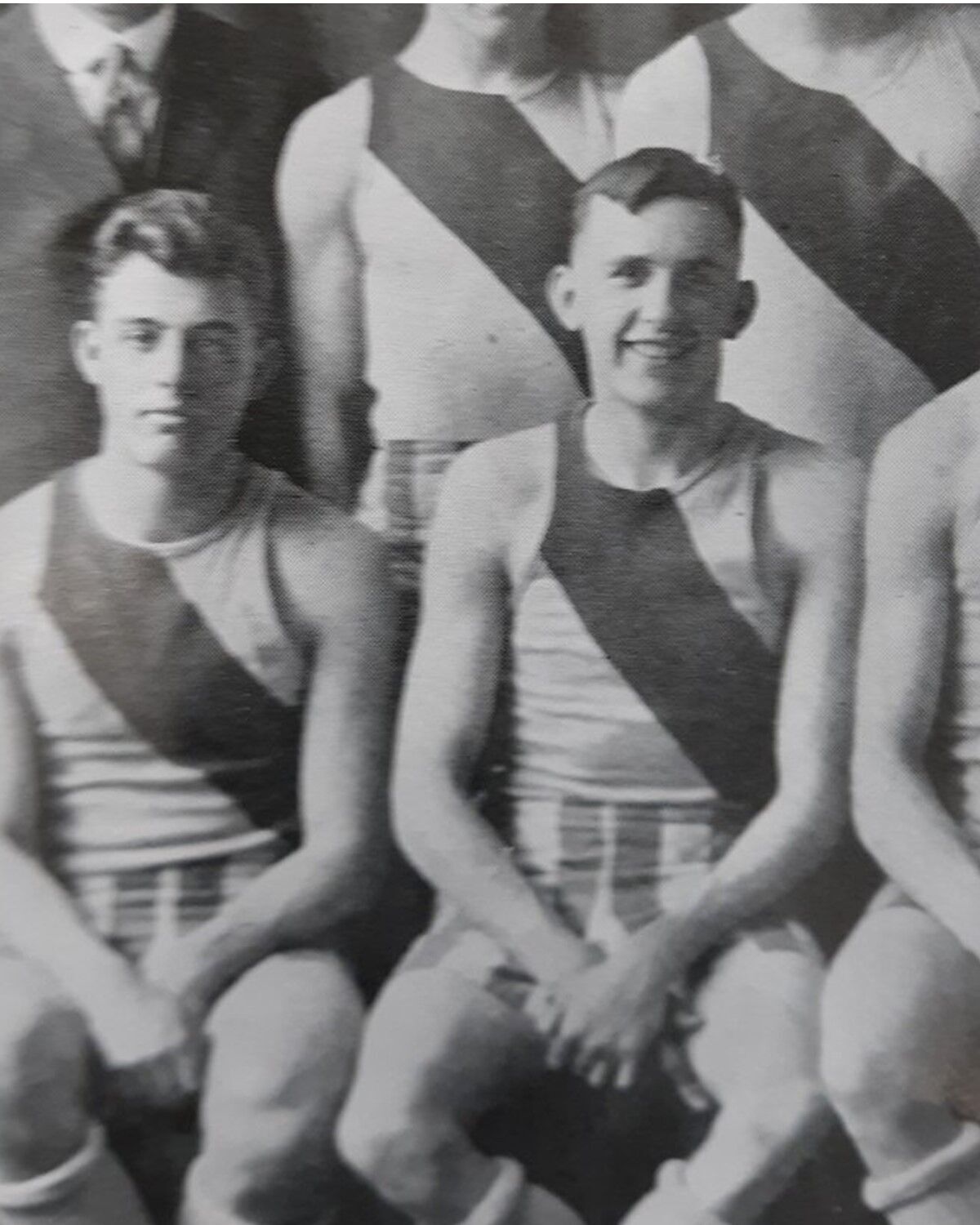
Joe Bruce, depicted at age 16 or 17, as an athlete at Colorado Springs High School. Bruce and friend Lester Atkinson, both from Colorado Springs, pedaled bikes across the country in 1916.
Courtesy photos


Joe Bruce, depicted at age 16 or 17, as an athlete at Colorado Springs High School. Bruce and friend Lester Atkinson, both from Colorado Springs, pedaled bikes across the country in 1916.
He figured out the boys, 20-year-old Lester Atkinson and 16-old Joe Bruce, had remarkably pedaled back to the Springs. On Sept. 30, 1916, papers around Colorado reported the round trip spanning 4,284 miles over four months — an impressive clip for those days of heavy, clunky bikes and still-developing roadways.
The boys were said to average 100 miles a day on the saddle. In talking with rider and industry types, Greene seriously doubts that figure. What technology would they have used to track? he asks. And how accurate was it?
“I’m thinking that possibly (the mileage) wasn’t as accurate as they imagined it was,” Greene says.
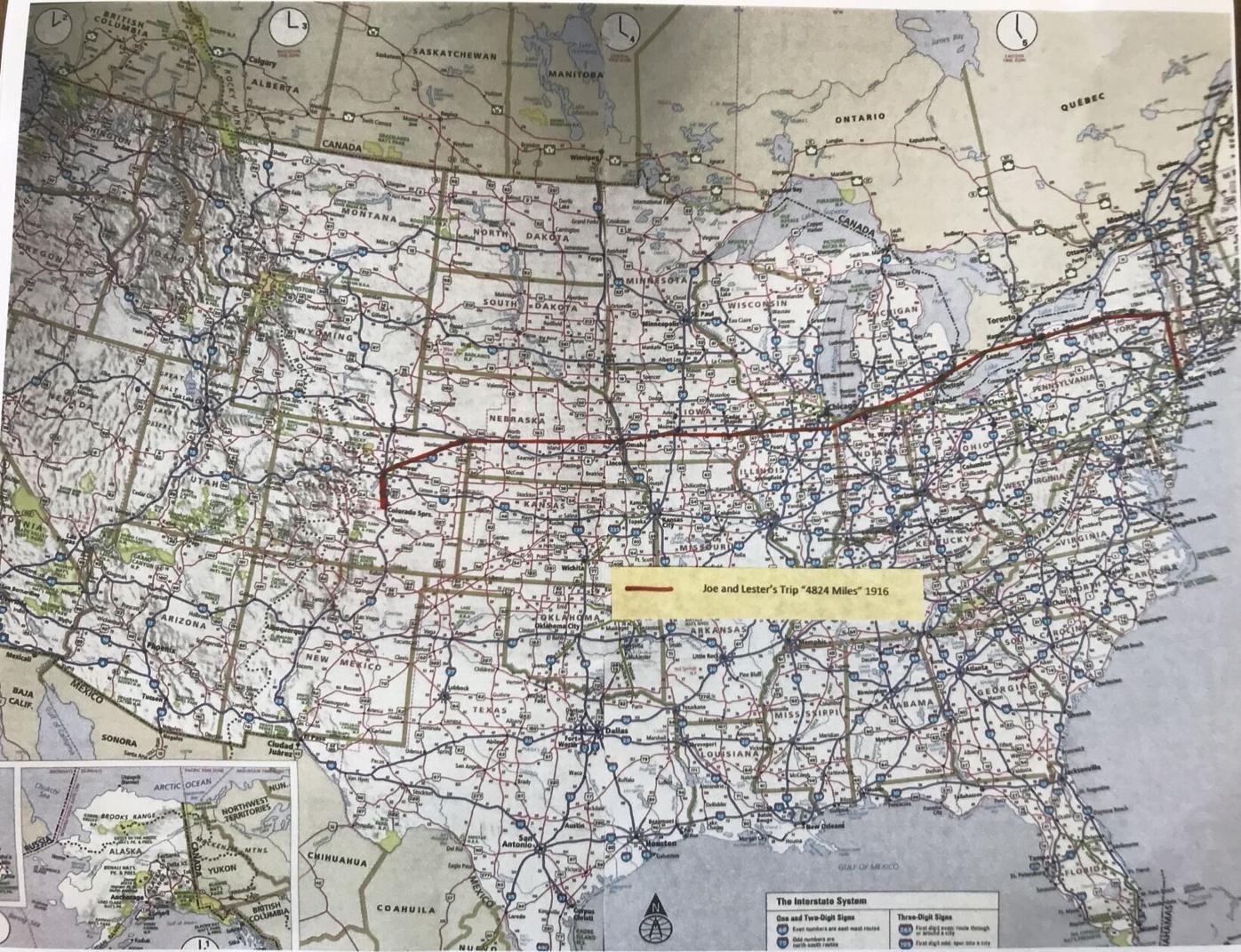
A map envisioning the 1916 bike ride across the country by Joe Bruce and Lester Atkinson from their home Colorado Springs to New York City. Courtesy photo


A map envisioning the 1916 bike ride across the country by Joe Bruce and Lester Atkinson from their home Colorado Springs to New York City. Courtesy photo
He used his imagination to pen his sixth novel, “4,284 Miles,” based on that very endeavor during that very time in America that equally fascinates him.
In 1916, the world was at war, women were marching for rights, freed slaves struggled to find their way, wheels of the Industrial Revolution continued to turn, and automobiles were on the verge of booming, connecting Americans to each other like never before.
“Labor was rising up,” adds the summary of Greene’s book. “Wall Street had begun an experiment called capitalism.” It was “the last days of innocence,” as the author sees it.
Greene says his first goal was to bring attention to the real-life protagonists. As far as he could tell, Lester and Joe died in obscurity, in 1972 and 1984, respectively. “I wanted to honor them, more than anything else,” Greene says.
“4,284 Miles” is as much a coming-of-age tale as it is a broader contemplation of the Land of the Free. In 1916, “America was on the edge of greatness,” also according to the summary. From the cycling boys’ fictionalized observations that hint at themes today, Greene clearly wonders if greatness was achieved. Lester’s and Joe’s destination of the Statue of Liberty serves as a convenient symbol.
“The failings of America vs. the ideals of America. I think that became the overriding theme,” Greene says.
He learned little about the true lives of Lester and Joe, beyond what he gleaned from Census data, sparse newspaper entries and old Colorado Springs High School yearbooks.
The story is told from the perspective of Joe, who carried the lofty nickname of “Pike” for the mountain above his emerging city. He was an all-state athlete considered scrawny “but consistent and scrappy” by his peers.
Greene got a rebellious image of Lester, from a notice of him being fined for riding his bike on downtown Colorado Springs sidewalks. Lester’s brother, Guy, was evidently adventurous; he once ran away to Salida and met his sudden, tragic end in Canada, where he drowned.
“4,284 Miles” begins with Guy’s body returning home, to be buried by his mother (known to have died in 1902). Reads Joe’s conscience, referencing the war’s shadow: “Aside from international events, I realized that day, life is just as unforgiving of those who seize it and lunge headfirst into peril as it is of those who stand at its sidelines clinging to safety.”
On their bikes, he and Lester lunge for the bluffs of Templeton Gap, “rife with rattlesnakes, coyotes and cougars.” They sail around the Springs’ dirt streets and other surrounding hills. They set a course for Denver — “past the Deaf and Blind school … cleared the Colorado College campus within minutes … tore through Roswell like a tornado, and shot past the dairy’s grazing lands like two bullets shot from a gun.”
In Denver, the boys scout the location of the Lincoln Highway — what Greene pictures as “little more than a muddy path across the nation.” That’s how Lester and Joe find it. Also, they find “Mr. Ford had indeed made good on his promise to build a million more Model Ts.”
Eventually, they rest in Detroit, the center for manufacturing. They eat lunch “while breathing acrid air of progress.” They see signs thanking the president for keeping the country out of war. They meet a young immigrant who is without fingers and partially deaf from his job. He reports seeing the boss now and then. “Fat. Bald. Smoking cigars. Rich. I’m still working for the same wage I worked five years ago.”
Greene lingers on the image of butterflies, tying their uncertain migrations to those of America’s new citizens. A hopeful scene plays out July 4: Lester and Joe observe a pianist in a lavender dress join a drummer boy, sparking a neighborhood band.
But discord mostly follows the cycling quest. Between strangers they meet along the way, there are moments of good as there are moments of greed, beauty as there is ruin, kindness as there is hate.
In New York City, Joe decides he’d rather not tour around as he and Lester had done at previous stops. Lester agrees with his friend’s admission: “I’m ready to go home.”