The future of financing space development
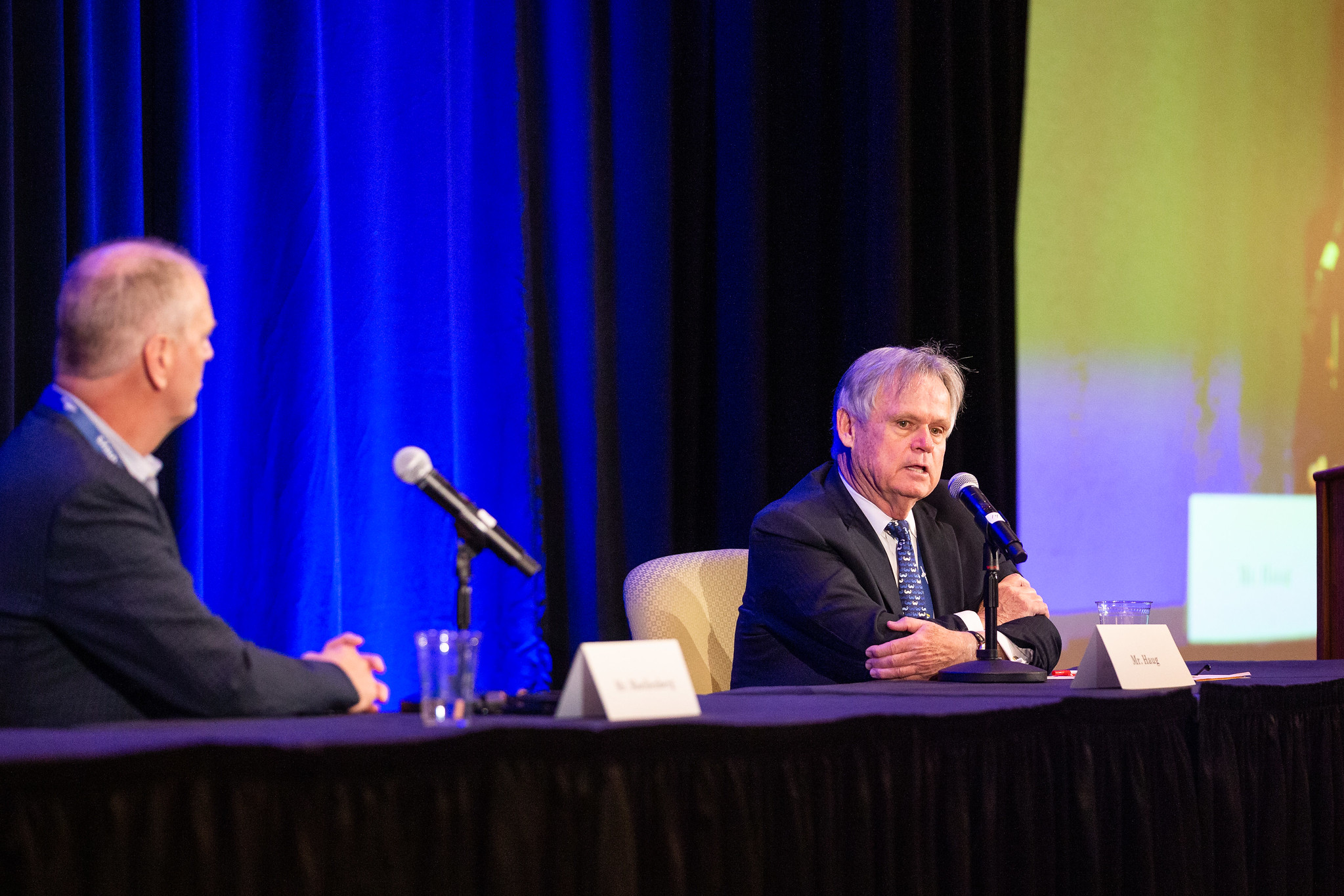
Once the Internal Revenue Service starts recognizing things like spaceports the way it does airports, docks and train stations, investment in the aerospace industry will really take off, according to two financing experts who spoke at the 37th Space Symposium in Colorado Springs last week.
Jon Moellenberg, Colorado-based managing director of RBC Capital Markets, and Howard Haug, executive vice president, treasurer and chief investment officer for Space Florida, gave advice for startups seeking funding and provided an outlook on the future of financing space-related projects.
“It’s really difficult to have a discussion about innovative finance, because there’s really no innovative financing. Everything has been done,” said Moellenberg. “So it’s really importing one idea from an industry at a certain stage to another industry that might be in a different stage.”
RBC secured $320 million in financing for the new U.S. Air Force Academy visitors center, which will be located near the academy’s north entrance and I-25 in Colorado Springs. The planned development also includes a hotel, office space, retail space and an entertainment component, he said.
“There are three components we start with. One is, does the facility serve a public purpose and does the Internal Revenue Service code recognize that purpose?” Moellenberg said. “If it does, we can enter into the tax exempt bond market, which allows large institutions to access your project.”
Space Florida, the state’s aerospace and spaceport development authority, has inked more than 100 deals since 2008 worth just under $3 billion, Haug said. It’s still actively involved in about 70 of those projects.
The for-profit public entity is a special district of the state, like an airport or seaport authority.
“Since I joined in 2008, we’ve gone from almost nothing to slightly under $3 billion,” he said.
And Space Florida has almost as much coming down the pipeline as its existing deals.
“This industry needs capital to attract more capital,” he said. “It needs discipline and smart money coming into the industry.”
Now that more commercial companies are involved, making it easier and more cost-effective to get into low Earth orbit, momentum should continue to build, Haug said.
Both Moellenberg and Haug advocated for legislation to amend IRS Code 142, which tax exempts a facility bond used for things like airports, facilities furnishing water, sewage facilities, mass community facilities and high-speed intercity rail facilities, according to the IRS.
Moellenberg used the Air Force Academy visitors center as an example of creative financing, saying the project leased the land from the federal government.
“(Section) 142 allows private entities to own businesses, generally on airport sites, where you’re actually running this business, but you can use taxes to finance the facilities,” Moellenberg said.
Spaceports can be built the same way, he said.
“There are all sorts of creative things that we can do to get into this big market,” Moellenberg said.
“There’s no space model. … We’re still frantically working to make sure we define it as best as possible to this emerging industry,” Haug said. “Space seems to be sort of part maritime models and actions we’ve seen with airports. We’ve had an effort underway for two to three years to get the IRS to work towards adding a spaceport to the definition under 142, which would allow entities like us, and any space venture, to benefit.”
He likened it to financing a cellular phone system.
“You financed the phone company. Now we want to be able to finance that satellite system as infrastructure,” Haug said. “If this industry continues to do things that brings value terrestrially to mass markets, whether it’s enhancement or whether it’s processing better data, who knows what’s even further down the line.”