As tempests swirl, the Bard has his day in Denver | John Moore

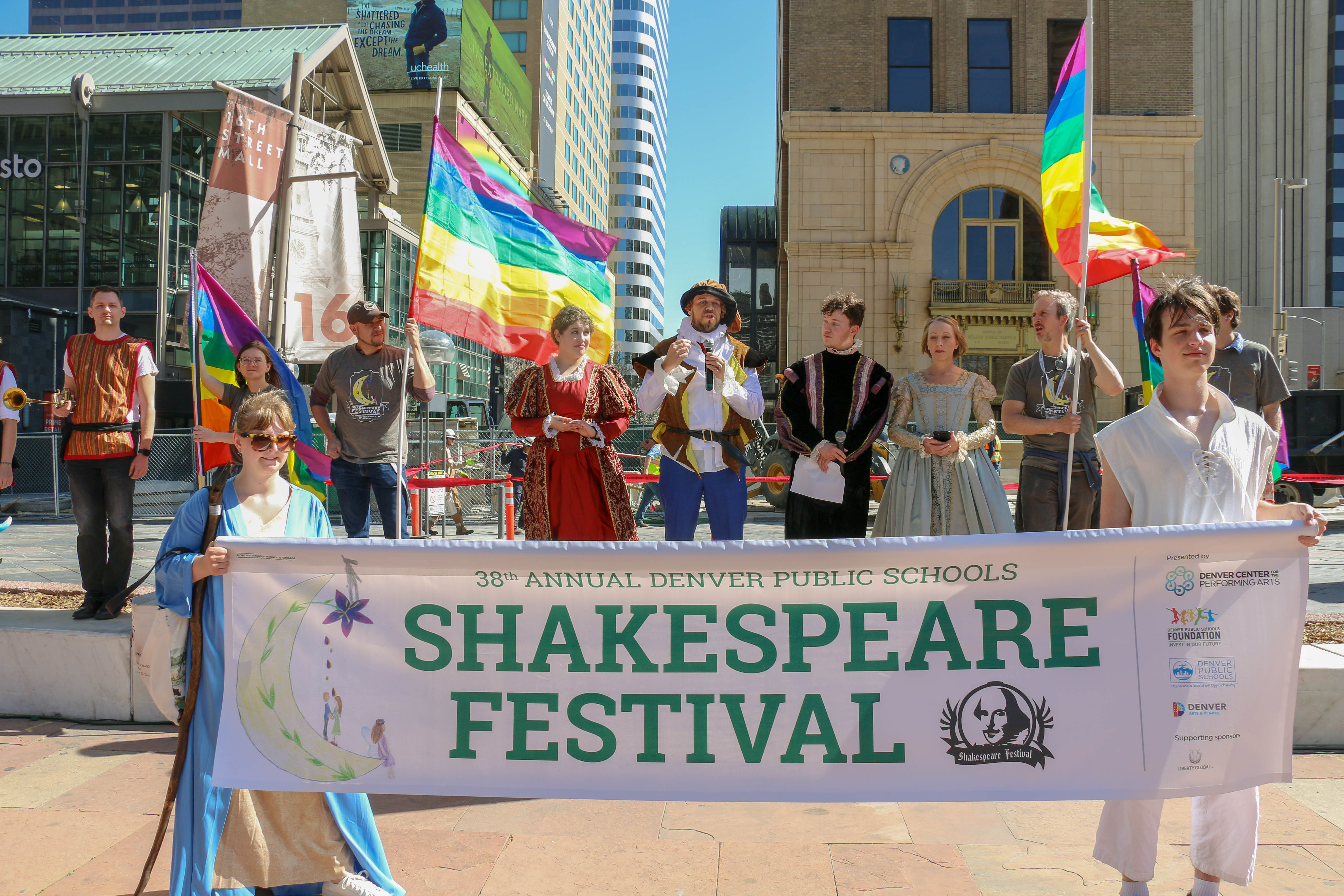
The meaning was not lost on Denver North High School drama teacher Megen Gilman when she saw that the flagbearers leading the 38th annual Denver Public Schools Shakespeare Festival parade on Friday were waving rainbow flags, which symbolize love and respect for the full spectrum of human sexuality and gender.
Even if it wasn’t entirely intentional.
Just last weekend, Gilman said, the North High choir was subjected to an anti-gay slur shouted by a band member from a rival school while they were walking to the stage accept a championship award. To go straight from that bile to joining up her Black Masque Theatre Company with 4,000 fellow students from 45 schools across Denver to perform Shakespeare in joyful community was, to her, as cleansing as the day’s eventual 50 mph winds.
“Coming here today, those Pride flags mean everything,” Gilman said. “For me, it means we are standing up for other places where students don’t have the freedom to be who they are in their schools.”
This is a strange time in America. And a strange time in public education. And, frankly, a strange time to be celebrating Shakespeare, whose eternal place as the greatest playwright in the history of the English language is fixed at the same time he is increasingly being seen as a leading symbol of historic white patriarchy. Many have called for schools to de-emphasize Shakespeare to make some room in the literary curriculum for more great but overlooked writers of color. This at the same time that competing special interests are starting to force extreme, agenda-driven curricula on school districts throughout America.
Florida, for example, has newly banned teachers from holding classroom instruction about sexual orientation or gender identity. Texas just passed a law saying parents can be investigated for child abuse if they provide certain medical treatments to their transgender children. (And in Texas, teachers are considered legally responsible for reporting suspected child abuse.) Meanwhile, 23 states have banned or are considering banning teaching any mention of America’s considerable racist past. And only 19 states actually require their teachers to teach the Holocaust.
I can’t even imagine the contradictory waters our teachers are being forced to navigate right now. Perhaps it’s a miracle that Shakespeare has so far endured. Not that he hasn’t come under renewed – and deserved – scrutiny as part of the seismic shift that began with the rise of the #MeToo movement in 2017 and the subsequent police murder of George Floyd. His blatantly anti-Semitic “The Merchant of Venice” has been all but canceled. Boulder’s Local Theater Company is developing a new play calling for a reconsideration of whether murderous Lady Macbeth has really deserved all the bad press she’s gotten for the past 400 years.
(Story continues after the photo gallery.)
But Friday, at least, was fully the Bard’s day in Denver, home of the largest student Shakespeare festival in the world. An estimated 4,000 Denver Public Schools students from kindergarten through high school took to downtown streets dressed as witches, ghosts, fairies and mustachioed swordspersons before performing around 500 short scenes, dances, soliloquies, songs and sonnets on 12 stages throughout the Denver Performing Arts Complex.
It was, by all accounts, a celebration of language itself. Students spend months learning lines and – importantly – the meaning of those lines, while also developing their costumes, props and makeup. That allows pupils of every grade to sharpen their critical thinking skills while exploring the Bard’s language and his stories in an unintimidating way.

And that’s what makes the long love affair between Shakespeare and Denver Public Schools both so unique and unlikely. Of DPS’ 92,000 students, 80 percent are non-White, with 50 percent classified as economically disadvantaged. Thirty-four percent are learning English as a second language.
What do those students get out of Shakespeare?

“They get a foundational experience,” said Denver Public Schools Superintendent Alex Marrero, himself the child of a Cuban refugee and an immigrant from the Dominican Republic.
“Shakespeare is a challenge of language, and we are fully embracing that challenge here at this festival,” Marrero said. If you can anchor the hard work and creativity of young people around something classical that has proven to turn students into scholars, he continued, then why not take advantage of it?

Two of those scholars are seniors Ben Feldman of Denver School of the Arts and Josie Kavet of Denver Montessori School, whose winning essays earned them the honor of playing the roles of Shakespeare and Queen Elizabeth in ceremonies to open the festival. Kavet has been performing at the festival every year since she was in the fourth grade. She said the ongoing annual exercise has complemented every aspect of her education. Shakespeare, she believes, “is a way for us to express ourselves and see that humanity transcends time.”
Friday was a full-circle moment for Feldman, who first performed at the fest as a third-grader at William Roberts Elementary School. “My parents tell me that when I saw the kid who was playing Shakespeare that year, I pointed and said, ‘I am going to be him someday,’ ” he said.

Shakespeare survives, and even thrives, “because of the timeless universality of his stories,” said Denver Center Head of Acting Tim McCracken, who also found particular meaning in those rainbow flags. He was waving one of them himself at the front of the parade. “These flags represent the opportunity that is made possible on any sort of journey that you might take,” McCracken said. “And that journey is supported by these incredible Shakespeare stories and characters – and told with language that blows my mind every single time.”
Beau Augustin, a DPS Instructional Curriculum Specialist, wishes the festival could take intentional credit for the meaning some happily took from this year’s flag choice. It wasn’t that deliberate. But he did say the color scheme is a confirmation of the district’s ongoing commitment to diversity and inclusion.
“The colors in the Pride flag are a timeless message of inclusivity, and Shakespeare’s messages are timeless as well,” he said. “The Shakespeare Festival is for everybody.”
Even if, historically speaking, Shakespeare has not been for everybody. Not even close. And that just makes the connection Gilman’s North High students feel to the material in 2022 all the more remarkable.
“He just really captures the human experience for my students,” she said. And those students have particularly embraced the gender-bending spirit of Shakespeare’s original acting company.
“In our classroom, we don’t ever look at anything in terms of gender restriction,” Gilman said. “We encourage the kids to just have fun with it and let them play.”
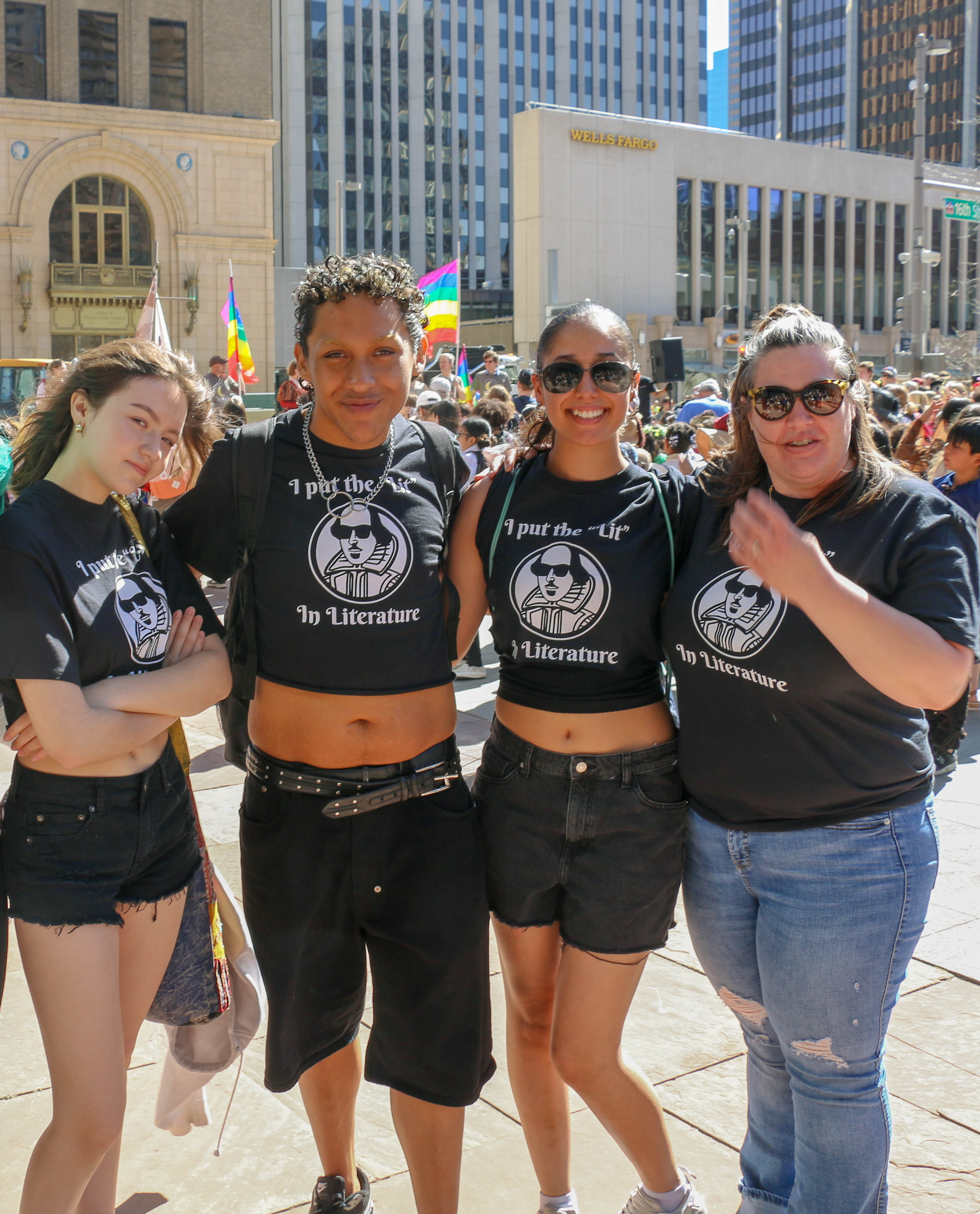
And that has been a life-changing and life-affirming thing for bilingual North High drama student Cebastian Gomez.
“I think history tends to repeat itself, so we can take a lot of meaning from Shakespeare and his way of writing in terms of what is going on in the world today,” he said. “And when you look at Shakespeare in a certain way, his language is expressive and loving and also very queer. We try to amplify that within our performances by gender-swapping and adding a modern take to his stories.”
If that freaks anyone out, then the irony would not be lost on Gomez, considering that, for decades, men were, for the most part, the only actors allowed to perform Shakespeare’s plays.
“I think some people might be intimidated by gender fluidity,” Gomez said, “but we think if you mix it up, you shift the lens and create a different narrative that is more open when it comes to sexuality and gender expression.”
What Gomez gets out of performing Shakespeare, he said, is simple.
“It’s freedom.”
Now, please don’t tell Florida. Or Texas. Or …