







Colorado River strain casts shadow over recreation
GUNNISON • On Colorado’s largest body of water, the water he’s known all his life, Eric Loken drives his boat toward an uncertain destination.
He drives between the sage hills folding around Blue Mesa Reservoir, between the ancient, volcanic cliffs and toward the high peaks that he and everyone else in this valley look to for snow that translates to water. Lately, they’ve looked on longingly. Loken drives not knowing how far the lake will last.


Erik Loken has been helping his father run the family businesses on Blue Mesa since he was a child. After a decade of running operations, he decided to let his brother take over for the summer while he enjoyed other things. “Enjoy the lake while I can,” he says. (Parker Seibold / The Gazette)
“I’m not sure how far up it goes when it’s this low,” he says.
On this morning in early summer, Blue Mesa is about 60 feet lower than normal. It’s not 50% full. There are stark images that people have come to expect on the drive along U.S. 50 in this western part of the state plagued by drought and meager snowpack: barren hillsides where the water is supposed to rise, barren ground where the reservoir built to be mighty recedes to a trickle.


An image of Bill Sunderlin’s family resort along the Gunnison River near Iola before the valley was flooded in the 1960s to create the Blue Mesa Reservoir. In recent years, the farming town has been exposed due to low water levels, similar to the relics of the past unearthed downstream at bigger reservoirs: bones at Lake Mead, cliff dwellings at Lake Powell. Photo courtesy of Bill Sundelin.(Christian Murdock/The Gazette)
In recent years, the farming town that thrived here before the dam and flood has even been exposed — Iola’s old foundations and fence lines. These are more relics of the past, more skeletons unearthed like others downstream at bigger reservoirs: Bones at Lake Mead, cliff dwellings at Lake Powell. They are ominous symbols from an unprecedented era, emerging in the wake of the first declared shortage in the Colorado River Basin. It’s said to be the region’s driest time in 1,200 years.
Behind the wheel under a big, sunny sky, Loken does not give in to gloom. He says things have been worse, like last summer.
In an attempt to shore up Powell and keep power-generating turbines turning, regulators pulled about 36,000 acre-feet from Blue Mesa, causing the closure of the marinas that Loken’s family have made a living from since the 1980s. That was part of an emergency response that included other drawdowns at Wyoming’s Flaming Gorge Reservoir and Navajo Reservoir in southwest Colorado.
“We’ve operated lower than this plenty of times,” Loken says. “It’s just the looming possibility of (another) draw-down that’s got people spooked.”


Elk Creek Marina on Blue Mesa Reservoir sits empty early in June. For the second season in a row, the government has ordered the marina to be closed due potential pulls from the reservoir to that would help maintain water levels at Lake Powell.
The possibility meant Elk Creek Marina not opening this season, as ordered by the government.
“Friends gather here,” reads the sign above the marina restaurant’s door. Now they do not, the building dark and cobwebbed. The deck overlooks empty slips where boats would otherwise be docked, boats belonging to longtime customers, anglers and kin whose traditions have been lost.
The Lokens were still able to open their smaller Lake Fork Marina, typically representing about 20% of their business. Typically, they hire about 30 employees. But none of them are back for the season as the family cuts costs.
“Devastating,” says Eric’s brother, Lance.


From left, Lance Loken, Amy Riser, Jim Loken and Erik Loken pose for a portrait in front of the Lake Fork Marina on Blue Mesa near Gunnison, Colo. The family has run two marinas on the lake since the 1980s. When they learned they’d only be able to open the smaller marina for the summer they thought about not opening at all. “The fear was, if we did that, what concessionaire is gonna come after us?” Lance Loken said. (Parker Seibold / The Gazette)
In Colorado, Blue Mesa represents the broader water plight across the West. While the stakes are high, ranging from impacts to agriculture, to electricity, to taps in homes, an essential way of outdoor life is also threatened, along with its associated, critical economies.
An Arizona State University study found the Colorado River supports 16 million jobs and annually totals $1.4 trillion in economic activity across Colorado, California, Arizona, Nevada, Utah, New Mexico and Wyoming. As that study’s lead author put it: “The Colorado River is the lifeblood of the entire region.”
It’s the lifeblood for the 9,180-acre reservoir that came to be a sporting mecca after construction in the 1960s. Jim Loken came to the Blue Mesa in 1981, an entrepreneur who would build the marinas with his and his young boys’ bare hands.
There’s been tough times, says the man called back to work at age 77. But none like this.


Jim Loken checks the gas levels in the tanks at Lake Fork Marina in early June. Loken came to Blue Mesa in 1981, and entrepreneur who would build the marinas, now threatened by low water levels, with his and his young boys’ bare hands. (Parker Seibold / The Gazette)
“They’re predicting drought for so many years,” he says. “How often are they gonna have to drain this down?”
Last year’s release was characterized as a short-term idea, and one that observers viewed as yielding little to no improvement for Powell.
“Not a long-term fix by any means,” says John Berggren, the Boulder-based water policy analyst with Western Resources Advocates. “You can’t expect to draw down Blue Mesa this much every year, because the water just physically won’t be there.
“But if Lake Powell is still flirting with these low levels, are the feds gonna just continue to drain Blue Mesa as a last resort? I don’t know. That could be.”
For outdoor-loving people and industries that depend on the Colorado River in its namesake, originating state, the uncertainties go well beyond the reservoir.
Staying afloat
In large part for the world-class whitewater rafting, Nik White moved to Colorado in 2011. “About a million people ago,” he says.
He says it as a joke, but the figure is close to accurate by Census counts. And that’s the kind of growth that underscores his worry about the future of his passion. It’s the kind of growth seen around the Southwest that comes with increased demand for drinking water, power and irrigation — complicating the picture for rollicking flows that White and his fellow boaters love.
White represents Colorado Whitewater, among organizations adding their muscle to the tug-of-war along the Colorado River. In the yearslong effort to be heard by decision makers and rights holders, such organizations have pointed to the monetary vitality of their sport.
In the best years, commercial rafting generates an economic impact close to $190 million statewide, according to Colorado River Outfitters Association. Starting high in Rocky Mountain National Park and stretching down through the Utah border past Fruita, commercial trips along this state’s portion of the Colorado were more than 100,000 in 2019, before outfitters’ pandemic-related limits in 2020. That’s not counting thousands more on other, go-to tributaries of the Colorado.
The industry’s report from 2021 has yet to be finalized. But the year has been called record-breaking, with more trips than ever tallied all around the state’s waterways — a total close to 625,000.
The demand begs the question: Will flows be around to supply in coming years?


For the headwaters fueled by high-elevation snowpack, there’s optimism in Colorado that doesn’t prevail in some parts of lower basin states. The hope, as ever, is that runoff provides.
But a study recently published in the journal Earth and Space Science suggests bleak decades to come.
By 2080, researchers predict Colorado will lose half of its historical snow, as climate change bears down and dries out the region similar to Arizona and Nevada. The study also lays out changes to the timing of runoff, earlier in spring.
“On the Colorado, I worry about more seasons like last season,” White says, “where late in the season, the flows decrease to the point where it’s not really raftable. That might not be every year, but there certainly will be more years where that happens.”
That happened at the start of this summer: Heat sent below-average snow in the mountains rushing down early, leaving onlookers to wonder if monsoons would deliver to extend flows later — increasingly less dependable amid this 20-year megadrought.
The late-season scene this year could be similar at Pumphouse Recreation Site, for example. Along the Colorado River near Kremmling, it’s a popular launch point and “usually a great, late-season run,” White says. “But last year, it was so low that people weren’t able to get rafts on it, or if they were, they were bumping on rocks the whole time.”


The Colorado River runs through Gore Canyon just north of Pumphouse Recreation Site.
Pumphouse is but one icon along the river steeped in legend. Since John Wesley Powell’s storied passage through the Grand Canyon in 1869, close to 30,000 people a year attempt that bucket-list route. With all-time low water at Glen Canyon Dam, regulars have seen changes there. As they have in beloved, vaunted stretches around Colorado, from Gore, to Glenwood to Westwater canyons.
“You’re on that river, and you just think, this is Colorado,” says David Costlow, executive director of Colorado River Outfitters Association.
While sitting on a collaborative committee for the better part of 15 years, Costlow has aimed to preserve that.
The Upper Colorado River Wild and Scenic Stakeholder Group formed in 2007 to contemplate a plan that would make happy both fans and foes of a proposed conservation distinction for the river between Gore and Glenwood canyons. Recreation enthusiasts, water providers, municipalities and farmers, all together including more than 100 voices, took more than a decade to get on the same page. In 2020, federal land managers approved their concept.
On the recreation side, the plan outlines flows to be maintained for boats and fish based on certain times and conditions. It calls for strategic “flushes” to benefit both thrill-seeking people and habitat, surges that would essentially clean spots where detrimental sediment builds. The plan outlines, too, steps to study and measure those flows.
The plan “has been a success on a lot of fronts,” said Evan Stafford, one of the early committee members representing advocacy group American Whitewater. “It’s also been a struggle.”
Two years after the plan’s approval, “there’s been a lot of phone calls,” Stafford said. “A lot of kind of appealing to the group in terms of, there’s supposed to be an agreement here, but it’s not being followed.”
With more people and more needs, it speaks to the larger battle for water, White says. “Whether that (plan) continues as the river gets lower and there are more calls on the water, that remains to be seen.”
Trouble for trout
Just as the rafting industry has had to adjust — picking and choosing sections of rivers in less-than-ideal conditions — so too have fishing guides.
“You’re seeing outfitters that are forced to start their days earlier and end them earlier,” says Scott Willoughby, the Trout Unlimited organizer living by the Colorado River tributary in Eagle. “You can’t fish past noon, because the water temperatures are starting to heat up.”
That’s a trend that figures to worsen, according to analysis by Dan Isaak, a fish biologist with the Rocky Mountain Research Station. His data on warming show fish will have to adapt in the West, as will those outfitters.
“For some, it’ll make a difference between being an economically viable business or not,” Isaak says. “If your trips are half days, you’re presumably being paid half as much.”
If they’re able to fish at all.
On more than a dozen occasions last year, Colorado Parks and Wildlife asked anglers to stay off streams deemed too warm and/or too low. Those were voluntary orders, while one was mandatory along a branch of the Colorado, the Yampa River. CPW ordered a closure there again in June, citing flows that were 20% of average. A death toll continues to be counted there, as in elsewhere.
Temperatures rise as waters shrink, and that can be fatal to the state’s cherished cold-blooded trout that swim through 322 river miles with Gold Medal ratings for anglers. The Upper Colorado accounts for 40 miles — one destination increasingly sought.
Nearly 886,000 state fishing licenses were reported last year, slightly more than the three-year average marked by CPW. A 2018 report compiled for the agency suggests the sport contributes a whopping $2.4 billion in economic output annually while also supporting more than 17,000 jobs around the state.
The popularity signals competition. And from Isaak’s view, that competition could heat up with the fisheries themselves.
From his base in Idaho, Isaak has committed his career to compiling a massive database tracking temperatures of the West’s rivers and streams. For the past 40 years, data show their temperatures rising by 0.4 degrees on average.
Using climate models, Isaak has come up with forecasts as well — still seemingly subtle, but enough to alter the next generation of fish and anglers, he says.
At the current rate of warming, he says, increases will be closer to 1.8 degrees by 2050, and 5.5 degrees by the end of the century. That kind of compounding change could mean the difference between fairly comfortable water for rainbow and brown trout (say 60 degrees) and water that strains (above 67 degrees). Eventually, according to Isaak’s research, it could spell as much as a 31% loss of habitat in the West.
The trend is consistent on thermal maps: the lower the elevation, the higher the temperatures. Higher temperatures, for example, on the stretch of the Colorado River through Grand Junction on its way out of the state.
Isaak’s assumption: Fish will gradually migrate higher.
“So it’s going to determine, to a large degree, where the best places are going to be to fish,” he says. “Places you might never dream to fish, because it’s so far out that you’d never consider it to be trout habitat.”
While those alterations develop over time, this age of bigger, hotter fires is creating fast, dire changes for habitat.
Trout mortality continues to be tracked through Glenwood Canyon as mudslides continue to threaten after the 2019 Grizzly Creek fire. The next year brought some of the largest blazes in state history, one being the Cameron Peak fire. It burned across the La Poudre River, where biologists recently relayed fears of “complete loss” in some sections.
All tragic warnings for fisheries anywhere in Colorado, Willoughby says. And then there’s the marina closures at Blue Mesa the past couple of seasons — “a major hit to fishing,” he says, and “just a small reflection of the large problem” downstream at Powell and Mead.
“It’s a reckoning right now,” Willoughby says.
Adapting to changes
Nearing the end of his 20s, Dylan Weihnacht identified work that would be more sustainable in the long term — specialized, higher paying — and allow him to stay close to the place he loved. Or so he thought.
The Lokens helped put him through a Florida training school for a year so he could come back and be their boat mechanic on the Blue Mesa.
“You can imagine,” Weihnacht says. “Moving halfway across the country to go to school so you could come back and work at a lake, and then find out that lake doesn’t even necessarily exist anymore.”
Now he’s working at a small engine shop in Gunnison. The job on the water still interests him. But it worries him, too.
“I would love if things turned around and I had some kind of assurance that I could make a future here,” he says. “But that’s just life. Nobody has assurances.”


Jim Loken stands on the deck at Lake Fork Marina in early June.
Not the Lokens. The family creation that has given for three generations now seems to be taking.
When they learned they’d only be able to open the smaller marina for the summer, they thought about not opening at all. They thought about nixing their contract with the National Park Service.
“The fear was, if we did that, what concessionaire is gonna come after us?” Lance Loken says. “It wouldn’t have just been one year, I think it would’ve been a number of years there’d be no marinas on the lake. That would’ve been heartbreaking.”
As it would be, he says, if this is the new normal.
“We all just have to make the adjustments that have to be made,” he says. “And not just here, but all around the country where they’re dealing with this low water.”
For this summer, Eric decided he’d let his brother stress over that. After a decade running operations, he’d enjoy other things. “Enjoy the lake while I can,” he says.
He’s enjoying it now on this ride out. He reaches a familiar place, a place that intrigued him as a kid.
It’s a bizarre cove. Trees protrude from the water, dead but still standing from the town that used to be somewhere below.
There’s another tree that always catches Eric’s eye. It stands elsewhere, higher on a ridge.
“One tree by itself, and all the branches are pointed this way, blowing like that,” he says. “It’s such an inspirational thing to see. Standing alone against the wind.”

Denver weather: Sunny and warm Wednesday ahead of Friday snow
Daniel Boniface
dan.boniface@denvergazette.com
Updated 31 minutes ago
Sunny skies and warm temperatures are on tap for Denver on Wednesday, but snow is on the way, meteorologists said. The National Weather Service in Boulder said to expect a high temperature of 63 degrees in Denver on Wednesday. That’s...

Daniel Boniface
Reporter

CSU basketball wins surprise WAC title after ‘Lean on Me’ viewing | March 4, 1989 | Colorado’s Top 150 Sports Moments
Paul Klee
paul.klee@gazette.com
Updated 16 hours ago
Happy birthday, Colorado — and Colorado sports. Leading into the state’s 150th birthday Aug. 1, The Denver Gazette has partnered with the Colorado Sports Hall of Fame to publicize the definitive list of Colorado’s top 150 sports moments. Colorado Sports Hall...

Paul Klee
Reporter
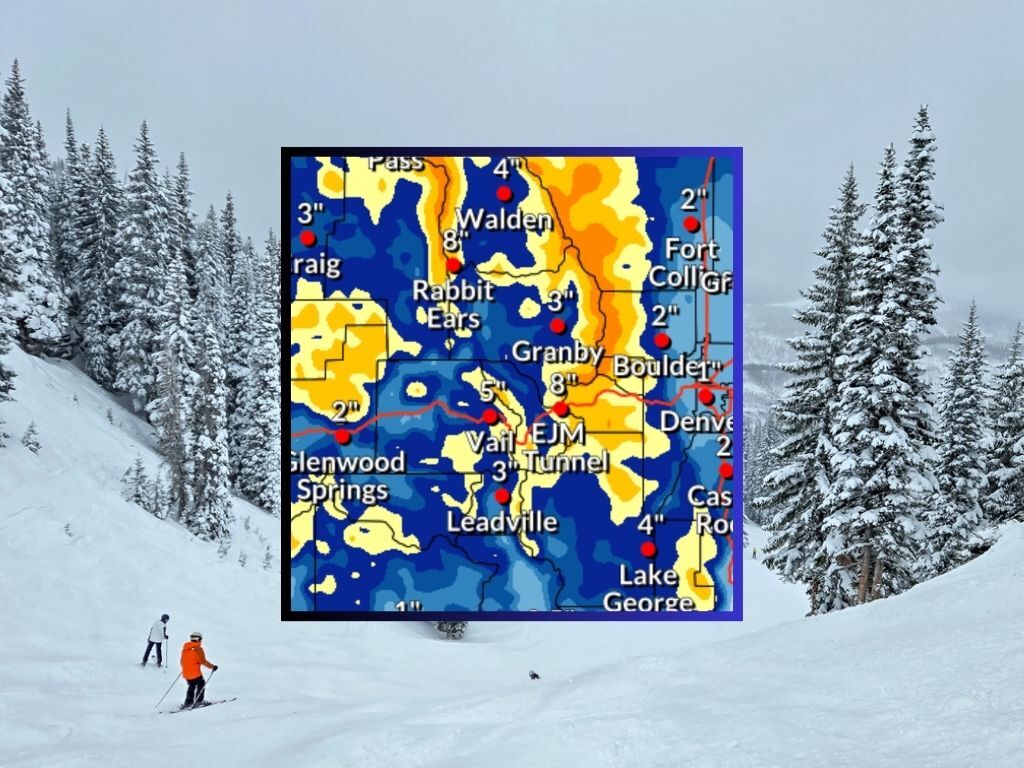
Double-digit snowfall totals likely on some Colorado peaks before weekend hits
Spencer McKee
spencer@outtherecolorado.com
Updated 1 hour ago
Weekend warriors, rejoice! It’s looking like many Colorado ski areas could get a nice refresh by the time the weekend hits. Mapping from the National Weather Service shows that in the most likely scenario, a winter storm will bring about...

Spencer McKee
Reporter

EDIT0RIAL: Downgrading murder is justice deformed
The Gazette Editorial Board
thegazette-editorial-board@gazette.com
Updated 11 hours ago
It might sound like an overstatement to say Colorado’s offender-friendly legislature is hellbent on decriminalizing crime itself. But, really, what else could you make of House Bill 26-1281, introduced just the other day at the state Capitol? Get ready to...

The Gazette Editorial Board
Reporter
Colorado hot springs celebrates ‘first-of-its-kind’ expansion
Seth Boster
seth-boster@denvergazette.com
Updated 2 hours ago
A hot springs destination in Colorado has marked a “major” expansion. And it’s not exactly the expansion you’d expect at a soaking retreat. In Glenwood Springs, Iron Mountain Hot Springs is calling its newly opened Sauna Summit “the country’s most...
Seth Boster
Reporter

Denver area events for March 4
Carlotta Olson
carlotta.olson@gazette.com
Updated 19 hours ago
If you have an event taking place in the Denver area, email information to carlotta.olson@gazette.com at least two weeks in advance. All events are listed in the calendar on space availability. Wednesday Capstan – Cultural Divide 10 Year Anniversary Tour — 6...

Carlotta Olson
Reporter

Avalanche looking for more goals from Nichushkin as Lehkonen exits lineup with injury
Evan Rawal
evan.rawal@gazette.com
Updated 9 hours ago
ANAHEIM – With one top six forward exiting the lineup, the Avalanche will look for more offense from another. Prior to Tuesday’s 5-1 win over the Anaheim Ducks, the Avalanche announced that winger Artturi Lehkonen is considered week-to-week with the...

Evan Rawal
Reporter
As rates dip below 6%, Denver agents see market come alive with multiple offers
Mark Samuelson
mark.samuelson@denvergazette.com
Updated 54 minutes ago
When Mile Hi Modern agent Brandy Pfalmer’s clients put in an offer on a $1.025 million home in Denver’s Park Hill neighborhood last week, her clients added an extra $75,000 to sweeten the deal. But that wasn’t enough. Ultimately, Pfalmer’s buyers...

Mark Samuelson
Reporter

Milahnie Perry’s final shot at home sets Air Force women’s all-time scoring record
Brent Briggeman
brent.briggeman@gazette.com
Updated 11 hours ago
Milahnie Perry’s last game in Clune Arena will live on in the Air Force record book. No. 2 is No. 1. Honored before the game as part of Senior Night, Perry then scored 26 points – she needed 24 –...

Brent Briggeman
Reporter
Kristi Noem defends her portrayal of killed Minneapolis protesters as agitators, in her Senate hearing
The Associated Press
the-associated-press@denvergazette.com
Updated 1 hour ago
WASHINGTON • Homeland Security Secretary Kristi Noem defended her department’s immigration enforcement tactics in front of a Senate committee on Tuesday and pushed back against criticism from Democrats who say she wrongly disparaged two protesters killed by federal officers in Minneapolis earlier this year....

The Associated Press
Reporter