







Colorado man’s garden with a ‘bit of wildness’ is haven for bees, positivity
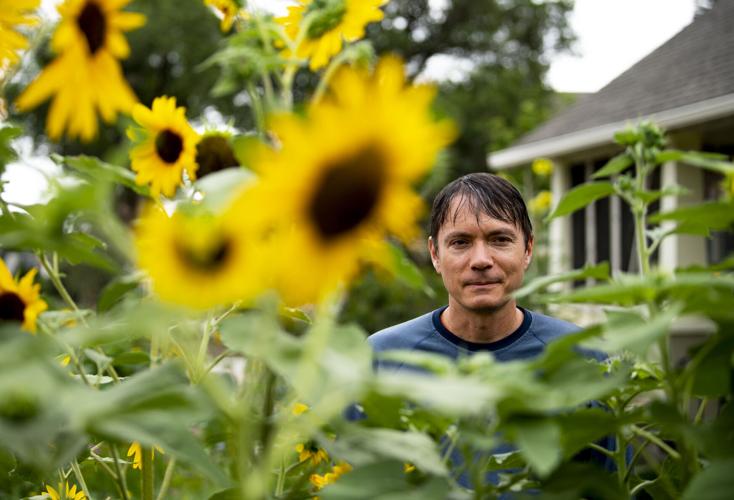
Three years ago, Tommy Schell cut down the front trees in his yard to make way for what could be call a haven for bees. He started planting an array of native and bee-friendly flowers that now make his yard stand out from any other on his block.
photos by Parker Seibold, The Gazette

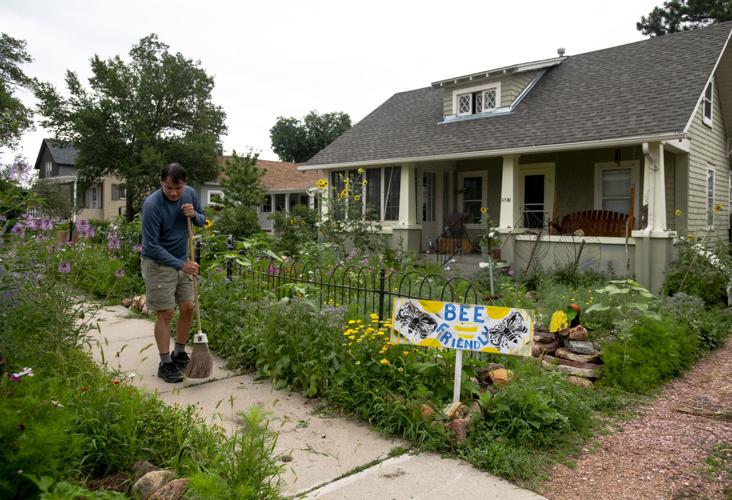
It’s not the fanciest or flashiest front yard.
Feedback from those who pass by the downtown Colorado Springs house, via foot or bike or scooter, would suggest otherwise.
“A lot of people comment on it, and it’s unanimously positive that people like it,” said Tommy Schell, who bought the little house on Cascade Avenue in 2013. “It surprises me. I’m like, ‘Are you talking about my yard?’”
The garden, a beautifully messy collection of sunflowers, wildflowers and plants mostly native to Colorado, is meant to attract more than positive words.
Schell started gardening several years ago after some friends gifted him some irises. It was a new challenge and an excuse to get outside for the computer programmer and Texas native who moved to Colorado Springs in 2004.


TOP LEFT: Tommy Schell poses on his front porch for a recent portrait.
“I’ve made a lot of mistakes with gardening,” he said. “I wanted to have that experience of trying to learn it on my own.”
Soon, another goal grew out of the experience.
Schell, 52, wanted his garden to attract bees and other insects in search of safe habitat spaces. He researched bees and their need for “food, water, shelter and space to support robust populations,” as stated in a fact sheet about pollinating on Colorado State University’s website.
Prolific Colorado Springs runner notches record on state's highest peak
“Home gardens, parks, community gardens, prairies and meadows can all provide pollen and nectar,” the fact sheet continues. “These habitats can be refuges for pollinators foraging through lawns and farmlands that may not have the floral resources they need.”
Schell isn’t a beekeeper, but he is a keeper of knowledge about and appreciation for bees, of which 956 species are native to Colorado.
“I do it mainly to help the little critters,” he said. “I thought it would help draw attention and help people be more conscientious of more environmental stewards.”


TOP RIGHT: A bee sips pollen from Mexican bush sage, a favorite in the garden, according to Tommy Schell.
Within the last year, additions to Schell’s yard have made that more obvious.
Painted signs reading “Bee friendly” and “Bee Zone” were made by artsy friends who know Schell’s vision. Passersby comment on the signs, and it tends to start conversations about bees and their mighty environmental role, which comes in small packaging and, because of their stinging, with negative connotation. But Schell doesn’t see them as tiny terrors buzzing around with ill intentions.
He sees native bees, as the Colorado State University site puts it, as “the unsung heroes of the pollination world.”
“Of all the pollinators found in gardens, agricultural fields and natural areas, bees are the most common and efficient,” the site reads.
“I want to bring awareness to that,” Schell said. “It’s one way I can help the environmental situation. It’s a small thing I can do.”


Passersby can literally stop and smell the flowers as they pass Tommy Schells garden, which overflows with inviting scents and colors. (Parker Seibold / The Gazette)
His small thing has proven to have a bigger impact. Each day when he’s out front watering his plants, he sees how the garden seems to lift people’s spirits.
“It’s some kind of enchantment they weren’t expecting,” he said. “There’s a bit of wildness that they like about it.”
The gardening process, and talking to friends and strangers about it, brings a sense of enchantment to Schell, too.
“My goal is that when people walk by, they feel positive,” he said. “I hope they feel a little bit of magic.”
Changes to camping being rolled out at popular areas in Colorado


Sweet and spicy Korean fried chicken will fire you up
Gretchen McKay, Pittsburgh Post-Gazette
gretchen-mckay@gazette.com
Updated 6 hours ago
Bold, spicy flavors have never been more in demand, especially when they add a global element to a dish. One of my favorite foods these days is Korean fried chicken, which I ate twice on a recent trip to New York...


34th annual Wine Festival of Colorado Springs blends flavor with fundraising
April Borjon
april.borjon@gazette.com
Updated 6 hours ago
Sweet, bold or a little bitter, however you take your wine, Colorado Springs will be pouring it by the glassful next week. The 34th annual Wine Festival of Colorado Springs returns Wednesday and runs through March 7, bringing four days...

April Borjon
Reporter
Mercy! Faith film takes center stage at Red Rocks
John Moore
john.moore@denvergazette.com
Updated 1 day ago
Faith-based movies are enjoying a resurgence driven by higher production quality and box-office performance. One was just filmed at Red Rocks. At a time when you can’t say anything without saying something controversial, I’m just going to come out and...

John Moore
Reporter

New Arvada Center CEO is Zoo’s Noelle DeLage
The Denver Gazette
the-denver-gazette@denvergazette.com
Updated 1 day ago
The Arvada Center has named Noelle DeLage, chief communications and philanthropy officer of the Denver Zoo Conservation Alliance, as its next president & CEO. DeLage succeeds the retiring Philip Sneed effective July 1, just as the Arvada Center begins its...

The Denver Gazette
Reporter

Live Well: Fall back in love with your ticker this month
Jennifer Mulson
jennifer-mulson@denvergazette.com
Updated 3 days ago
Well, well, well, you thought you were going to get away without me mentioning your heart health this month, didn’t you? I don’t mean to be a downer, but the stats are sobering. According to the Centers for Disease Control...

Jennifer Mulson
Reporter

We’re looking for Denver’s best ice cream shop. Submit your nominations.
Daniel Boniface
dan.boniface@denvergazette.com
Updated 2 days ago
The mild winter has already got us thinking about ice cream. So, we’re on the hunt for Denver’s best ice cream shop. The Denver Gazette’s Ice Cream Shop Bracket is launching next week, pitting the best of the best against...

Daniel Boniface
Reporter
Colorado history told through poetry, spoken word by poets laureate
Linda Navarro
linda-navarro@denvergazette.com
Updated 1 week ago
Young poet and social justice activist Amanda Gorman, the first National Youth Poet Laureate, was just 22 when her “The Hill We Climb” launched the literary art back into a major worldwide spotlight with her 2021 Joe Biden inaugural poem....

Linda Navarro
Reporter

Little-known legend of Colorado Nick to be celebrated at Colorado Springs Pioneers Museum
Seth Boster
seth-boster@denvergazette.com
Updated 4 days ago
For years in Colorado Springs, Scott Boyer had been learning little by little about a tattoo artist in local lore who went by Colorado Nick. His real name was Leonard Newell Wisner, Boyer learned. And in learning this he learned...

Seth Boster
Reporter

Ancient biblical coins talk; here’s what they’re saying
Debbie Kelley
debbie-kelley@denvergazette.com
Updated 4 days ago
With the penny being ushered out of circulation early in the 21st century, theologians, historians, archaeologists and numismatists continue to glean insights from coins of the first century, when Jesus Christ walked the Earth and his followers promulgated the new...

Debbie Kelley
Reporter

Friends forever: Broadway superstars Denver-bound to sing praises of legends
John Moore
john.moore@denvergazette.com
Updated 5 days ago
Sutton Foster and Kelli O’Hara will honor Carol Burnett and Julie Andrews with tribute concert joined by Colorado Symphony I remember seeing Sutton Foster’s utterly charming breakout role as Millie Dillmount in the 2002 Broadway musical “Thoroughly Modern Millie” and...
John Moore
Reporter
PREV
PREVIOUS

At Home: Tech-infused Airbnb shows seniors how to age in place in style
I don’t know about you, but as far as aging goes, I have a plan. Plan A is I will not age. Plan B is, if I must age, I will go down swinging. Thus, I was encouraged to learn that new technology and forward-minded designer promise to make aging at home a lot easier. […]
Mountain vibes rule this remote town | Main Street Colorado
Facebook Twitter WhatsApp SMS Email Print Copy article link Save About 150 years ago, you might’ve seen two Silvertons. Reads the history kept on the local chamber of commerce website: “From the very beginning an imaginary line ran down Greene Street, dividing the town between the law-abiding, church-going residents and the gamblers, prostitutes, variety theaters, […]