







Colorado Chamber panel: Lack of affordable housing driving more homelessness
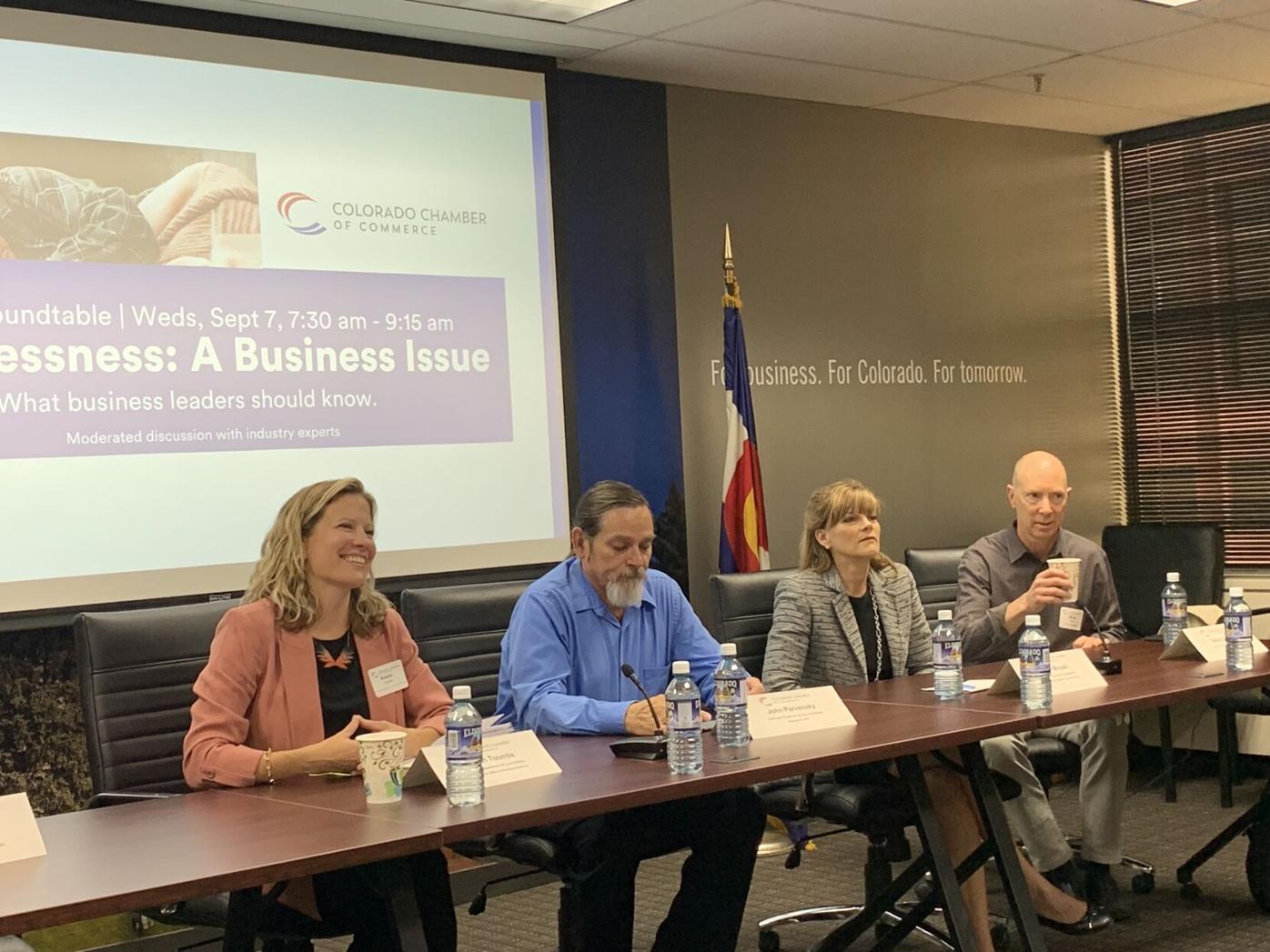
DENNIS HUSPENI/THE DENVER GAZETTE
Colorado’s lack of affordable housing has worsened homelessness here, and the problem is going to get worse before it gets better.
That’s according to a panel that included a developer, a representative from the Downtown Denver Partnership and the Colorado Coalition for the Homeless and others who presented to business leaders at a Colorado Chamber of Commerce event Wednesday.
“The housing market here is likely to make more people homeless over the next five years,” said John Parvensky, president and CEO of the Colorado Coalition for the Homeless. “The biggest correlation between homelessness from community to community, state to state, is the availability or lack of affordable housing.”
The panelists first defined the problem, discussed programs that have worked in recent years and then laid out ideas for public-private partnerships, which they called essential to adequately address the issue.
“The efforts to create dedicated affordable housing is only a fraction of the need,” Parvensky said. “Just as an example, the city estimates there’s a shortage of 28,000 units of affordable housing for people below 30% of the area median income. That’s $30,000 or less a year. If all of our plans work, we may create 5,000 to 6,000 units of affordable housing over the next five years, but that still leaves us 20,000 short.”
Getting an exact count of the homeless population is difficult, said Kristin Toombs, director of the Office of Homeless Initiatives for the Colorado Department of Local Affairs.
For example, the “point in time” survey taken in January that includes people on the streets and in shelters shows about 10,000 people statewide — two-thirds of those identified as newly homeless. But a survey of public school students showed that number is around 21,000.
Toombs said that number is probably two to three times that size to account for siblings not in school, those “couch surfing” with friends or family or people living in hotels.
“Denver itself has 45% of the shelter beds for the entire state, but about a third of the people who utilize those shelters come from other parts of the state,” Toombs said.
She estimated the state needs about 14,600 “supportive housing units” to truly address the problem. The coalition has about 2,500 shelter beds in Denver, Parvensky said.
“There’s no silver bullet,” Toombs said.
The Downtown Denver Partnership and the Business Improvement District constantly do a “balancing act” to address the needs of downtown businesses, property owners and homeless people, said Beth Moyski, senior vice president Special Districts.
“I get phone calls from property managers and property owners if there’s an encampment asking, ‘What are you going to do about it,’” said Moyski.
The partnership has ambassadors who contact those who might need help, offering to connect them to services.
“We’re bridging the business and service industry,” she said. “It’s a balancing act. Every situation is unique.”
She praised Denver’s STAR program (support team assisted response), in which an EMT and behavioral health specialist respond to calls for service instead of Denver police.
Parvensky pointed to a five-year Urban Institute study of Denver’s program that stresses Housing First found that 92% of people offered housing accepted it, and 80% of those who accepted housing remained in housing two years later. The study concluded that “expanding investments in supportive housing could end homelessness, break the homelessness-jail cycle, and shift resources away from policing and other costly emergency services toward services.”
“It demonstrated not only reduced emergency service costs, but also emergency health costs with the federal government basically reimbursing the city,” Parvensky said.
Developer David Zucker, founder and CEO of Zocalo Community Development — which includes about 30% affordable housing units in all its developments — said “it really is going to take businesses more and more to get involved.”
“There is nothing more complicated than this issue of supporting those who are suffering homelessness because it really is so intertwined,” said Zucker, also the chair of the State Housing Board.
He suggested the federal Low Income Housing Tax Credit program is “simply not enough” to encourage developers to build more affordable units, despite “the state doing a really good job of augmenting that.”
That’s partly because construction costs have soared in the last 12 years, and there has been little efficiency improvements in the industry in years.
“Housing that we built six years ago is essentially twice as expensive as it is today,” Zucker said. “There simply aren’t enough subsidies.”
He suggested ideas like giving property tax abatements for developers “who are, out of their own volition, are providing affordable housing.”
He praised Parvensky’s coalition as a model for other cities to emulate.
“I’ve had the opportunity to go to other cities like Minneapolis, Portland, Seattle, Philadelphia, Los Angeles and universally Denver and the coalition are seen as leaders in resolving or helping to support those who are facing homelessness,” Zucker said.
Both he and Parvensky pointed to projects completed in areas like Curtis Park that were opposed by neighbors who worried about declining property values or rising crime.
“Since we broke ground on that first project (in 2000), there’s been some 2,000 new market rate and luxury apartments built within blocks of that site,” Parvensky said. “So the reality does not match the fear.”
Toombs said the legislature passing a “homelessness tax credit” that goes into effect in 2023 will hopefully help.
“For an individual business that wants to donate to a nonprofit or to a capital campaign that is helping people experiencing homelessness,” she said. “If it’s in the metro area, they will get a 25% tax credit. In rural areas, that’s 35%.”