







Late in life of triumph and tragedy, Denver’s Les Franklin opens up
Christian Murdock, The Gazette

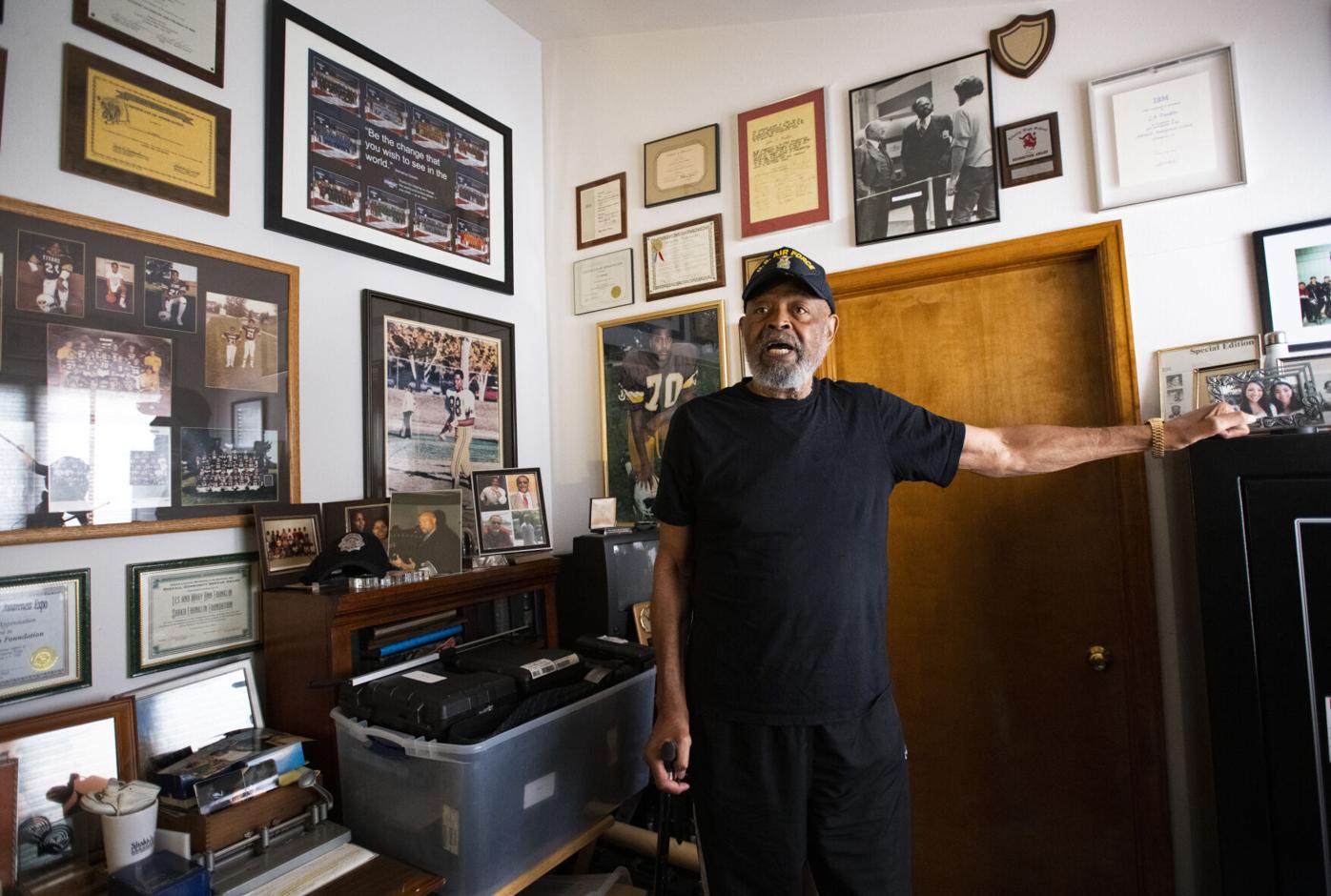
Les Franklin, 83, talks inside his Denver home last month about his life, from growing up in Colorado Springs in the 1940s and ’50s around his Aunt Fannie Mae Duncan and the Cotton Club to the suicides of his two sons, Shaka and Jamon.
photos by Christian Murdock, The Gazette
DENVER • It’s a beautiful home in a leafy, gated neighborhood. A beautiful home filled with beautiful things: South African art, sports memorabilia, safes of shiny collectibles, a garage of sleek cars, a theater and a pool that isn’t used much, not since a father swam with his son one last time 32 years ago.
The walls are lined with plaques and awards and photos from a big life. They depict humble beginnings before a career of moving and shaking among businessmen, politicians and the rich and famous.
Alone in the midnight hours, hobbling with the help of his cane, Les Franklin roams around it all. He either can’t sleep or doesn’t want to.
“I’m up all night,” he says.


Les Franklin stands among the memories of his two sons, Shaka and Jamon, at his Denver home. Franklin lost them to suicide.
He’s either working or distracting himself. He’s working on all of his scrapbooks, filled with years in the IBM corporate world and years in social activism, show business and government. Or, more recently, he’s mesmerized by videos of violin-playing prodigies.
That’s a hint at Franklin’s musical DNA, linked with Fannie Mae Duncan. Before his rise in Denver, Franklin spent much of his 1940s and ’50s youth in Colorado Springs at his aunt’s Cotton Club, legendary for its performers and its reputation for bringing together Black and white crowds.
Those are some of the many, vivid memories in Franklin’s new self-published book, “Love, Les.” In the sleepless hours, the memoir was something else keeping Franklin busy.
However failing his big, once-athletic body, his mind and memory are as strong as ever. At 83, Franklin decided it was time to write it all down. All of it.
“I got great stories, and I got horrible stories,” he says. “I wrote the good, the bad and the ugly.”
Like any rags to riches tale, there is triumph and tragedy. It is a tale laced with conflict and contradictions. In some moments, for instance, Franklin seems to let go of past grievances — he writes of the importance of it — and in other moments he seems to hang on to them. His late, famous aunt from back in Colorado Springs is at the center of one such conflict.


A picture of Les Franklin’s Aunt Fannie Mae Duncan’s Cotton Club hangs on the wall of his Denver home.
If his life is one thing, it is complicated, Franklin knows. As he wrote: “I’m pretty sure a therapist could make a lifetime of study out of me.”
And whether triumph or tragedy prevails over the other, that is at the center of another ongoing conflict late in his life.
One does not simply overcome ugly chapters like these. Those were the hardest chapters to write. Franklin lost both of his sons, Shaka and Jamon, to suicide.
By day and night, everywhere he looks around his home, he sees them. He keeps their pictures on the walls. He keeps them everywhere.
“I can never get away from that,” he says. “Always looking at me.”


Les Franklin tells the stories behind the pictures hanging on the walls of his Denver home.
Working his way up
The early pages of “Love, Les” are spent on early traumas.
Franklin was born in 1939 in Colorado Springs to a young, single mother who dreamed of Los Angeles. They moved to a rough L.A. neighborhood. Young Franklin navigated gangs; he writes of captures and assaults. Back home, the boy faced a whiskey-swigging stepfather.
“My stepfather used to beat the hell out of me,” Franklin says. “I was only 4 or 5.”
At 8, Franklin wound up in the local paper for catching a thief. “He has already shown that he can match wits with a grown-up burglar and come out on top,” read the report from court.
The judge, though, had a problem with the boy being home alone while his mother worked. Franklin went back to Colorado Springs to live with Aunt Fannie Mae.
The paper had credited burglar-busting Franklin with “a quick action brain,” and that served him well at the Cotton Club. Just as he charged people parking in his yard in L.A., he collected coins from the club’s jukebox while sweeping floors and wiping tables. He’d drop the change in a glass “and appreciate the sound it made,” he wrote in his book.
Later, the teenager worked a job digging ditches at the under-construction Air Force Academy. Also, he shined shoes of men in suits and top hats, listening to them talk business. He aimed to impress as they did; he bought a 1949 Mercury in time for high school.
From a young age, Franklin was set on reversing his and his mother’s fortunes. “Teachers never knew how I worked,” he says. “I used to come to class and fall asleep.”
He was awake enough to notice deep-seated animosity toward him and other Black students.


Les Franklin, bottom left, was a bat boy for the all-black Brown Bombers baseball team. The team was Colorado Springs city-league champions in 1948 and 1949.
It was, he explains in his book, “veiled racism” that “permeated everything we did every day we lived.” It was systemic and, he resolved, responsible for the confined, gang-ridden neighborhood back in L.A.; for keeping him on the sidelines of Palmer High’s 1956 football state championship game; for threats he received later while dating a white girl in college; for suppressing his mother all her life and, eventually, closing his aunt’s Cotton Club.
Colorado Springs at 150 years | The city that now honors Fannie Mae Duncan once cast her out
Franklin would combat those forces with wit and confidence — with an air of exceptionalism symbolized by the cars he drove.
Soldier’s attitude
Out of the University of Northern Colorado and the Air Force in 1965, Franklin interviewed with a boss from IBM’s base in Boulder.
“Where do you see yourself in 10 years?” the man asked.
Franklin replied: “I see myself having your job.”
This more or less happened. Franklin rose the IBM ranks, all while working side hustles that would be wealth-altering along the way: selling mutual funds and insurance early on, real estate investments later, his biggest boon.
In the ’70s, the United Negro College Fund kept him busy around the clock as well. Inspired by the civil rights movement, Franklin proved to be an adept fundraiser for the organization giving scholarships to Black students. The group had him putting on fancy events in California for a couple of years. The actor John Amos took notice. Franklin leveraged another opportunity, fundraising by day, managing the star by night.
IBM waited for him in Colorado. Franklin came back a little heavier, his hair and beard a little longer.
In his book, Franklin recounts an uncomfortable meeting with the company chairman, whom he quotes: “Are you a Black Panther or one of those revolutionaries? Do you hate us? Are you a militant?”
Franklin recalls his reply: “I don’t hate anyone. I simply know there are attitudes and ideas that are archaic, and I’m in a position to help facilitate change.”
Maybe that made him a militant, he said. “But hear this,” Franklin ended. “I won’t take s— from anyone.”
Elephant’s mind
All the while, Franklin’s marriage crumbled. His two boys were struggling, and he didn’t realize it. He does not spare those difficult details in “Love, Les,” those days of leaving them in a hotel while he went off to work. Nor does he spare feelings that developed over time with Aunt Fannie Mae.
There were, by his account, favors done and money loaned, words said and emotions flared. Anger, pride, jealousy — ingredients of family fallouts. Franklin did not attend Duncan’s funeral in 2005.
Franklin always forged on. He made more friends and foes in a failed run at Congress.
This was once again leveraging an opportunity. Taken by Franklin’s leadership at IBM, then-Gov. Roy Romer had appointed him to lead his Job Training Office. Franklin writes of perceived resentment toward his own campaign later, “primarily because I didn’t first seek the blessings of the power brokers in the Colorado Democratic Party.” (He now counts himself a Republican.)
Franklin keeps pictures from that brief time in politics. He keeps pictures from his formative years at the Cotton Club — the place that stood against the odds for equality. For what she built, Franklin admires his aunt.
“I know a lot of it was because the way she was treated, she was cold,” he says, reflecting on their relationship. “They treated her horrible. Fannie Mae got slaughtered with racism.”
Now at his home he comes to a statue of an elephant.
“I like elephants because they’re big and they don’t forget,” he says. “He’ll never forget.”
Long road to forgiveness
Franklin can never forget, as much as he’d like.
He’ll never forget that October day in 1990.
He and his second wife, Marianne, walked into the house, surprised by the silence.
“Did Shaka have something after school?” Marianne asked.
Shaka was in his room. Franklin found him there on the floor, pistol at his side. He was 16.
Ten years later, Franklin and Marianne came home through the garage. They smelled something foul. They saw a body in the back of the Cadillac. Jamon was 31.
Franklin can never forget.
Late in his life, he’s trying to forgive.
He’s trying to forgive himself for something he said to Shaka. The boy struggled with the divorce of his parents, struggled more as his mom was dying of cancer.
“I was in Full Stupid Parent mode when I told Shaka that his mother hadn’t wanted him,” Franklin wrote in his book. “I’ll regret what happened between us that day for the rest of my life.”
He regrets not listening to Marianne. Something was wrong with Jamon, she tried to say, “but I wouldn’t listen,” Franklin wrote. “Worse, I snapped at her.”
Sadness gave way to anger. He was angry at Jamon for what he did, like he was angry at anyone else who ever tried kicking him when he was down.
He was angry at himself. Why did he have to be so busy? Why was he not paying attention?
He was angry at the world. “Seeing the sun coming up day after day seemed like some kind of rebuke,” he wrote.
He wrote through sleepless nights. He wrote for others, he says now; maybe his life can be a lesson. And maybe he wrote for himself.
“Love, Les” reads like a confession, like a long, hard journey for redemption. However out of reach forgiveness often feels, he finds acceptance from Marianne:
“Even after all these years, I can still get all wrong in my head. … I think about killing myself and ending all of this pain, then I consider how devastated she would be if she were to be the one to find me.”
Loving more
Franklin finds purpose, too, in his foundation that has had him speaking around the country, raising awareness about mental health and lifting up youth through sports and other outings. A lot of the pictures around the house are of him and those kids.
“If there’s any pictures shown of me when I die, those should be the ones,” he says. “That’s me.”


Les Franklin said his favorite pictures on the wall of his Denver home are the ones with him and the kids he has worked with through his foundation.
He’s trying to be gentler now, less of that tough-talking, all-business man he felt he needed to be.
There’s a big teddy bear on the sofa now. There’s a memorial for a dog he recently lost. He found himself crying about this in the arms of a neighbor the other day, him and this other big man. That was OK.
The nights are still long. The sun rises as in those days of torment. He greets it.
He greets the squirrels.
“Every day I feed the squirrels,” he says.
If you or someone you know is struggling, please reach out to the National Suicide Prevention Lifeline at 988 or text TALK (8255) to 741741 at the Crisis Text Line.


Will Denver’s dueling underground music fests face off at once?
John Moore
john.moore@denvergazette.com
Updated 3 hours ago
Less than a year ago, local music fans collectively pondered whether the summer music festival might be dead in Denver. (To our credit, we opined in this space: “Categorically not.” Actually, our exact words were: “Don’t be daft, punk!”) But...

John Moore
Reporter

Broncos QB Bo Nix, wife Izzy welcomed birth of first child on his 26th birthday
Chris Tomasson
chris.tomasson@gazette.com
Updated 2 hours ago
Bo Nix and his wife Izzy on Wednesday announced that their first child was born Feb. 25. The birth of daughter Riley Belle Nix happened on the 26th birthday of the Broncos quarterback. “The best birthday party I’ve ever been...

Chris Tomasson
Reporter

Avalanche add defenseman Nick Blankenburg in trade with Nashville Predators
Evan Rawal
evan.rawal@gazette.com
Updated 3 hours ago
ANAHEIM — Fewer than 48 hours before the NHL trade deadline, the Colorado Avalanche added blue-line depth on Wednesday. The Avalanche said they’ve acquired defenseman Nick Blankenburg from the Nashville Predators in exchange for a 2027 fifth-round draft selection, a...

Evan Rawal
Reporter

Secretary Hegseth: U.S. is ‘winning decisively’
Wire Services
wire-services@denvergazette.com
Updated 4 hours ago
U.S. Defense Secretary Pete Hegseth on Wednesday said that the U.S. is quickly gaining air superiority over Iran but that America cannot stop all air attacks. He signaled a longer timeframe for the U.S. war in Iran, saying it will...

Wire Services
Reporter

Denver Nuggets will still be without multiple forwards vs. Lakers
Vinny Benedetto
vinny.benedetto@gazette.com
Updated 5 hours ago
David Adelman is not going to get his wish. A few weeks ago, the Nuggets coach hoped his team would be at full strength for the final 20 games of the regular season. The Nuggets will be without three forwards...

Vinny Benedetto
Reporter

Colorado declares measles outbreak after third case linked to Broomfield school
Nicole C. Brambila nico.brambila@denvergazette.com
nico.brambila@denvergazette.com
Updated 5 hours ago
An unvaccinated Adams County child who tested positive for measles is tied to a case from Broomfield High School last month, leading state health officials to declare an outbreak. Colorado has four measles cases to date, amid a national outbreak....


Federal audit finds $77.8M in improper Medicaid payments for Colorado autism therapy
Nicole C. Brambila nico.brambila@denvergazette.com
nico.brambila@denvergazette.com
Updated 5 hours ago
Colorado’s Medicaid payments for a therapeutic program for individuals with autism increased 172% in four years, prompting a federal audit by the Office of the Inspector General. Auditors found Colorado made $77.8 million in improper Medicaid payments for Applied Behavior...
Almost 40 apply for board to oversee revitalization of Colfax Avenue
Kyla Pearce
kyla-pearce@denvergazette.com
Updated 5 hours ago
Aurora officials received almost 40 applications for the Aurora Downtown Development Authority Board that will oversee the revitalization of Colfax Avenue. The application period ended Saturday, and an Aurora spokesperson said 38 people applied. Of the 38 applicants, 32 met...

Kyla Pearce
Reporter

Chris Marve quickly thrust into new role as CU Buffs defensive coordinator
Tyler King tyler.king@gazette.com
tyler.king@gazette.com
Updated 5 hours ago
BOULDER — Chris Marve came to Colorado knowing he would have a chance to be a defensive coordinator again. He just didn’t know it would happen so soon. “Man, things happen fast in this profession,” the Buffaloes’ new defensive coordinator...

Tyler King tyler.king@gazette.com
Reporter

Kaleigh Kurtz brings NWSL ‘Ironwoman’ streak to Denver Summit FC
Kyle Fredrickson
kyle.fredrickson@gazette.com
Updated 4 hours ago
GLENDALE — Kaleigh Kurtz holds National Women’s Soccer League records for consecutive regular-season minutes, games and starts. The veteran center back now brings her legendary durability as the defensive anchor for Denver Summit FC in its inaugural NWSL campaign. Kurtz,...

Kyle Fredrickson
Reporter