







Aurora buckles in for potential of lengthy police chief search
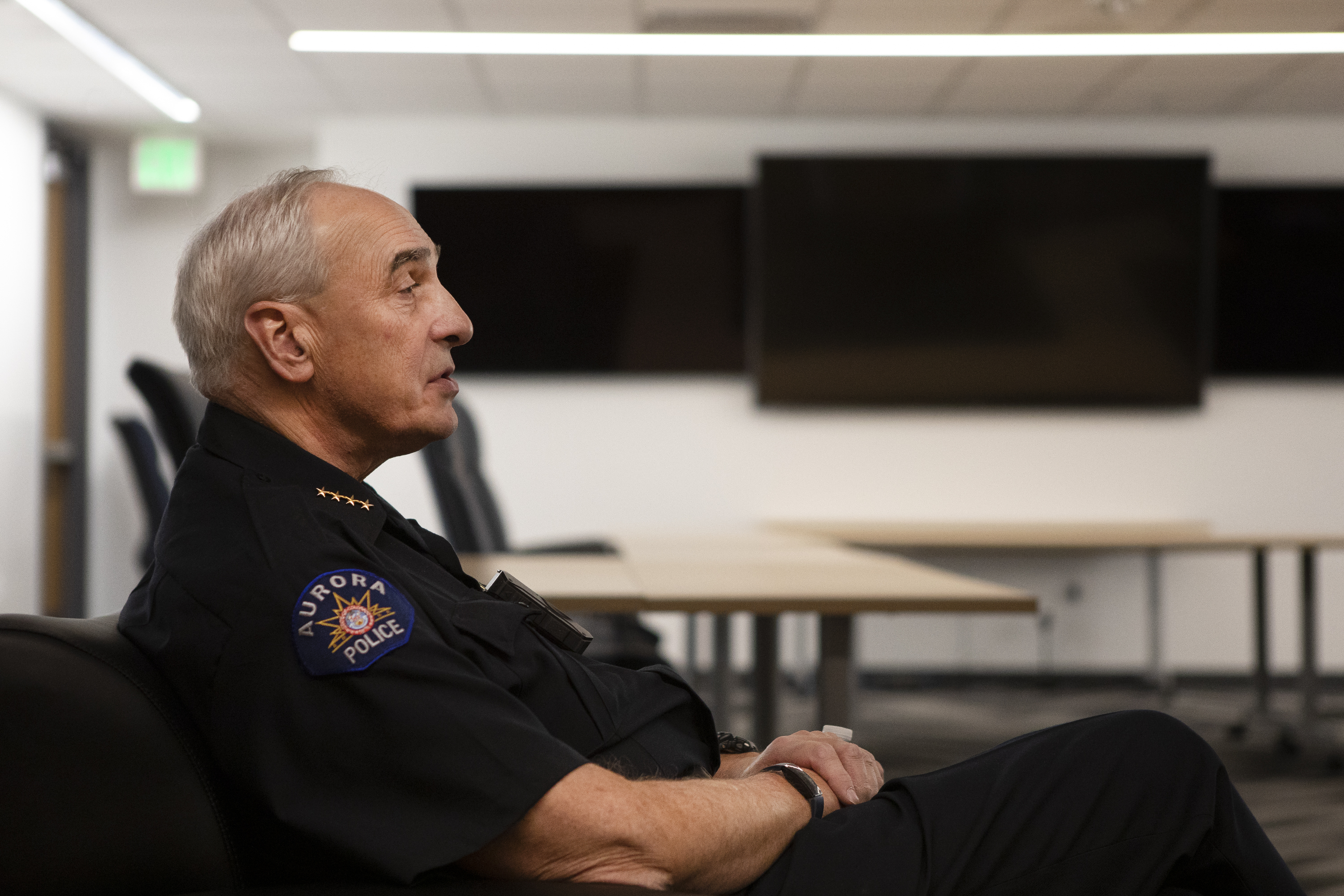
More than a month after Aurora restarted its search for its next chief of police, the city has not received any formal applications. Some recruits approached about the job have reportedly been leery of throwing in for the position. There remains no set timeline by which the city aims to name the next chief.
Despite the slow start, alarm bells aren’t ringing for community leaders who say they’ve buckled in for the search to take as long as necessary to find the right person.
Aurora announced it was starting its search over on Oct. 4. That was after two finalists — Scott Ebner, a retired lieutenant colonel from New Jersey, and David Franklin, a chief of staff for the Albuquerque Police Department — were publicly announced, narrowed down from an original group of four. Both underwent interviews with council and public meet-and-greets. One ultimately withdrew, becoming the third of the four finalists to do so, and council did not support the last finalist vying for the job.
Ebner and Franklin had advanced from a pool of 21 applicants. Seven were people of color or women, but four white men were selected as finalists — three announced publicly. Controversy quickly brewed about the lack of diversity among them, and the level of community engagement involved in their selection.
City Manager Jim Twombly did not agree to an interview regarding how the city is incorporating community engagement during the extended search and questions about emails obtained by The Denver Gazette through a records request.
Twombly provided an emailed statement saying he wants to recruit the best candidate who will equitably serve the community, the police force and city staff.
“I recognize that our first efforts to name a permanent chief met resistance for a variety of reasons in September,” his statement said. “I have been pulling on the many relationships I have built over the years to gather insight on successful — or unsuccessful — recruitment strategies that other communities are using that simultaneously recruit top talent and afford community members the voice they deserve.”
The city has spoken with potential candidates “from a variety of professional, cultural and ethnic backgrounds all over the country who are qualified for our position,” Twombly said in his statement.
“Many of them expressed hesitancy about formally applying for the position and engaging in the process we used previously,” he said.
Twombly did not elaborate on what their concerns with the previous process were and did not directly address an emailed question asking if the city will engage with community members before announcing another round of finalists. His statement said Aurora is working “toward a new strategy.”
Records show Twombly did contact other municipalities about their approach to police chief searches as Aurora’s hit troubled water.
In September, Twombly wrote to a Wichita city official that Aurora’s search “just kind of blew up. Went from four white male candidates to two. We’ll plow ahead.” Twombly asked how the city had incorporated a committee of community leaders in its search process, saying “we just got beat up by some community leaders because they weren’t involved” in whittling semifinalists down to finalists.
The Wichita official said two committees helped narrow their field, one of department leaders and one of community leaders. Where there is a difference of opinion, he leans toward the community leaders’ opinion, the Wichita official said.
“So you must have trust that the review committee will not leak any of the names before you get to making the finalists’ names known. That’s better than we can do,” Twombly wrote back.
In his statement to The Denver Gazette, Twombly also thanked interim Chief Dan Oates for “his work that’s stabilizing APD, improving the department’s internal leadership structure, and placing a renewed focus on crime reduction and community engagement.”
Although, Oates has also recently come under fire after Channel 4 News reported he has reversed disciplinary recommendations by an internal review board for officers.
Community criticism
Critics of the initial search saw the extension as a good move and an opportunity to get it right in the end.
Aurora failed to engage community leadership early in the search process, the president of the Aurora NAACP chapter Omar Montgomery said after the search was extended last month. Starting over was “100%” the right decision, he said, and was hopeful at the time that the city would find ways to involve community members.
“What candidate would want to walk into a situation where days prior to their interview there is controversy about the lack of community engagement and the lack of diversity that’s among the final candidates,” Montgomery said.
Come early November, Montgomery said there had been efforts to better involve the community. Some councilmembers have reached out to constituents about the search, he said. The Aurora NAACP chapter also plans to host a town hall in the next couple of weeks to seek community input on qualities they want in the next chief, he said. That will produce data the NAACP can share with the city.
“Now the question is … can we attract a candidate that understands the complexities of the City of Aurora,” he said.
One of those is that the department has little control over hiring officers, he said, something he wishes council would address within the charter.
Montgomery had not met with the first round of finalists last month, he said, worried that getting involved at that point “was endorsing a process that I felt was flawed from the beginning.” His concern was not with the specific individuals chosen, but with the murkiness around how they were screened because community leaders were shut out of the process.
“Some people said, ‘Well because he wasn’t a Black candidate you want him thrown out.’ No, that’s not what I’m saying,” Montgomery said last month.
Montgomery said there are still steps Aurora should take to improve its likelihood of finding diverse candidates. Recruiters must know how to look at qualifications “that may not show up on their resume,” he said, and there is training available to help people fill executive positions while keeping equity in mind.
“Then even if we don’t have a diverse pool, we at least know that these people have been vetted and can address the diversity needs of the city,” he said.
The chief of police in Aurora should be able to implement the consent decree reforms and be someone who has a passion for working with diverse communities, he said. Montgomery wants an innovator. Rather than hold to old norms of policing, he hopes the next chief can combine pursuing public safety with partnering alongside organizations providing social services.
“They have to have the skillset to address the needs of their rank and file. Address the needs of an extremely diverse community that has been wounded several times by police abuse cases,” Montgomery said. “Who understands how the Elijah McClain case has changed public safety in the City of Aurora forever. Someone who understand that during training, regardless of the situation, you do not pull guns on four young ladies and have them lay down on the hot summer concrete and say, ‘Hey, we got the wrong car.’”
Montgomery is not sure either how long the search should take, he said, just “until they get the best possible scenario.”
Pastor Topazz Johnson-McBride of Restoration Christian Fellowship felt disappointed not only with the initial search process but with the finalists, she said. She was surprised the city did not include community leaders involved with the consent decree in the search.
Johnson-McBride learned that after she was asked to hold an event at the church introducing the previous finalists to residents. It felt insulting, she said, and forced her to consider whether she should move forward with the event, worried it could appear as an endorsement of a process she felt excluded critical voices.
“I had to really pray about it,” she said.
Whoever the city finds must be familiar with uniting a divided police force, ready to rebuild the department through recruitment, and be well versed in cultural sensitivity, she said.
To gain diverse applicants, Topazz-McBride said recruiters needed to show up in-person to attract candidates, and not just post bulletins online. The search process should involve people outside of the hired firm, who know the community well and what the future chief will face leading the Aurora Police Department, she said.
“Aurora is the most diverse community in Colorado,” she said.
Community activist Candice Bailey felt similarly. There need to be people involved in the search who know Aurora deeply, she said, and the intricacies of issues the city faces, such as youth violence. There is a Black-owned search firm based in Aurora that the city could have relied on but didn’t, she said, choosing instead a firm run by white leadership.
“I strongly warn against identify politics,” she said, but she wants congruence between leadership in APD and the demographics of the city.
She called for a lengthier process than the first go around, as the city works with a slender pool of candidates who are initially qualified, she said.
Hoping for the right candidate
The level of interest one month into the relaunch is not concerning, Councilmember Dustin Zvonek said, who stressed the process should not be rushed.
“One of my contentions is that we should take our time to find the right person,” he said. “This is an important role.”
As the city hit the reset button, Zvonek walked away with the belief Aurora needed a more discreet approach. One new strategy during the extended search would be initiating direct conversations with potential candidates, he said.
He is also comfortable with naming a sole finalist as opposed to multiple, he said. That might happen if the city believes it has found the right person, but they are not willing to go through a public finalist process when they might not receive the job.
“There were a number of top tier potential chief candidates out there who told us if this was a more private process that they would have applied,” he said last month.
In response to calls for more public involvement, Zvonek had said the public “are involved. They elect the city council.” He was clear about the type of police chief he wanted while running, Zvonek said.
“There were nearly 30,000 people who voted for me,” he said.
Attracting a diverse applicant pool is a challenge across law enforcement agencies, Zvonek said amid the relaunch.
“There are not enough … women and people of color who are applying for these jobs. I wish there were,” Zvonek said. “I believe at the end of the day what we should be focused on isn’t someone’s gender or race.”
Councilmember Curtis Gardner called the issue close to his heart. He’s a lifelong resident of Aurora and the nephew of a former police chief in the city. Gardner became frustrated with critiques of the city’s process, particularly from councilmembers, because the council had agreed on how to conduct the search before starting, he said.
“I think we have competing political interests that are preventing us from moving forward,” he said. “I think you have a group of community activists. I think you have a group of ‘tough on crime crowd’ and I think those two factions are clashing.”
The next chief’s primary focus should be crimefighting, he said, while they follow the consent decree and build community relations. It takes a special person to accomplish all three, he said. Gardner understands candidates may not want their name made public but said “I think going through a public process is appropriate” for a police chief job.
He could not point to a part of the process Aurora had already used that he would change, but he would be open to discussing what earlier community engagement might look like, he said.
Gardner did not have suggestions for generating a diverse applicant pool. He believes the search firm brought forward the candidates it determined were best qualified. Being able to garner both diverse and highly qualified candidates is ideal, he said, but “I don’t think one should come at the expense of the other.”
Gardner could envision the search’s fallout deterring both white and Black candidates from applying, he said, adding “I do fear that we have adopted identity politics into selecting our next police chief.”
“I am very worried about our ability to attract a candidate,” Gardner said. “You know, I’ve had that concern since the handling of the termination of our prior police chief.”
