







Colorado cold cases: Pueblo County reaches out to Florida forensic expert for help

Image created by Grace Wride with the Gazette
In September 2022, investigators with the Pueblo County Sheriff’s Office discovered skeletal human remains in a remote location in eastern Pueblo County.
With no leads, foul play suspected and DNA test results taking longer than expected, Pueblo County sheriff’s Detective Vanessa Simpson decided to embark on a different method for identifying the remains. On the recommendation of a colleague, she reached out to noted forensic artist Samantha Steinberg.
“The DNA hadn’t come back, and we had a family out there in some capacity who needed to be brought peace,” Simpson said.
Steinberg has been a forensic artist with the Miami-Dade Police Department in Florida for more than two decades. A pioneer of forensic art, Steinberg has lent her talents to police departments across the country, including elsewhere in Colorado.
Steinberg got her start in forensic art shortly after graduating from the Rhode Island School of Design with a degree in fine art. In a virtual interview with The Gazette, she said she’d always loved true-crime books. Through her reading, she learned about forensic art.
“So here I am, out of college, reading this serial killer book and seeing that they’ve contracted a fine artist to help find them. And I’m thinking that if someone taught me the science behind it, I could do this — and it would be such a great merge of (my) two passions, all things true crime and my art,” Steinberg said.
She began trying to learn about forensic art, even cold calling the FBI.
“At the time, they had a three-week forensic facial imaging course at the academy in Quantico. But you had to be employed by a police agency, and you had to have a number of successful cases,” Steinberg said. “So, I thought, OK, I need to get a police department to take me on.”
She reached out to Miami–Dade police and was connected to Detective Charlie Holt.
At the time, a forensic artist position didn’t exist within the department. Although Holt was responsible for producing forensic art, he was listed as a detective with the auto theft unit.
“He said to come on by, and to bring my portfolio, and he’d be happy to talk to me,” Steinberg said. “He said that I’d never get a job here — the position simply didn’t exist. He was willing to humor me.”
That is, it didn’t exist yet. With Holt teaching Steinberg the ins-and-outs of law enforcement, and Steinberg helping Holt sharpen his artistic skills, the two were an unlikely but solid team.
“That first year, I was an unpaid volunteer with the department,” Steinberg said, but it wasn’t long before she proved herself to be worth more than volunteer status. The second case she worked on with the department helped lead to an identification.
“Thankfully, my supervisors soon realized they might be able to get a better product (forensic art) by hiring a civilian and paying them less than what they were paying a veteran police officer with little artistic training,” Steinberg said.
With Holt on his way to retirement, the department spent the next two years creating the position of forensic artist for Miami-Dade police.
“And I was the very first one to have it,” Steinberg said.
“It’s quite a small field. We carry the opinion that if we have the time and the talent that it’s in everyone’s best interest if we assist other law enforcement agencies when we can,” Steinberg said.
A meticulous process
With only roughly 30 full-time forensic artists employed in the U.S., Steinberg has always had an “open door policy” regarding her work.
That’s how she found herself involved in the unidentified remains case in Pueblo County.
In looking at the image Steinberg created for Pueblo County, it takes a second or even third glance to realize it isn’t a photograph. It’s nothing like the pencil sketches seen on popular crime TV shows or even real-life courtroom scene renderings.
Steinberg begins her process by conducting measurements of the skull and jaw and analyzing the forensic anthropologist’s report.
“The doctor (forensic anthropologist) determines the individual’s gender, approximate age, ethnicity and if there’s any anomalies present (such as a healed fracture),” Steinberg said.
The more niche the injury, the more helpful it can be in identifying remains.
“Once I have the biographical information of the individual, and the skull itself, I’ll prep the skull for photography by applying tissue-depth markers.”
Using a chart that indicates common facial contours for different gender, ages and demographics, the tissue depth markers are blended with the biographical information provided by the forensic anthropologist.
“If you get the science and the photographs right, then the outside contours should be pretty straightforward — just connecting the dots,” Steinberg said.
She then takes measurements of the eyes, nose and mouth to determine the proportions of the individuals’ facial features.
Creating different images
The remainder of the process is when Steinberg’s artistic skills and creativity come into play.
Steinberg explained the technique she uses is one she’s worked to perfect for years — and one she wasn’t always sure would be accepted by the public.
“When we started back in the ’90s, we did everything by hand. When I started here, I already knew how to use Photoshop (invented in 1987). I just thought at the time that in 1998 and ‘99 that the public wasn’t as familiar with digital imaging software, and I thought it was almost a disservice by making an image too realistic or photographic in quality. Because then people think it’s an exact individual, not an approximate likeness based on skeletal remains and the anthropologist report.”
Over time, she began using Photoshop more and more as public perception advanced, and with real-time success in cases being solved. Today, most of her work is done digitally.
“What I had started doing years ago was a hybrid technique where I draw most of it by hand and I would add the hair and clothing in Photoshop, both in composite drawings and in facial reconstructions. Over about a decade or so I sort of kept sliding that needle over more and more until it was almost entirely done with Photoshop,” Steinberg said.
Utilizing tracing paper to ensure measurements and proportions are accurate, Steinberg then scans the “outline” of the individual into Photoshop and uses a “scrapbooking” technique to complete the composite image.
“I try and pull images of people who fit the demographics of the individual. So in this case I’m looking for white males who are sort of middle aged, maybe 30 to 50 and try and figure out what is average for a man based on this description,” Steinberg said. “I’m able to sort of take anything (facial features) and make it into the proportions and the angles for anything that needs to be.”
Steinberg said any single rendering could be a combination of 20 to 50 different images of different people found in stock photos or mugshots.
In the case of the rendering she created of the Pueblo remains, Steinberg featured the man with several combinations of hairstyles and facial hair.
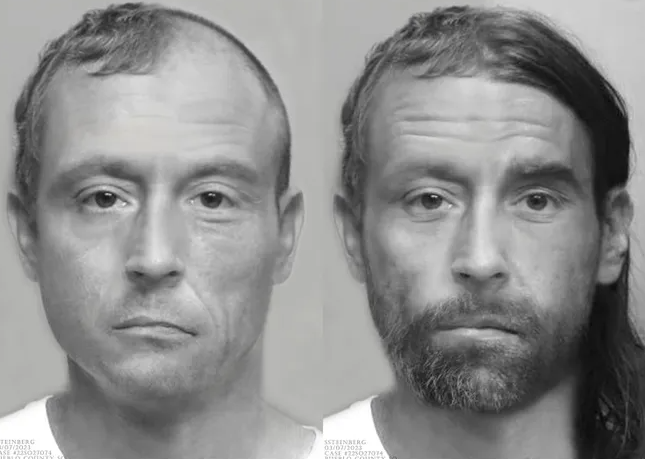
Rendering created by Samantha Steinberg of a set of unidentified skeletal remains found in east Pueblo County in 2022.
Courtesy of the Pueblo County Sheriff's Office


Rendering created by Samantha Steinberg of a set of unidentified skeletal remains found in east Pueblo County in 2022.
“There’s nothing on our skulls that indicates if a person has a unibrow, or if they’re balding or have long hair. Nothing is going to tell you the exact shape of someone’s eyes, or if they have heavy eyelids, or the shape of their mouth,” Steinberg said. “It also happens a lot with skeletal remains that you don’t recover hair.
“I always explain in my lectures that if you did a rendering of me based on my skull and you had me with straight hair, there’s not a person in my life, not even my own parents, who would call in if I were missing. If we don’t recover the hair or facial hair or something then you must be willing to build in ambiguity, like I did in this case.
“One side of the hair is short, and one side is long. I also provided alternate appearances with longer hair and facial hair. These are things we can’t determine based on the circumstances we have, and I don’t want to visually exclude someone who could be a match because I wasn’t ambiguous or vague enough in some of the choices I made,” Steinberg said.
Redecker case
Simpson, the Pueblo County sheriff’s detective, hopes the forensic rendering produces a promising lead.
“We ended up going down the forensic artist route because the DNA was taking too long to get back to us. We ended up getting the results back the same day Samantha returned the completed reconstruction,” Simpson said, but “we didn’t end up getting any hits on the DNA.”
This was the first time Simpson has used forensic art. She could only recall one other time the Pueblo County Sheriff’s Office opted to use a forensic artist.
“We only have four sets of unidentified remains, including the set from 2022,” Simpson said. “The only other time that I know of that we did any facial reconstruction was in 2001.”
That case is still open, with the victim’s remains unidentified.
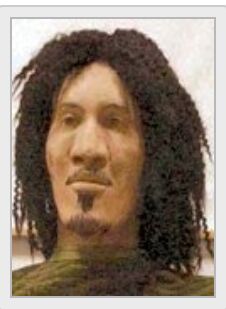
A bust rendering of a John Doe, whose remains were recovered in Pueblo County near the Walking Stick housing development, north of Pueblo. His remains were discovered in August 2000, and remain unidentified.
Courtesy, CBI


A bust rendering of a John Doe, whose remains were recovered in Pueblo County near the Walking Stick housing development, north of Pueblo. His remains were discovered in August 2000, and remain unidentified.
In 2020, Steinberg’s technique proved successful in identifying a set of remains from 1994 in Douglas County.
Becky Redecker, who was previously known as the Rainbow Falls Jane Doe, was found murdered at the Rainbow Falls campsite by a hiker. It was determined her death was a result of blunt force trauma.
For more than 20 years, Redecker’s remains went unidentified. Finally, in August 2020, Redecker was identified through a tip brought by a facial reconstruction created by Steinberg.
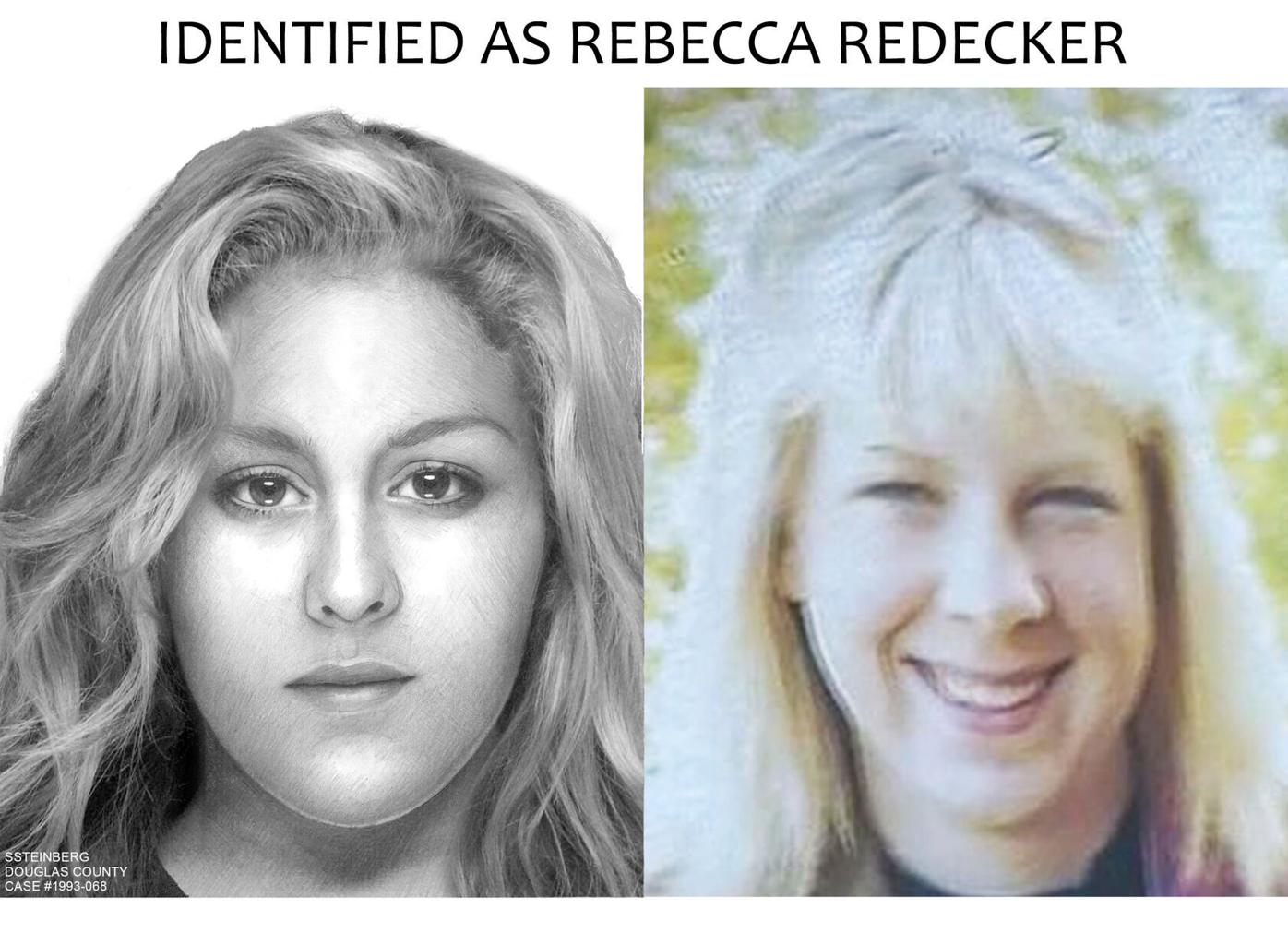
Rebecca Redecker, who was previously known as the Rainbow Falls Jane Doe, was identified in 2020. Her identity remained a mystery for over two decades, following the discovery of her remains at the Rainbow Falls campground in 1994 in Douglas County. The rendering that lead to her identification was created by forensic artist Samantha Steinberg.
Courtesy of Samantha Steinberg


Rebecca Redecker, who was previously known as the Rainbow Falls Jane Doe, was identified in 2020. Her identity remained a mystery for over two decades, following the discovery of her remains at the Rainbow Falls campground in 1994 in Douglas County. The rendering that lead to her identification was created by forensic artist Samantha Steinberg.
“It always feels great to close the book on a case, to have it come full circle with an identification,” Steinberg said. “In the end, that’s one of the reasons I love it, having the ability to bring a sense of closure to a case.”
Age progression
There are 1,354 cold cases statewide, including 81 cases of unidentified remains. El Paso County has 157 cold cases, including one set of unidentified remains, said Audrey Simkins, a cold case criminal intelligence analyst with the Colorado Bureau of Investigation.
Although she said she hasn’t had a great deal of experience with forensic artists, Simkins said their work has also been helpful in long-term missing persons cases.
“In a long-term missing person case we may look to see what the possibility of doing an age progression might be,” Simkins said. “You see this used most often when kiddos go missing and the age progression of the missing kiddo can be completed and then shared with members of the community in hopes that someone might recognize them.”
In unidentified human remains cases, Simkins said, “Oftentimes, you may have crime scenes or morgue photos that cannot readily be shared. However, with the use of forensic artists you may be able to clean up the image enough to create a sketch or an image similar to a photograph that could be shared with the community.”
Simkins said the bureau used a forensic artist in a recent Weld County case to conduct a facial reconstruction of a female homicide victim.
“The case remains unsolved but at least we have an image that can be shared with the community in hopes of generating new information that might lead to the female’s identification.
“Getting an updated image to share with the community aids in the development of tips and leads,” she said.
That is what the Pueblo County Sheriff’s Office is hoping for with Steinberg’s work, that someone will step forward with a tip that helps identify an unknown victim of foul play.