







Despite higher mortgage rates, Colorado housing prices inch upward
On a day after the Federal Reserve in Washington signaled that it may raise interest rates again in coming months to cool inflation, Realtors in Denver are wondering whether rate hikes are having the opposite effect — discouraging sellers from listing their homes and driving up prices for buyers.
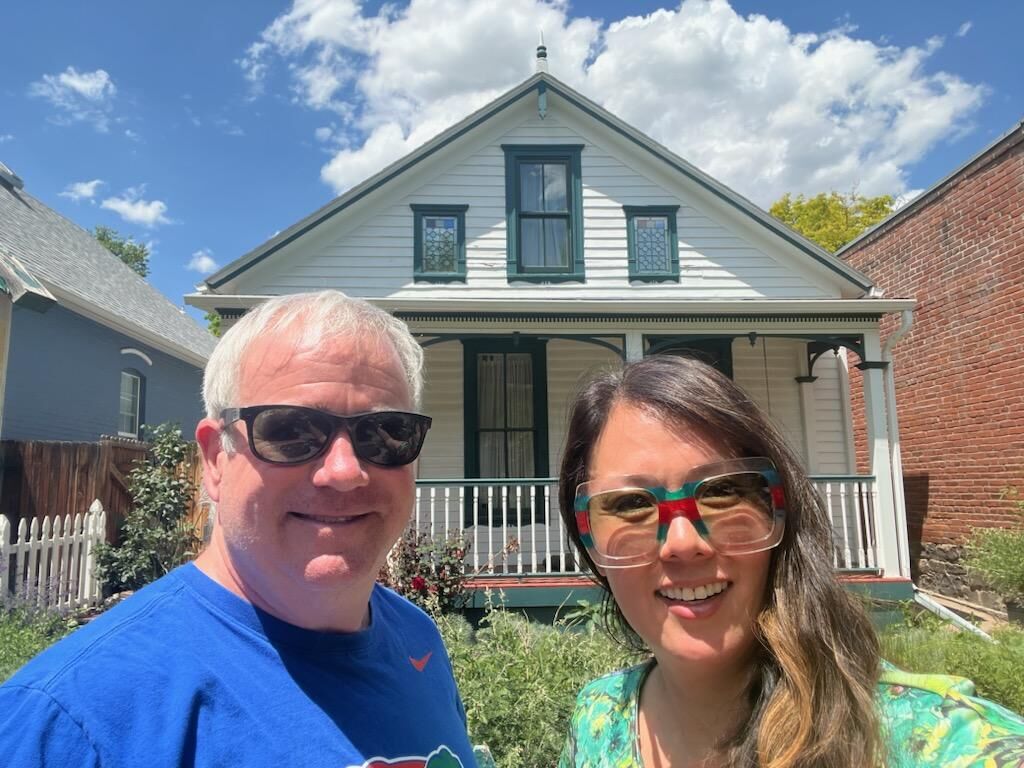
Denver Broker Lydia Lin (right) prepares a rare listing for market in Denver’s Baker neighborhood. Her seller, David Danforth, is moving to North Carolina.
Courtesy of ONE Realty


Denver Broker Lydia Lin (right) prepares a rare listing for market in Denver’s Baker neighborhood. Her seller, David Danforth, is moving to North Carolina.
That’s a question in the air after the Colorado Association of Realtors released its latest Market Trends Housing Report, showing that the number of listings that arrived on the market in May in the Denver metro area, some 4,913 single-family homes, trailed last year’s performance by 23%.
Agents see that lack of inventory as being why home prices are once again inching upward, in a year when buyers had hoped to get a break from record prices that homes were drawing during the pandemic.
“Potential sellers aren’t selling because they like their sub-3% mortgages and don’t see value in making a move-up purchase right now,” said Fort Collins agent Chris Hardy in the CAR report. “Yet demand for housing remains at an all-time high.”
Keenly aware of the state’s housing needs, Colorado’s policymakers have been trying to figure out ways to boost the inventory. Among other things, Democratic legislators want to encourage affordable housing development by making it possible to build housing on state-owned property and ban local laws that limit annual housing construction or residential permits, erasing those that currently exist in several cities in Colorado, such as Boulder, Golden and Lakewood.
The median sales price of a single-family home in the seven-county Denver area last month stood at $632,000 — off just 2.8% from the price in June 2022 after the Fed had begun calming the runaway market. The price had topped-out earlier that spring at $660,000.
Despite that modest year-over-year drop, prices in most Front Range neighborhoods are once again edging upward. That median single-family home price was a 3.9% increase in May over the previous month — the fourth straight month in which area prices have crept up.
That’s no surprise to Lawrence Yun, chief economist for the National Association of Realtors, who last November predicted that market demand would return nationally this year and that prices could rise, despite mortgage rates that were twice what buyers had grown accustomed to.
After the Fed’s announcement Wednesday, Yun told The Denver Gazette that prospects for continued demand in Colorado remain high.
“In Denver, there was an exceptional runup,” Yun said. “But given the job market strength combined with limited inventory and people are fighting over homes, especially on mid-price affordables.”
“The Fed needs to consider rate cuts by year end,” Yun said.
Broker/Owner Lydia Lin of ONE Realty is already seeing that brisker pace in the Highlands area west of Lower Downtown, where her LoHi office is a few blocks from the Highland Bridge.
“The market is not slow,” Lin said. “There are tons of buyers looking even though rates are a tad higher.”
Those include a couple that Lin has worked with for more than a year, currently renting a few miles south in Denver’s Baker neighborhood. With rates rising, the pair began searching in the less expensive suburbs. But they’re now back, focusing on the higher priced areas closer in, she said.
“It took a year for them to figure they really want to be close to downtown, and now we’re stalking Highlands, Sloan’s Lake and Berkeley,” she added. “They’re smart people. They saw prices hit bottom and then turn around.”
As an odd consequence, Lin said the shift has made new-built homes in the distant suburbs an attractive option for buyers, compared to a year ago when few were available.
Lin made a trip to Castle Rock this week with Aurora buyers that have a baby on the way, needing more space and a kid-friendly neighborhood. That took them to Toll Brothers at Montaine, where they found inventory waiting, and where the couple went under contract on a home that will deliver next spring.
Lin said that’s a marked change from 2022, when she had taken buyers to the same area and had found a waiting list of 60 people for the next lot release.
According to the CAR report, inventory is low not just in Denver but around the state — slightly higher than a year ago, but not enough to bring prices down.
However, there are a few areas where prices are still dropping.
Kelly Moye of Compass Real Estate in Broomfield, who tracks data for CAR in Boulder and Broomfield counties, observed that the two popular markets were rare examples where prices have continued to fall over the past few months.
“The lack of inventory and continued buyer demand should presumably push up prices,” Moye noted in the report. “But, instead, buyers are requiring concessions to get assistance with the interest rate.”
Median prices in those areas, she wrote in the report, have declined 6% since the beginning of the year.
The pandemic runup in prices in Boulder and Broomfield put them at levels beyond reach of the flurry of demand that mid-priced homes are now luring, said Ali Van Westenberg with Keller Williams Van Westenberg Partners, who specializes in Denver and the western suburbs. Buyers up north are still waiting.
That’s not true of equally popular, but less expensive, areas, such as Golden and Lakewood, with access to foothills recreation. That’s where a new listing that Van Westenberg’s team put up Wednesday had drawn 500 viewers within hours.
“We’re seeing multiple offers in some cases, and over-asking,” she said, adding that some buyers are willing to do what agents call “appraisal bridges,” where a buyer will pay another $5,000 or $10,000 to fill any gap between the contract price and whatever comes in as the appraised value.
Aurora is another rare area where prices are a little off. But Sunny Banka with Sunny Homes and Associates, who reports for CAR on Aurora, said demand there is stronger than it first appears.
“Prices are down a little,” Banka told The Denver Gazette. “But we’re getting multiples on nice properties and are under contract in a couple of days.”
That happened for a paired home near Smoky Hill Road and Tower Road that one of Banka’s agents put on the market last week at around $500,000.
Back in the 1980s when those areas in east Aurora were being built, Banka recalls seeing when 30-year mortgage rates topped out at 18.5%. Today’s rates in the sixes and sevens, she said, are relatively easy to get used to.
“I think it’s going to be really busy this fall,” Banka said.
“I’ll make a prediction that we’re going to see the second half (of the year) break out a little bit,” said Keller Williams’ Van Westenberg. “There’s pent up demand, and even if rates just hold steady, we’ll start to see things moving again.”
NAR’s Yun agrees.
“Demand will begin to pick up,” he said. “People should view these stabilizing prices, plus or minus, as very small changes in the long term.”
Buyers who get serious about that now would likely find that prices would have meaningfully risen in five or ten years, he said.
At the state Capitol, lawmakers approved bills to cap pet fees for renters; allow remote participation in eviction court proceedings; and, create a tax credit for employers who help employees purchase a home. In addition, they required mediation before eviction for tenants on government aid, limited tenant income requirements and security deposits, restricting leases from waiving tenant rights and allowed the reuse of rental applications without extra fees. Each of these proposals drew critics, some of whom argued that they violate local control, merely prolong the eviction process too or dis-incentivize landlords and developers from investing in Colorado’s rental industry.
Policymakers rejected legislation to let local governments enact rent control, and to ban evictions and lease terminations without “just cause.” And legislature balked at a proposal pushed by the governor to effectively wrest zoning control away from local governments and put it in the hands of the state.
The Association’s Monthly Market Statistical Reports are based on data from Colorado Multiple Listing Services. Metrics don’t include for-sale-by-owner transactions or all-new home construction. It represents 29,000 realtors statewide.