







Denver business leaders on the ‘future of the workforce’
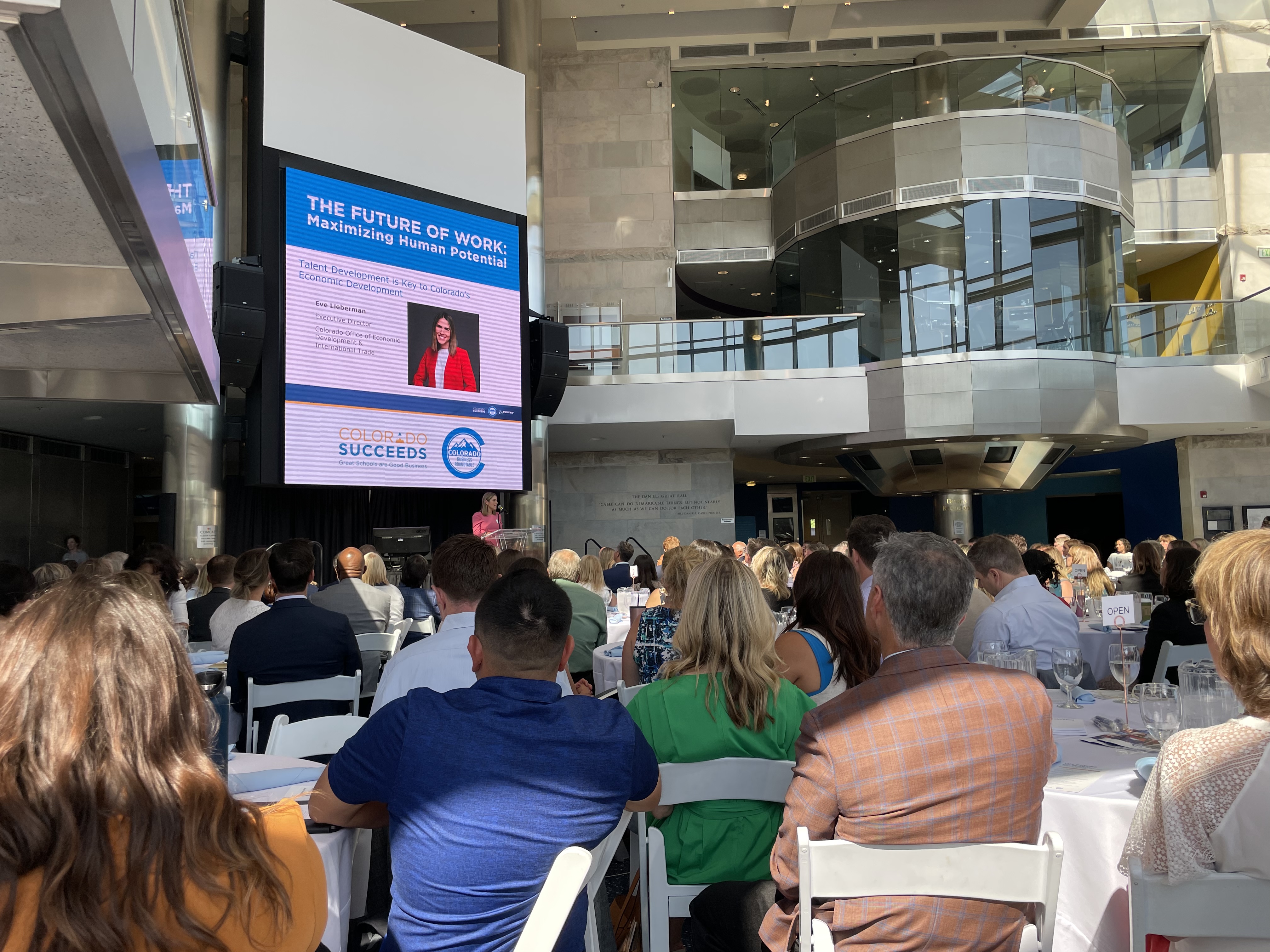
The Colorado Business Roundtable and Colorado Succeeds hosted a sweeping discussion about the future of workplaces with its event “The Future of Work: Maximizing Human Potential” on Tuesday.
Speakers made the case for moving past debates about the “Great Resignation” or the return to offices and in support of adapting to new global workforce trends. They challenged attendees to think about whether traditional pathways that led to their success will work for future generations entering the workforce amid high inflation and cost of living. They investigated the link between education and hiring organizations, and how that pipeline needs to be innovated moving forward.
Among them was Steve Hatfield, principal with Deloitte Consulting, who walked the audience through global workforce trends he said matter most. In summary, he said, the workplace is undergoing a revolution.
Was it a great resignation, or did new talent pools form, he asked the packed lobby of The Cable Center in Denver. U.S. participation in the labor force is higher than it’s ever been, he said.
Questions may abound about the future of AI or the metaverse, but humans and machines will continue to collaborate. Hatfield argued technology like AI has the capacity to free up workers from the “drudgery” in their roles and give them time to boost productivity elsewhere, and that surveys indicate employers will use it to augment workers responsibilities more than replace them.
Climate change is having its workforce ramifications too, he said. Certain sectors are under major duress as a result of climate change, but new green jobs are coming. History shows that as some jobs fade into irrelevancy, jobs that never existed before are also created, he said, stressing that managing that transition is key.
“It’s a churn, it’s an ongoing evolution,” he said.
The pandemic created a new sense among workers about what they want from their workplace and their quality of life, he said, asking the audience to weigh “work ethic” versus “life ethic.”
Younger generations are not interested in the 9-to-6 model, or lifetime employment, in the way past generations were. Millennials and Gen Z are putting more stock in work-life balance. Burnout and mental health stressors are leading reasons they might leave a job.
What’s more, a 2023 Deloitte Millennial and Gen Z Survey found 76% of participants prefer hybrid work models because of their flexibility. A 2023 Deloitte Women @ Work Outlook survey found 74% of women agreed.
One survey found that 60% of participants listed “no compelling reason” as their top reason for not going to the office. What does that have to say, Hatfield asked, and why aren’t workplaces creating those compelling reasons.
“It’s time to think about something beyond these conversations. It’s time to think about moving beyond” talking about the “Great Resignation” or the “return to office” and instead ruminate on what workplace shifts have emerged and how to adapt, he said.
Individuals want a say in shaping their work experiences, according to Deloitte surveys. A majority of participants want to join organizations that value their skills and potential over jobs. Managers view some external workers as part of their organization’s workforce, leading to more of an emphasis on “workforce ecosystems” than employees alone. There’s also a shift from employer-led to employee-led workplaces, as workers report they are increasingly willing to switch employment models throughout their careers.
Organizations should be willing to “think like a researcher” and experiment as they change with new workforce trends, he said. There is a demand for organizations to co-create with their employees new workforce rules in an evolving environment and to prioritize “human outcomes.” Businesses are realizing that the wellbeing of the workforce matters more than ever, he said.
Eve Lieberman, executive director of the Colorado Office of Economic Development and International Trade, told attendees it is imperative Colorado develop its homegrown workforce.
Businesses regularly choose Colorado for expansion or relocation because of its quality of life, a central location with access to the global market, an expanding industry portfolio and its talent pool.
The state’s workforce consistently places at the top of rankings from Forbes, CNBC, U.S. News & World Report, she said. The state had the third highest share of adults with advanced degrees as of 2021, and the second-highest labor force participation as of November 2022.
But Colorado has a dilemma. More than 90% of family-sustaining jobs require postsecondary education and training, while only 49.9% of high school graduates enrolled in postsecondary education in 2020.
“That was a 10% decline from the previous year and a trend that preceded the pandemic. And this decline can be seen across ethnic groups, and cities and rural areas across Colorado,” she said. “And we know the Colorado paradox. It’s true that many Colorado residents with four-year degrees come here from out of state, and our home-grown students are less likely to see the value of a college degree.”
Colorado is also seeing slowing migration trends and growth in its aging population.
“We need to work to provide workers with the skills and trainings for the jobs now and in the future, and we need to double down to retrain our homegrown talent and ensure that Coloradans are trained in the skills that our industry partners require,” she said.
Numerous schools districts have rolled out programs that allow high school students to take concurrent enrollment with community colleges, and to graduate with certificates and work experience that make them job ready.
Educational institutions are beginning to transition from slow education and training cycles to more nimble systems, she said. There must also be continued transition from place-based learning to on-the-job and work-based learning, more zero-cost options, and skills-based hiring, among other shifts, she said.
She also called on Colorado industries to help prepare high school graduates to enter the workforce.
“It’s not sufficient anymore to leave this training to academic institutions alone,” she said.