







Shape-shifting, tiny robot can squish itself into tight spaces
Engineers at CU Boulder unveil CLARI
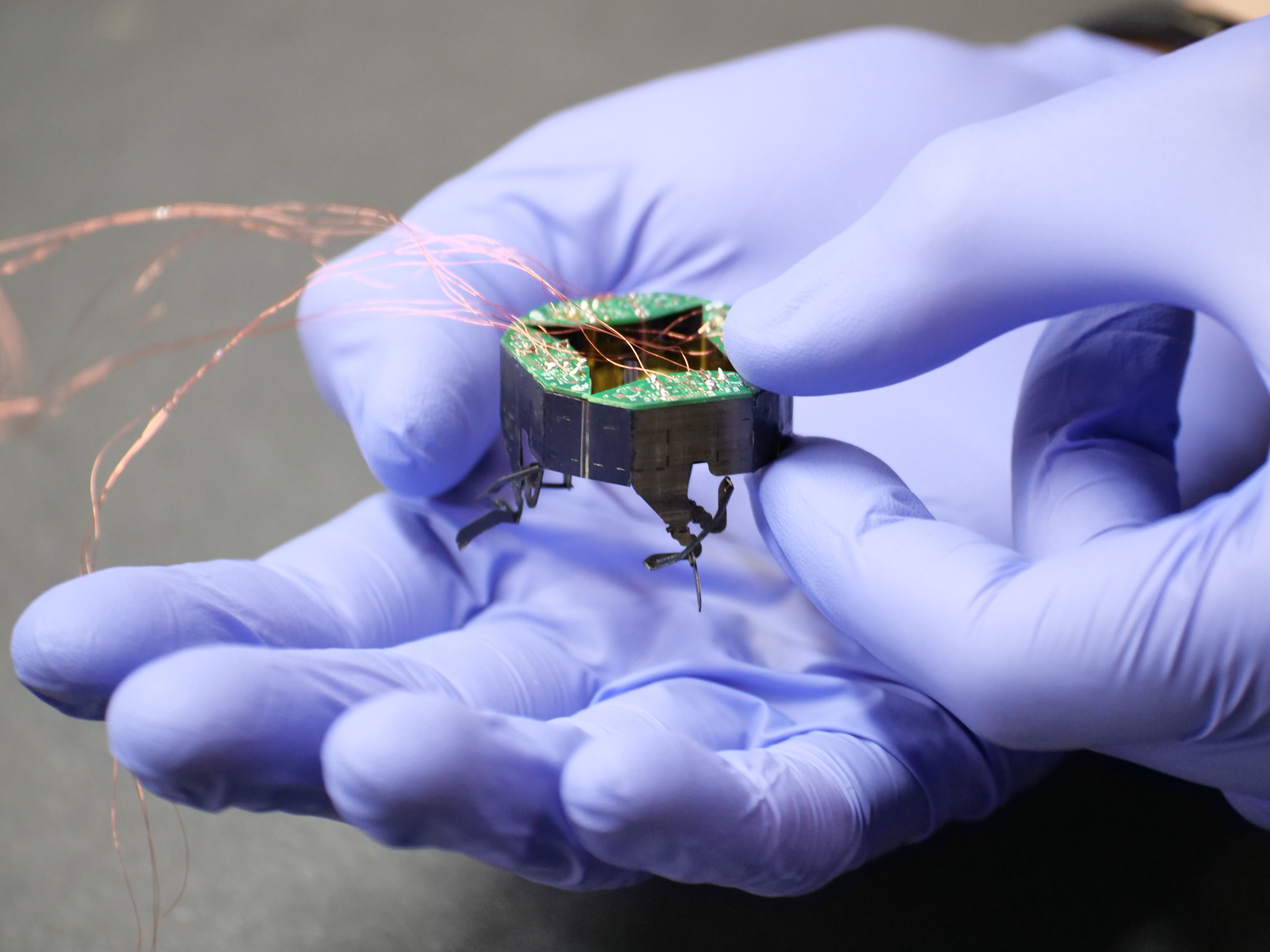
A team of engineers at the University of Colorado Boulder developed a new shape-shifting, tiny robot that according to University officials is ‘squishable’.
Compliant Legged Articulated Robotic Insect, or CLARI, can passively change its shape to squeeze through narrow gaps — with a bit of inspiration from the bug world, the university said.
One application the robot is said to have is the potential to aid first responders after major disasters in an entirely new way.
“Several of these robots can easily fit in the palm of your hand, and each weighs less than a Ping Pong ball,” Heiko Kabutz said in a news release. “CLARI can transform its shape from square to long and slender when its surroundings become cramped.”
Kabutz is a doctoral student in the Paul M. Rady Department of Mechanical Engineering at CU Boulder.
Kabutz and his colleagues introduced the miniature robot in a study published Aug. 30 in the journal “Advanced Intelligent Systems.”
CLARI has four legs, but the machine’s design allows engineers to mix and match its appendages, potentially giving rise to some wild and wriggly robots.
“It has a modular design, which means it’s very easy to customize and add more legs,” Kabutz said. “Eventually, we’d like to build an eight-legged, spider-style robot that could walk over a web.”
In its most basic form, the robot is shaped like a square with one leg along each of its four sides. Depending on how you squeeze CLARI, however, it can become wider, like a crab, or more elongated, like a cockroach. In all, the robot can morph from about 34 millimeters (1.3 inches) wide in its square shape to about 21 millimeters (0.8 inches) wide in its elongated form.
CLARI is still in its infancy, said Kaushik Jayaram, co-author of the study and an assistant professor of mechanical engineering at CU Boulder.
“The robot, for example, is tethered to wires, which supply it with power and send it basic commands,” Jayaram said.
But he hopes one day these petite machines could crawl independently into spaces where no robot has crawled before, such as the insides of jet engines or the rubble of collapsed buildings.
“Most robots today basically look like a cube,” Jayaram said. “Why should they all be the same? Animals come in all shapes and sizes.”
Ultimately, the team wants to develop shape-changing robots that don’t just move through a lab environment, but a complex, natural space. They want, and need, the machines to bounce off obstacles like trees or even blades of grass or potentially push through the cracks between rocks and keep going.
Read the full article here.