







NC State’s Final Four berth has David Thompson fired up 50 years after Wolfpack’s ‘amazing’ run
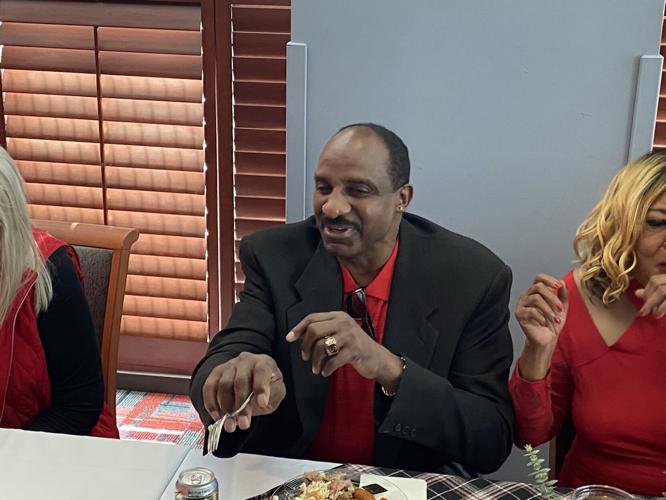
Former Denver Nuggets star David Thompson at the Saturday, Feb. 24 reunion of the 50 th anniversary of North Carolina State winning the 1974 NCAA basketball title. The event was held at PNC Arena in Raleigh, N.C., in conjunction with North Carolina State's game against Boston College. Thompson starred for the Nuggets from 1975-82. (Photo by Chris Tomasson/The Denver Gazette)
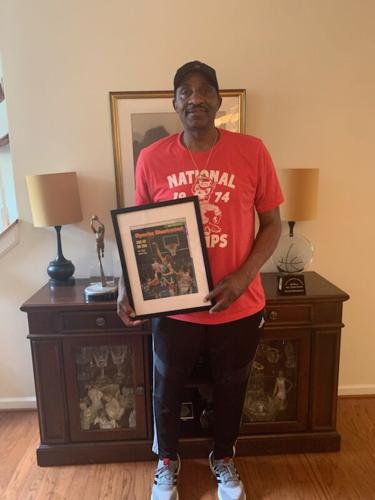
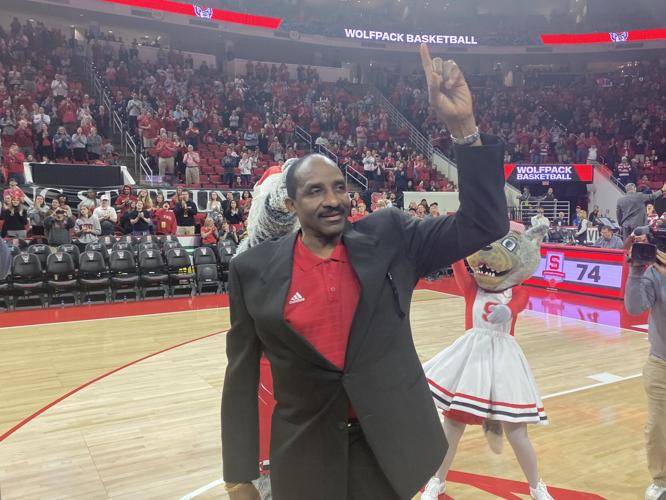
On Feb. 24, David Thompson and his teammates from the 1974 NCAA champion North Carolina State team gathered for a 50th reunion on campus in Raleigh, N.C.
They joked about how they were all getting old and shared plenty of stories from yesteryear.
The former players were introduced at halftime of NC State’s game against Boston College at PNC Arena and got a big round of applause. The Wolfpack that day defeated the Eagles 81-70, but nobody thought then they might go on to the Final Four.
“No way,’’ said Thompson, a Basketball Hall of Fame swingman and former high-flying Nuggets star.
After that game, North Carolina State was 17-10 before soon losing four straight to drop to 17-14. Then the Wolfpack caught fire.
NC State won five games in five days to win the Atlantic Coast Conference tournament and earn an automatic bid to the NCAA tournament. Then the Wolfpack, as a No. 11 seed, won four straight tournament games to stunningly reach the Final Four.
“It was just amazing how they came together,’’ Thompson told The Denver Gazette. “Maybe in a way they were motivated by us being around and by us having won it, so they figured they could make their own path to glory.”
So now the legendary North Carolina State team of 1974 can have another reunion of sorts this weekend in Glendale, Ariz., site of the Final Four. The Wolfpack face No. 1-seed Purdue on Saturday with the winner to play for the national title Monday night against the winner of the other semifinal between defending champion and No. 1 seed Connecticut and No. 4 Alabama.
Thompson, who had a statue last December unveiled in his honor at NC State, will attend the game as will Tom Burleson, the Wolfpack’s star center in 1974. Others from the team also might be there.
Thompson, who lives in Charlotte, N.C., will fly Friday to Arizona in a private plane furnished by Derek Close, a longtime North Carolina State donor, and his wife Sally. Also going along will be Dereck Whittenburg, Thompson’s cousin and a guard on the 1983 NC State title team, and his nephew Curtis Brown.
“It will be nice if they give us a little shout out (at the game Saturday),’’ Burleson said of he and Thompson.
Thompson plans to sit with NC State athletic director Boo Corrigan at Saturday’s game. The previous night, Corrigan will cheer on the Wolfpack facing South Carolina in the women’s Final Four in Cleveland.
It will be NC State’s fourth appearance in the men’s Final Four, the first being a third-place finish in 1950 and the latest being the Wolfpack’s miraculous 1983 championship under head coach Jim Valvano, who died in 1993. At the very least, with it being the 50th anniversary of the 1974 champions, there figure to be some grainy highlights rolled out this week depicting that team.
“It will bring more attention to our team,’’ Thompson said. “Them showing 50 years later us going against UCLA and beating them and beating Marquette, it’s going to be great for us.”
The Norm Sloan-coached Wolfpack went 30-1 that season and in a dramatic national semifinal in Greensboro, N.C., on March 23, 1974, stunned seven-time defending champion UCLA and star center Bill Walton 80-77 in two overtimes. The Wolfpack won the title two days later, 76-64 over Marquette.
Burleson chuckled when talking about how the Wolfpack’s win over Duke last Sunday in the South Region final was by the same score as the 1974 championship game. And last Friday NC State defeated Marquette 67-58 in the regional semifinal 50 years and four days after the teams met in the 1974 title game.
The 1973-74 season thrust Thompson into the national spotlight during his junior year. The Wolfpack had gone 27-0 but were on probation in 1972-73, so Thompson had been denied a chance to show his stuff in the NCAA tournament.
The season 50 years ago also served as a springboard to Thompson eventually being taken with the No. 1 pick in the 1975 draft by Atlanta but surprisingly jilting the Hawks to sign with the Nuggets, who had made him the No. 1 pick in the ABA draft. The coach of that Denver team, the legendary Larry Brown, had been coach of the ABA’s Carolina Cougars in 1973-74 and had seen Thompson plenty that season in what one could consider the start of a recruiting process.
“He was an amazing kid and an amazing player,’’ Brown said of Thompson, who earned the nickname “Skywalker” during his Denver years. “A lot of people talk about Michael Jordan, but he was Michael before Michael.”
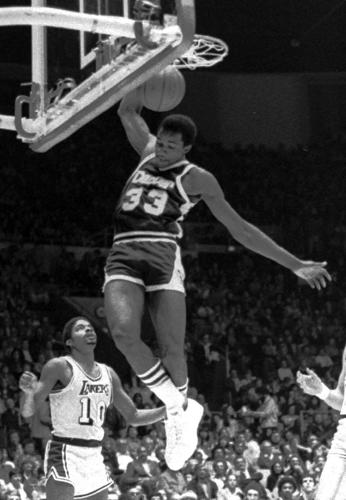
The 6-foot-4 Thompson, who threw down his share of dunks while utilizing his 44-inch vertical leap, played for the Nuggets in the ABA in 1975-76 and then made three All-Star Games in the NBA from 1977-82. He finished his NBA career with Seattle from 1982-84 and never played past the age of 29 due to drug issues and a knee injury suffered while falling down the stairs at New York’s famed Studio 54 nightclub. He was inducted into the Basketball Hall of Fame in 1996.
Thompson, 69, has been sober since 1988. He regularly speaks to youth groups about avoiding some of the pitfalls he had. Of course, he also talks about winning an NCAA championship.
“It was great,’’ he said. “It was amazing how the whole state was captivated by that team.”
Dunking wasn’t allowed when Thompson played in college, but his highlights from that era are still spectacular. Monte Towe, North Carolina State’s 5-7 point guard, popularized the alley-oop by throwing the ball up high to Thompson for layups. And Thompson also had a lethal jump shot.
“He’s one of the greatest ever,’’ said Towe, who played for the Nuggets from 1975-77. “He’s always been a legend.”
Brown said a lot of younger people don’t know much about Thompson’s greatness, and he gets asked more often about Allen Iverson, whom he once coached with the Philadelphia 76ers. Burleson said the 50th anniversary of the 1974 champions coupled with North Carolina State making the Final Four might get some more folks to know about “Skywalker.”
“I hope so, because David was such a spectacular player,’’ Burleson said. “It would be good to give this generation a look back at what he could do and how good of a player he was.”
Thompson, a native of Shelby, N.C., arrived at North Carolina State in 1971 at a time when freshmen weren’t eligible to play varsity basketball. He averaged 36 points and 13 rebounds on the freshmen team, but there was some controversy surrounding him.
After he signed, Thompson had gone to NC State to play in a pickup game and then-Wolfpack assistant coach Eddie Biedenbach happened to be in the gym at the time. There was a North Carolina football player taking part in the pickup games, and he went back to his school and reported what he had seen. The NCAA ended up putting the Wolfpack on probation for the 1972-73 season due to an illegal tryout, a violation Burleson said was “not a big deal” and a penalty he said was pushed for by iconic North Carolina coach Dean Smith.
Thompson in 1972-73 averaged 24.7 points and 8.1 rebounds and did come up big in a few nationally televised games. But Towe said he was “under the radar a bit” that season due to the Wolfpack being unable to participate in the NCAA tournament.
“They knew me more on the East Coast, but you really make your name when you play well in the NCAA tournament, so that’s where that was,” Thompson said.
With the Wolfpack off probation, they were ranked No. 2 entering the 1973-74 season behind UCLA, which had had gone 30-0 in 1972-73 and won its ninth title in 10 seasons behind Walton and star forward Keith Wilkes, who later changed his name to Jamaal Wilkes.
Walton and Wilkes were back as seniors in 1973-74 and the John Wooden-coached Bruins were ranked No. 1 entering the season. A game was set up in St. Louis between the top two teams on Dec. 15 and televised by ABC.
“Going against UCLA at that time was like going against movie stars because they were on TV all the time and had won seven consecutive national titles,’’ Thompson said. “So, we were a little bit in awe of them at first but once we got out there, we saw we could play against them. But I didn’t shoot well, and myself and Burleson, we played nowhere near our best game.”
The Wolfpack actually led by one point at halftime before being overwhelmed in the second half of a 84-66 loss. But Thompson said the Wolfpack were getting a bit complacent at the time following the undefeated previous season and that the game served as a wake-up call.
North Carolina State dropped to No. 5 in the nation after the loss to UCLA but then began rattling off lopsided wins and got back to No. 2. The Wolfpack ascended to No. 1 by mid-February after UCLA had its 88-game winning streak snapped at Notre Dame in mid-January and lost back-to-back games a month later at Oregon State and Oregon.
“He was head and shoulders above everybody else in the ACC,’’ forward Bobby Jones, who was a senior that season at North Carolina and later was Thompson’s Nuggets teammate, said of the Wolfpack star averaging 26 points and 7.9 rebounds in 1973-74.
When the finals of the ACC tournament arrived on March 9, the Wolfpack took on No. 4 Maryland, which featured stars Len Elmore at center, Tom McMillen at forward and John Lucas at guard. Because back then the NCAA tournament only took the winner of the ACC tournament, it was a do-or-die game.
In what some regard as the greatest college basketball game ever played, the Wolfpack won 103-100 in overtime. The Terrapins, under coach Lefty Driesell, were determined to stop Thompson, who had averaged 40 points against them in two previous meetings that season. While Maryland double- and triple-teamed Thompson, he still had a workmanlike 29 points. And the 7-foot-2 Burleson really made Maryland pay, totaling 38 points in the scoring fest.
“Burleson was unbelievable, but the whole deal was Lefty saying, ‘We’re not going to let Thompson beat us,’’’ Towe said.
The following week, the Wolfpack hammered Providence 92-78 and Pittsburgh 100-72 in the East Regional at home at Reynolds Coliseum to advance to the Final Four. But there was still plenty of drama in the regional final.
About 8 minutes into the game against Pittsburgh, Thompson became frustrated after believing he had been fouled on a jump shot. So, he sprinted back up the court with vengeance on his mind.
“I was trying to do something spectacular on the opposite end of the court, so I took off running,’’ he said. “I jumped up with my 44-inch vertical leap and I tipped the ball, but (Wolfpack forward) Phil Spence moved over into rebounding position and I tripped over his shoulder and hit the floor and I was knocked unconscious.”
After Thompson’s head hit the floor, he said he was out cold for 10 to 15 minutes. He was rushed to the hospital, waking up in the ambulance, and was diagnosed with a concussion while getting 15 stitches.
“You look at that fall and you’re saying, ‘Is he alive? Did he break his neck?’ And if he broke his neck, he’s probably paralyzed for the rest of his life,’’ Burleson said.
Thompson said there was so much concern about him he later learned that CBS news anchorman Walter Cronkite and O.J. Simpson, then a Buffalo Bills star running back, had called the hospital to inquire about his health.
After being treated at the hospital, Thompson was determined to return to Reynolds Coliseum to let his teammates know he was OK. He arrived late in the game, and the crowd gave a standing ovation to Thompson, wearing a big bandage on his head he said resembled a turban.
“When he came back, we all just stopped playing and walked off the court,’’ Towe said. “We all gave him a big hug.”
Thompson didn’t return to the game. And with the national semifinal against UCLA a week away, there was some concern about whether he would be able to play in the Final Four an hour west of the NC State campus.
“If this was today, there was no way I would have been cleared to play due to the concussion protocol,’’ Thompson said. “But there was no way I was not going to play.”
Thompson said he felt fine when taking the floor against the Bruins. But it was noticeable that he had been injured since part of his Afro had been shaved to insert the stitches and they were covered by a big white bandage.
The game against the Bruins was a classic, being tied 65-65 after regulation and 67-67 after the first overtime. UCLA then took a 74-67 lead midway through the second overtime.
“We were a little worried and Coach Sloan called a timeout and said, ‘Boys, we got to make something happen,’’’ Thompson said.
The Wolfpack did just that, going on a big run to take the lead for good at 76-75 on a Thompson bank shot over Wilkes with about a minute left. Thompson finished the game with 28 points and 10 rebounds while leaving Walton on the losing end. Walton had 29 points and 18 rebounds but had six turnovers and had two of his shots blocked by Thompson.
“We were all so excited,’’ Thompson said. “We had slayed the mighty giant. It felt good. Not only did they have Walton, but they had Jamaal Wilkes, Dave Meyers and Marques Johnson. Walton always tells me I was the best player he played against in college — and vice versa.”
Walton was the unanimous two-time winner of College Player of the Year awards prior to 1974, when he split honors with Thompson. Thompson was the 1974 Associated Press Player of the Year and then was the unanimous winner of awards as a senior in 1975.
“David proved then he belonged on the same stage as Walton,’’ Towe said.
After the win over UCLA, Thompson said Sloan stressed to the team “not to take the next game for granted.” That final against Marquette turned out to be anticlimactic, with North Carolina State winning easily behind 21 points from Thompson.
“It’s hard to explain what a great feeling it was,’’ Thompson said of winning the championship. “On the drive back from Greensboro, we stopped at the grave of (former Wolfpack coach) Everett Case, who was one of the guys that started ACC basketball, because Coach Sloan wanted to give him respect. So we stopped by and said a prayer and then we went back to Reynolds Coliseum and the place was packed. Then the next day we had a parade.”
There is a statue of Case, who was North Carolina’s State’s coach from 1946-64 and died in 1966, outside of Reynolds Coliseum, which opened in 1949 and still stands on campus even though the Wolfpack haven’t played there since 1999. There also is a statue of Sloan, who died in 2003.
Early last year, Corrigan called Thompson with a request.
“He asked me if I would be OK with them building a statue of me outside of Reynolds Coliseum,’’ Thompson said. “I was floored. I said, ‘Of course, it would be OK.’ I didn’t know what to say. I was stunned. It brought tears to my eyes. I was so grateful, so thankful.”
The unveiling of the statue came last December. Thompson is depicted jumping exactly 44 inches off the ground and reaching up with a basketball in his hand. He said the statue is an excellent match, all the way down to “getting my ‘fro right.”
As far as Thompson is concerned, a lot has gone right lately at NC State.
“This has been a special year for Wolfpack nation, starting with the statue and the 50-year anniversary,’’ Thompson said. “And now the men’s team is in the Final Four, and the women’s team is too. It’s crazy. Everybody’s excited around here with this Cinderella (men’s) team, pulling for the Wolfpack. Even some Carolina (Tar Heels) fans are, which is pretty unusual.”
***
Leader of the Pack
David Thompson’s varsity stats at NC State
Year Games Points Rebounds FG%
1972-73 27 24.7 8.1 56.9
1973-74 31 26.0 7.9 54.7
1974-75 28 29.9 8.2 54.6
***
North Carolina State’s Final Four appearances
Year Coach Location Finish
1950 Everett Case New York Third
1974 Norm Sloan Greensboro, N.C. Champions
1983 Jim Valvano Albuquerque, N.M. Champions
2024 Kevin Keatts Glendale, Ariz. TBD