Seconds matter: How Columbine changed police response
Colorado police highlight evolution of response and prevention methods since 1999

When two teenagers shot and killed 13 people at Columbine High School on the afternoon of April 20, 1999, Gene Enley was working the night shift.
Enley was an overnight officer for the Littleton Police Department, the agency that responded to the school shooting. His mother called to wake him up, alerting him of the news.
“I can’t say that right away as the incident was going on I thought, ‘Oh, geez, this is going to change things.’ But clearly it did for law enforcement soon after,” Enley, now a division chief of patrol for the department, said.
While Enley noted that he was not one of the officers who responded to Columbine that day, he has seen the major shift in the way police officers plan, prevent and deal with mass-shooting situations over the past 25 years — changes other law enforcement has made throughout the state and country.
“We understand that seconds matter,” Douglas County Sheriff Darren Weekly said. “We understand that the longer it takes us to get it in the building, someone’s loved one could be dying — whether it’s their child or it’s a staff member at the school.”
A change in response
Officers and deputies responding to the Columbine shooting took more than 40 minutes to enter the school.
The reason? Officers were trained to secure the perimeter and wait for SWAT teams to arrive before entering the sites of major shootings, according to Enley.
Today, officers are trained to respond to situations without the help of tactical units. They are now armed with tactical training and long guns, such as the AR-15.
Before Columbine, most cops carried handguns and shotguns.
“People had a lot of questions, and rightfully so, like, ‘Why didn’t law enforcement go in? We have the guns, we have the protection, we have the bullet vests.’ A lot of people were very critical,” Weekly said. “Now, law enforcement around the country does train to immediately go in and immediately neutralize the threat.”
Enley added: “Every police officer, every deputy knows that they need to stop the killing as soon as possible.”
The officer noted that these changes happened almost immediately in Littleton after the high school mass shooting in 1999. The rest of the state and nation picked up quickly after, he said.
Both Enley and Weekly also pointed to multi-agency training involving other police departments and fire departments, working together to create quick response plans.
Weekly was a SWAT commander during the Arapahoe High School shooting in 2013 when a student, Claire Davis, was shot and killed by another student. He said the biggest issue during the event was communication.
“When we do have an active killer situation, one of the biggest things is communication between the agencies,” Weekly said. “Who is going in? What are they doing? What are they seeing? What are they hearing? How do the responding units go in to neutralize the threat and make the situation safe?”
Now, these tactics and communication are coordinated through multi-agency training and in-agency scenario drills done throughout each year, according to both Weekly and Enley.
The DeAngelis Center
One headquarters for situational training added to police departments’ regimen over the last 25 years lies in a Wheat Ridge neighborhood.
The Frank DeAngelis Center for Community Safety, which took over the former Martensen Elementary School in 2017, works to train law enforcement by replicating school-shooter situations for departments nationwide — a mission that was started by DeAngelis, the principal of Columbine High School during the shooting.
The center — which keeps the layout and structure of a school — gives law enforcement, school administrators and other emergency responders a place to replicate mass shooting scenarios.
Both the Littleton Police Department and the Douglas County Sheriff’s Office train at the facility, with countless other departments also participating in drills.
Since its inception in 2017, the center has trained more than 170,000 people — including more than 350 federal, state and local agencies — in active shooter situations.
“It’s hope,” DeAngelis said of the facility. “If there’s anything I could have done to protect those kids and Mr. (William) Sanders, that’s something I have to live with for the rest of my life. They walked into my school at 7 o’clock and they never made it home. That’s something that I can’t take back, but what can I do to carry on their legacy? I think this building does that.”
Sanders was a computer and business teacher at Columbine.
“How do we get the kids to where they need to be? How do we get the parent with the kids as quickly as possible?,” Enley said of the newfound training that exists at places like the center. “So, working on those plans and making sure that we’re up-to-speed on contact information has changed as well.”
“The only drills we did back in 1999 were fire drills,” DeAngelis said. “We had school resource officers but we didn’t know what the kids know today… It’s not to scare. It’s to prepare.”
Experts: Prevention is key
One change stretches beyond preparation and response — officials said prevention has become a necessary step in the process of lowering the number school shootings, a tactical shift that started around a decade ago.
There have been 404 school shootings between Columbine and April 2024, according to the Washington Post, which said it pieced together data from news articles, reports from law enforcement, open-source databases and calls to schools and police departments.
There have been 1,676 causalities from school shootings between 2000 and 2022, according to the National Center for Education Statistics.
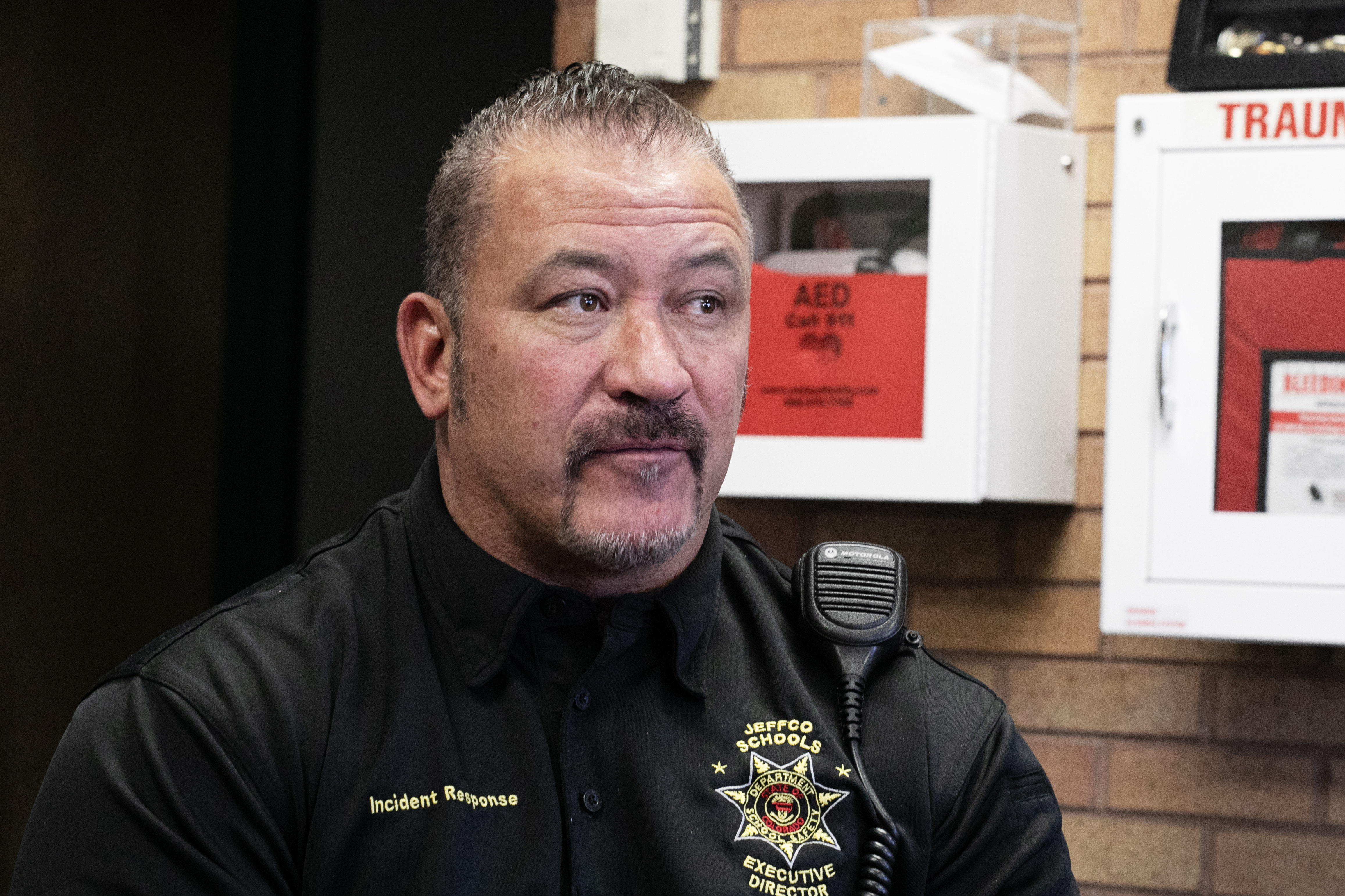
While great response and training can help reduce casualties, it doesn’t stop the overall amount of school shootings that occur within the country, according to Jeff Pierson, executive director of safety and security for Jefferson County Public Schools.
“We are working really hard to understand what the culture and climate looks like in our schools,” Pierson said. “We got really good at response. What we were missing was how to connect with the kids. We want to get to the point where we’re understanding and setting a culture of awareness early on with kids and providing resources before we get to the response phase.”
The changes within local police departments regarding prevention start at the mental health level — for the officers themselves and their response training, according to Enley.
“They saw some horrific things. In that, they were probably put to work in the next couple days after seeing that,” Enley said of the officers responding to Columbine. “That’s probably not the way we should do things and we knew it back then. We just didn’t know a better way to do it.”
Now, officers have peer support teams, psychological services and debriefings, allowing officers to decompress before going back to field work, Enley added.
They are also now trained on how to deal with mental health crises other people may be experiencing.
“Prevent may be a strong word, but the way that we can try to intervene before is through the work we do with mental health responders, co-responders, how we train our officers on how to deal with mental health issues,” Enley said. “In the past, we thought it was somebody else’s problem to deal with. Now, it’s our job to get them the help they need.”
“We expect for our law enforcement officers to understand mental illness when they see it, to recognize it, to de-escalate situations, instead of escalating situations, and that’s because that’s what the public demands of us and expects of us,” Weekly said.
Regarding school shootings specifically, the communication bridge between schools and law enforcement agencies, as Pierson noted, still stands as the most important factor in prevention.
School Resource Officers
School Resource Officers (SROs) — sworn officers assigned in schools — did not become a widespread idea until the 1990s.
The practice has faced its share of scrutiny — and support.
Notably, the Denver Public Schools board voted to get rid of SROs in 2020, citing fears of over-policing. Under public pressure following the school shooting at East High School that left two administrators wounded in March last year, the school board reversed their decision and returned SROs to schools.
To law enforcement officials, the placement of SROs in schools is crucial for both response and reduction of school shootings.
“We want to harbor a good communication between law enforcement and our youth and our community,” Weekly said. “But bottom line, if somebody goes in there to kill kids and kill staff, that SRO is there to neutralize that threat as quickly as possible.”
Douglas County, for example, has only bolstered the number of SROs the department deploys since 2020, according to Weekly.
To Pierson, it’s paramount to create a conducive learning environment, in which children feel safe — creating a place that’s culturally safe, not just perimeter safe.
“We can provide as much of a secure perimeter as we want. We cannot allow visitors in. We can put secure vestibules and lock doors,” Pierson said. “But what we’ve found is a lot of the tragedies are being done by former students or students, which tells us that we’ve got to pay attention to the internal pieces of mental health awareness.”
Both Pierson and DeAngelis added that the addition of Safe2Tell, Colorado’s anonymous reporting system, into JeffCo schools has certainly helped increase the awareness.
“I can honestly tell you we’ve mitigated many threats, many issues simply because our students or our community were willing to see something and say something, but (were) able to stay anonymous while they did it,” Pierson said of Safe2Tell, adding there has been a “staggering” amount of mitigation since the system was adopted.
What’s next?
While police response isn’t the only factor that can help reduce the number of shootings, there are still improvements that can be made by departments, according to Enley.
“What we’ve done well — we just need to continue doing,” Enley said.
He added that some things can get in the way, like “putting everybody’s ego in check — whether you’re a legislator, whether you’re a law enforcement officer, whether you’re an educator — and make sure that we’re all working together.”
“I think we do that pretty good right now,” he said.
Weekly said he believes some legislation might get in the way of reducing critical incidents.
In particular, Weekly cited Senate Bill 24-131, which, as originally introduced, would have banned firearms, including concealed weapons, from “sensitive spaces,” notably colleges, universities and schools and local government offices and courthouses.
“Too many Coloradans have been impacted by gun violence, and this bill would keep these dangerous weapons out of certain sensitive spaces,” co-sponsor Rep. Kyle Brown, D-Louisville, said in a news release. “From preschools to polling places to the Colorado Capitol, there are places where guns pose a serious threat to Coloradans’ safety and can be used to intimidate people from their constitutional rights to free speech and to vote. Coloradans deserve to feel safe, and I am proud to sponsor this commonsense gun violence prevention bill.”
“That’s absolutely ridiculous,” Weekly said of the idea. “If something happens at a Walmart or a park, I’m a former SWAT officer, so I know what I’m doing with a weapon. You want me armed in those spaces to protect the lives of the people there.”