







Colorado energy regulators reject Xcel’s plans to build hundreds of EV charging stations

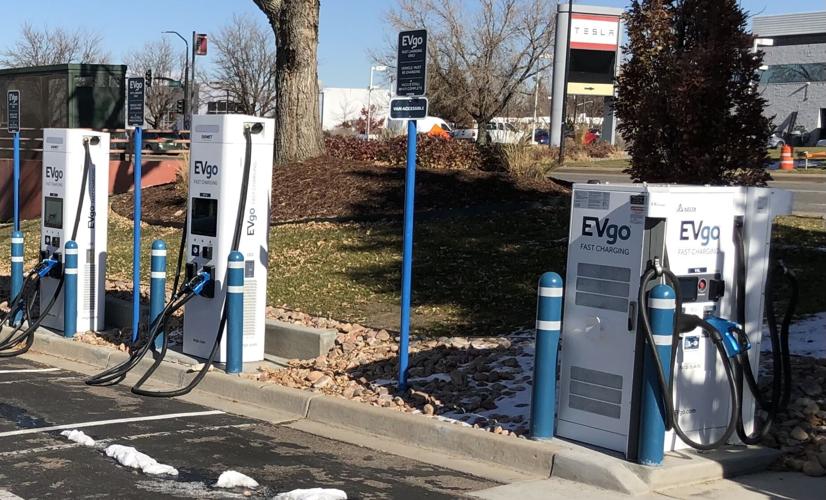
FILE PHOTO: Electric vehicle chargers sit outside a Ford dealership Sunday, Jan. 21, 2024, in Broomfield, Colo. (AP Photo/David Zalubowski)
David Zalubowski/Associated Press
Xcel Energy’s state-mandated transportation electrification plan for 2024-2026 is moving forward after getting the approval of Colorado’s energy regulators.
What won’t be moving forward are Xcel’s plans to bill some customers $120 million to build 460 electric vehicle chargers it would own and operate.
The Colorado Public Utilities Commission approved the company’s updated transportation electrification plan, whose original request was $344 million, but cut the budget by more than $172 million overall.
Notably, regulators reduced the budget for the proposed company-owned EV chargers to $16 million, which will be used for a rebate program for private companies wishing to build chargers statewide, according to Ryan McKinnon, spokesperson for the Charge Ahead Partnership, a coalition of businesses and organizations working to expand the free market for EV charging in Colorado.
Xcel Colorado filed its second, three-year Transportation Electrification Plan on May 15, 2023, asking that the commission authorize the company to build, own and operate public chargers with roughly 580 individual charging ports.
McKinnon said the issue is that Xcel, a regulated monopoly, shouldn’t be in the business of competing with private industry in providing vehicle chargers because it’s an unfair economic advantage for the company to use captive ratepayer money.
“With private businesses eager to offer EV charging to customers, the PUC understood that steering $120 million of ratepayer money to Xcel to run its own EV charging business would dis-incentivize long-term private investment,” McKinnon said in a news release.
The PUC also cautioned the company from bringing forward any similar requests in the future, McKinnon said.
Michelle Aguayo, spokesperson for Xcel Energy Colorado, said the company appreciated the commission’s approval of the rebate program for public fast chargers.
“A rebate program for public fast charging was included in the settlement we reached with a wide range of parties in the Transportation Electrification Plan,” Aguayo said in a statement to The Denver Gazette. “We are closely reviewing the commission’s written order and the details of the program as modified by the commission in its decision. Our transportation vision compliments the state’s vision and we’re proud to partner with many others to achieve the state’s ambitious clean transportation goals.”
Amy O. Cooke, Energy Policy Visiting Fellow for the State Policy Network, doesn’t think Xcel should be in the business of providing EV charging infrastructure at ratepayers’ expense, arguing it “socializes” the costs and privatizes benefits for a minority of drivers.
“EV charging stations and infrastructure should be beyond Xcel’s scope of work,” Cooke said in a prior statement to the Denver Gazette. “Ratepayers should remember that lawmakers and other elected officials are to blame for skyrocketing utility bills.”
Without authorizing Xcel to bill ratepayers for electrical infrastructure improvements for EV charging, the company and the state risk falling behind in keeping up with EV charging demand and state transportation electrification goals, the settlement document said.
“Simply stated, without approval to recover the needed distribution system capacity investments the Company has no current plans to fund them,” the settlement document said. “To support the levels of transportation electrification Colorado desires, the Company will need to upgrade its distribution system.”
The state’s clean transportation goals might be facing more headwinds.
In January, Reuters reported an international slowdown in EV manufacturing and sales, saying investment in capacity and technology development has outrun actual EV demand, boosting pressure on companies to cut costs.
GM previously cut EV production targets due to the slowing demand, as did Ford, but GM CEO Mary Barra told analysts the company was “encouraged” by industry forecasts that EV sales in the United States would rise at least 10% this year from about 7% in 2023.
Gov. Jared Polis’ Greenhouse Gas Reduction Roadmap calls for hitting a target of 940,000 EVs on the road statewide by 2030, six years from now.
To reach Polis’ goal, auto dealers would have to sell about 125,000 EVs per year — a “hockey stick” uptick in sales, Tim Jackson, the former director of the Colorado Automobile Dealers Association, said in a prior interview with The Denver Gazette.
Jackson added that EV sales would need to make up about 50% of the approximately 250,000 annual new vehicle sales to reach that goal.
The introduction to the settlement agreement said: “Despite recent progress made, Colorado is only 11% of the way to achieving its 2030 goal of putting 940,000 EVs on the road.”
“In assessing the costs and benefits of meeting Colorado’s 2030 EV goal for its service territory, the company’s consultant has found a statewide infrastructure need of over $4 billion,” the document said.
Keith Hay, senior director of policy at the Colorado Energy Office acknowledged that Colorado is lagging behind the desired pace of EV purchasing, despite state and federal rebates, saying that only 236 of 1,075 residential EV rebates for low-income customers have been awarded in the 2021-2023 timeframe, likely due to the high cost of buying EVs, even with rebates.
More than $15 million of Xcel’s approved transportation electrification plan is dedicated to trying to educate and inform people of the benefits of EVs and how they can get rebates.
Xcel Energy in Minnesota faced the same opposition to its plan to spend $192 million to build 460 public chargers there.
After the Minnesota PUC drastically cut the company’s requested rate increase, Xcel withdrew its entire $330 million clean transportation portfolio proposal, saying it wanted to “reevaluate” its investment plans for the state.
According to a June 14 letter from the Minnesota Department of Commerce to the Minnesota PUC, Xcel Minnesota acknowledged that despite approval of 21 direct current fast charger stations in April 2022, as of October 2023, Xcel did not have any stations in operation.
Xcel also disclosed that, as of March 21, 2023, it had no operational direct current fast charger stations in Colorado or New Mexico, despite receiving approval in Colorado in December 2020 and in New Mexico in September 2021.
Aguayo told The Denver Gazette in an email in October that the public charging network would be paid for by commercial and industrial customers, not residential customers. She also confirmed that Xcel did not have any operating chargers in Colorado at that time.