







Aurora council to vote on several major issues Monday, including homeless court, domestic violence cases
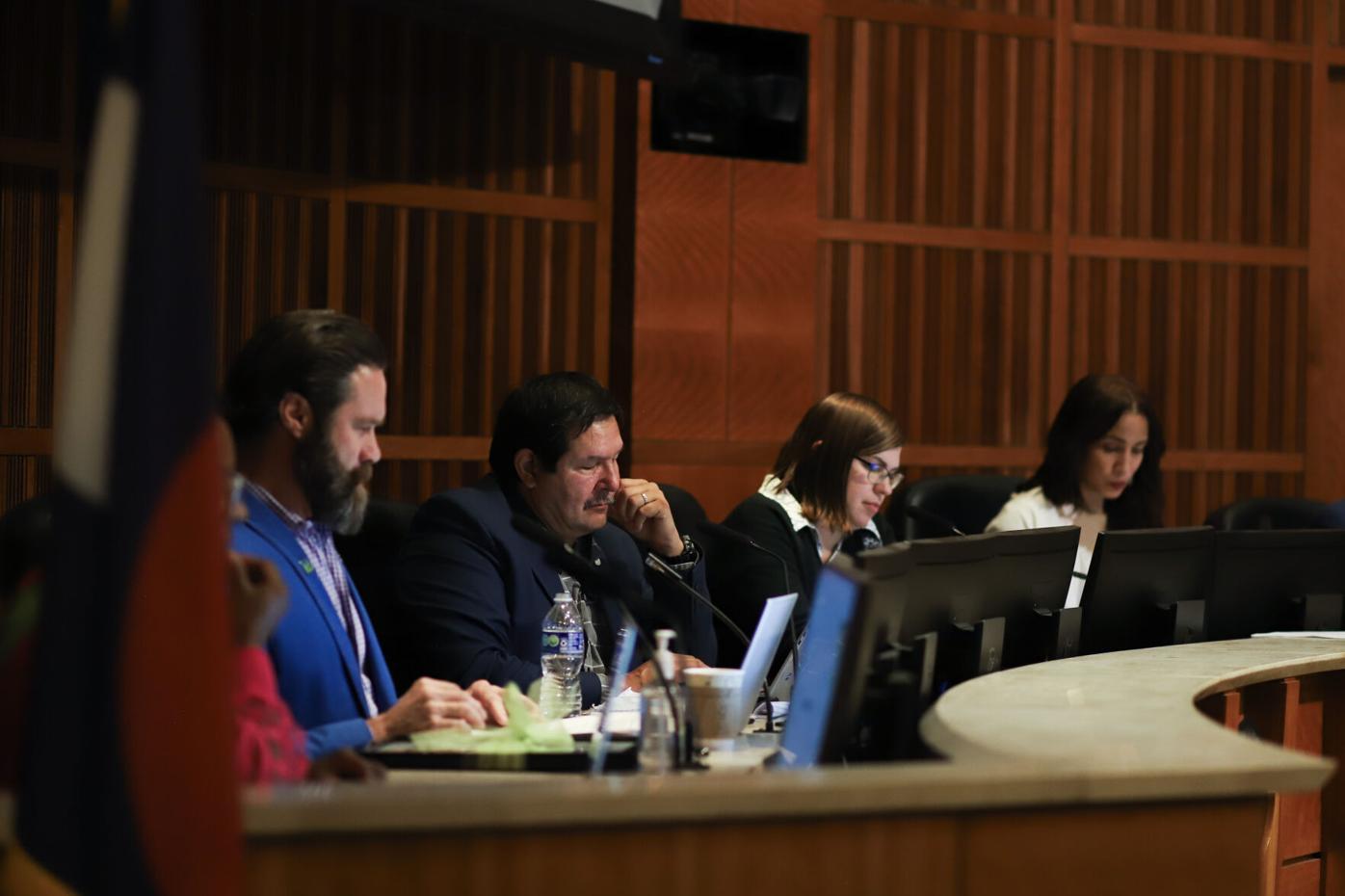
Kyla Pearce/Denver Gazette
Several ongoing conversations will be up for vote at Aurora’s City Council meetings Monday night, including proposals to harshen camping penalties in the city, create a homeless court, remove domestic violence cases from Aurora’s municipal court and get rid of the “sunset provision” on mandatory minimum jail sentences for car theft.
At the study session Monday night, the council will vote on approving a $1.1 million ARPA allocation from the Douglas County Board of Commissioners for use in the homeless navigation campus project.
In April, Aurora city staff attended a commission meeting to answer questions about the ARPA money and the navigation campus and the board voted to approve the use of the money.
With the Douglas County ARPA money, the city has almost $40 million for the navigation campus.
During study session, the council will also vote on a proposal to remove domestic violence cases from municipal court, passing them instead to state, county or federal court.
Aurora’s public safety committee voted unanimously in early May to move the proposal forward to study session.
The proposed ordinance, which is sponsored by Councilmember Dustin Zvonek, said the municipal court “may not hear domestic violence cases,” adding that domestic violence cases should instead be filed in the appropriate county, state or federal court.
Aurora’s municipal court has been handling domestic violence since it began, with reported increases in domestic violence cited as part of the reason for the court’s creation. The rationale is that municipal court could handle them more quickly than state or county court, according to a 2021 review of Aurora’s public defense system from the National Legal Aid and Defender Association.
However, proponents of the ordinance said this costs taxpayers more than necessary and moving these cases to county courts instead would save the city money and resources.
The ordinance and debate around it are tangentially related to a contentious issue that has been going on in the city for months about whether the city should contract out for indigent defense or keep its in-house public defender’s office.
One argument against contracting out indigent defense is that Aurora handles domestic violence cases, making it an outlier among municipalities. And, under that argument, an in-house public defender’s office is necessary.
During the regular meeting, the council will vote on two ordinances that go hand-in-hand to create harsher penalties for violating the city’s urban camping ban along the I-225 corridor and create a new court for low-level homeless offenses.
The two proposals passed in a study session earlier this month with unanimous council support.
The approach includes two proposals from Mayor Mike Coffman, Councilmember Steve Sundberg and Councilmember Curtis Gardner.
The first of the two proposals would “put the entire I-225 corridor under a new trespass ordinance,” in which individuals would be ticketed and given a date to appear in court. The second measure would create a new specialized court to deal with low-level offenses by homeless people, such as violating the trespass ordinance, illegal drug possession or retail theft.
Currently, people camping along the interstate are given a 72-hour notice to move and, if they do so, they are not penalized — even if they set up tents in another unauthorized location.
The new proposal takes away the 72-hour notice and results in immediate tickets to individuals, making them subject to arrest if they don’t appear for their court dates, Coffman said.
The second piece of the new approach is a resolution, sponsored by Gardner, that would establish what council documents call the Aurora HEART — short for Housing, Employment, Assistance, Recovery, Team program in Aurora Municipal Court.
Homeless people who have been charged with trespassing or “similar non-domestic violence low level non-violent municipal ordinance offenses” will be eligible to participate in the court system, where they would be offered services and can use them in exchange for closure of the case, according to council documents.
Councilmember Zvonek is also bringing forward an ordinance that would allow city councilmembers to voluntarily decline all or part of their salary or other compensation.
Additionally, Zvonek is bringing forward an ordinance — which was approved by members of the council’s public safety committee in early May — to remove the “sunset provision” on a law requiring mandatory minimum jail sentences for car theft.
The original ordinance putting the mandatory minimum sentences in place was approved by the City Council in July of 2022.
Since the program was new, the council added a “sunset provision” to it, essentially making it more of a pilot program that would expire in 2024 unless the council voted to extend it.
The study session will be held at 5:15 p.m. in the Aurora Room of the Aurora Municipal Center, 15151 E. Alameda Pkwy.
The council’s regular meeting will start at 6:30 p.m. in the Paul Tauer Aurora City Council Chamber, 15151 E. Alameda Parkway.
Both meetings will also be live streamed at auroraTV.org and Youtube.com/TheAuroraChannel. They will also stream live on cable channels 8 and 880 in Aurora.
Those who want to speak during “Public Invited to Be Heard” must submit a speaker slip by 6:30 p.m. Monday, the day of the meeting. Anyone who wants to comment on an agenda item must submit a speaker slip before the city clerk reads the title of the item.