







Ever wonder how Denver officials pay for spending priorities? Here’s where the money comes from

A view of the Denver City & County Building from the top floor of the 13-story Populus Hotel on May 30, 2024.
Bernadette Berdychowski / Denver Gazette


While sales and use taxes, along with property taxes, account for a majority of Denver’s general fund revenue, the city collects other sources of funds from residents and visitors that make up the pool of money that pays for government operations.
These sources don’t yet count a measure approved by the City Council to ask Denver voters whether to further increase the sales tax. If approved, the sales tax — which stands at 8.81% total in Denver — would rise to 9.15%, with Denver charging 4.75% of that amount. The rest come from state and other regional taxes.
For 2024, the city under Mayor Mike Johnston put together a $1.7 billion general fund budget.
Sales and use tax provided just over half of that amount. A tenth came from property taxes.
Denver does not rake in all of the cash from property taxes. Of total property tax revenue, about 65% goes to Denver Public schools, according to Joshua Rosenblum from the city’s Department of Finance.
“Other categories include the occupational privilege tax, lodgers’ tax, facilities development admissions tax and telecommunications business tax,” he said. “There’s also ‘use taxes’ like food and beverage, short term car rental and aviation fuel.”
Here’s a summary of the taxes and fees that Denver residents pay to fund the city’s operations.
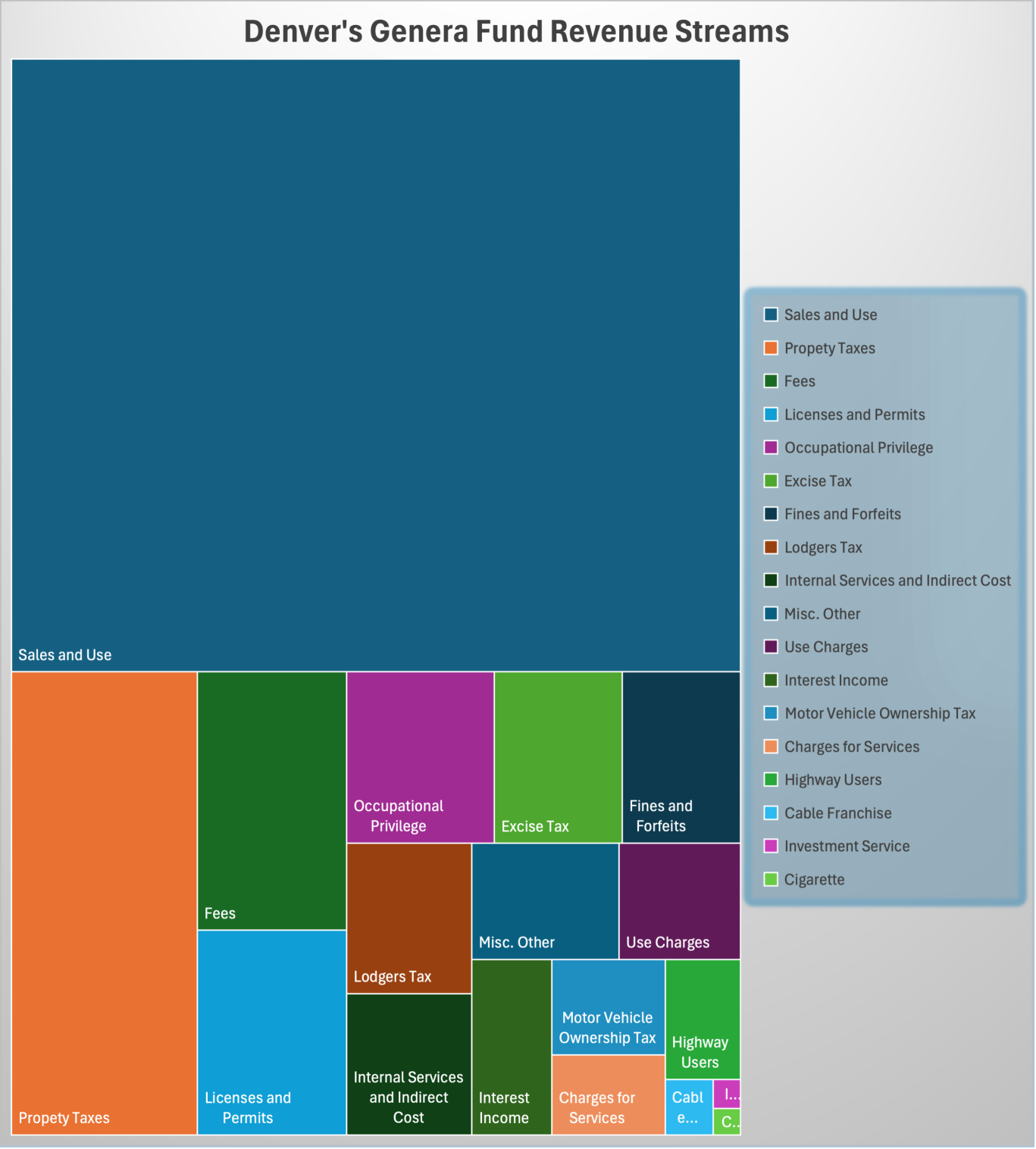
This chart shows the revenue streams that make up Denver's general fund budget. The largest by far is sales and use tax, followed by property taxes. Fees round out the top three. (Alex Edwards/The Denver Gazette)
Alexander Edwards [email protected]


This chart shows the revenue streams that make up Denver’s general fund budget. The largest by far is sales and use tax, followed by property taxes. Fees round out the top three. (Alex Edwards/The Denver Gazette)
Occupational Privilege: 💸👨🍳🧑🚒🧑🏫
Denver imposes an occupational privilege tax — also called a head tax — on all residents who receive $500 or more per month. Businesses who have a fixed or mobile location within the city are also on the hook for this tax. An employee pays $5.75 per month, while employers pay $4 per month for each owner, partner manager or taxable employee, according to the city.
There are exceptions for religious and charitable organizations.
Miscellaneous Other: 💸🧾🏚️
These are sources of money that include salvage item sales, unclaimed money, insurance recoveries and other one-time revenue increases. This can include the sale of surplus city vehicles and scrap material sold by the city.
The city expects $37.2 million from this source.
Lodgers Tax: 🏨🏟️⛷️
Denver imposes a tax on guests staying in facilities (hotels, motels, Airbnbs, etc.) for fewer than 30 days in a row. It is applied to the purchase price of their lodging at a rate of 10.75%. Visit Denver receives 2.75% of the money, while the remaining 8% goes toward repaying Denver’ 2016, 2018 and 2021 excise tax bonds, which helped pay for the National Western Center redevelopment and the expansion of the Colorado Convention Center.
The city expects $41 million from this source.
Licenses and Permits: 🏗️🏚️🛠️
This is revenue from the sale of licenses and permits from various city agencies. It includes contractors’ licenses, building permits and business licenses.
The city expects $66.3 million from this source.
Internal service and Indirect Cost: 🏦💼👨💻
These are charges that come about when an agency provides services and bills other city funds for those services. Indirect costs are the reimbursement of all costs a general fund agency have when supporting something that is not related to the general fund and not recovered through internal service charges.
The city expects $38.5 million from this source.
Interest Income: 🏦💰📈
Money from this stream is found from investing “general pool” money in various securities. The money earned from those investments are paid back to the individual funds based on “the ratio of a fund’s average daily equity to the total equity of the pool,” according to the city budget.
The city expects $30.5 million from this source.
Fines and Forfeits: 🏦👨⚖️🎆
Fines are collected from people or businesses that violate state statutes or city ordinances. Forfeits are collected from the sale of confiscated or abandoned property.
The city expects $44 million from this source.
Fees: 💸🪪🏗️
Agencies who get money from the general fund charge people and businesses for various services. This includes motor vehicle licensing, docket fees, foreclosure fees, court cost fees and zoning fees, as well as many others.
The city expects $83.7 million from this source.
Excise Tax and other transfers: 👩💻➡️👩🚒
This value includes direct cash transfers from other city funds. By far the largest transfer is the excise tax revenue fund transfer, which sees money transferred from the excise tax bond when it exceeds the required debt service and reserve requirements.
The city expects $47.6 million from this source.
Charges for Services: 👮🚜🥂
These are revenues the city gets from charges to people and businesses for services like towing and storage charges, the care of federal and state prisoners in city facilities and DUI alcohol evaluation charges, according to the budget.
The city expects $19.7 million from this source.
Cable Franchise: 📺🖥️💵
Denver has a franchise agreement with Comcast and draws revenue from that agreement. The city’s franchise fee payment is 5% of gross cable service revenue collections.
The city expects $5.8 million from this source.
Use Charges: 🍻🅿️🛫
These are user fees charged to the public for specific services that benefit the person charged. This includes parking meter and parking lot charges and recreation center or athletic field fees.
The city expects $30.3 million from this source.
Investment Service Fees: 💵⚖️📊
These are repayments to the general fund for services completed and money spent on various enterprise funds.
The city expects $1.7 million from this source
Motor Vehicle Ownership Tax: 🏎️🚗
This is a tax paid by Denver residents annually on vehicle ownership. The tax is collected when a new vehicle is registered or when license plates are renewed. This tax is variable, changing from 2.10% to 0.45% as a vehicle ages. If a vehicle is 10 years old or older, it is taxed at a flat rate of $3.
The city expects $23.5 million from this source.
Telecommunications Business tax: 📱☎️📟
This is a tax imposed on all companies that provide local telecommunication service to residents and is a flat tax rate of $1.12 per account per month.
The city expects $300,000 from this source.
Highway Users Trust Fund: 🗺️🚧🚦
This is an intergovernmental tax collected at the state level and then distributed monthly among the state, counties and municipalities. Money comes from gas taxes, special fuel taxes, motor vehicle registration fees and certain truck registration fees. Money from this tax is sent to the general fund, capital improvement fund and the wastewater enterprise fund.
The city expects $19.6 million from this source.
Cigarette Tax Rebate: 🚬🚭💸
The state of Colorado levies a flat tax on the sale of cigarettes and rebates a portion of that money to cities and counties. This tax increased from 84 cents to $2.64 by 2027 after voters approved Proposition EE in 2020.
The city expects $1.6 million from this source.
Sales and Property Taxes: 🏚️💰
Sales and use taxes will provide around $970.6 million, while property taxes will net the city $187.3 million, according to the 2024 budget forecast.