Water overshadows worry in Douglas County’s Pine Canyon development proposal
The proposed development would add 1,800 residential units to a 530-acre site near Caste Rock.
The proposed development of a century-old ranch in unincorporated Douglas County refreshed one the county’s most pressing issues: water.
Pine Canyon ranch, a 530-acre unincorporated plot of land, splits the town of Castle Rock near the Metzler Ranch neighborhood. Its redevelopment proposal, which has drawn the ire of town officials and some residents, suggests a large residential development and a new water system.
Pine Canyon’s proposed development, which requires the county to rezone the land from agricultural to residential, calls for 1,800 residential units with a mix of land for open space and parks. It aims to establish a renewable water system. The company behind the development is JRW Family Limited Partnership, LLLP, represented by James Walker.
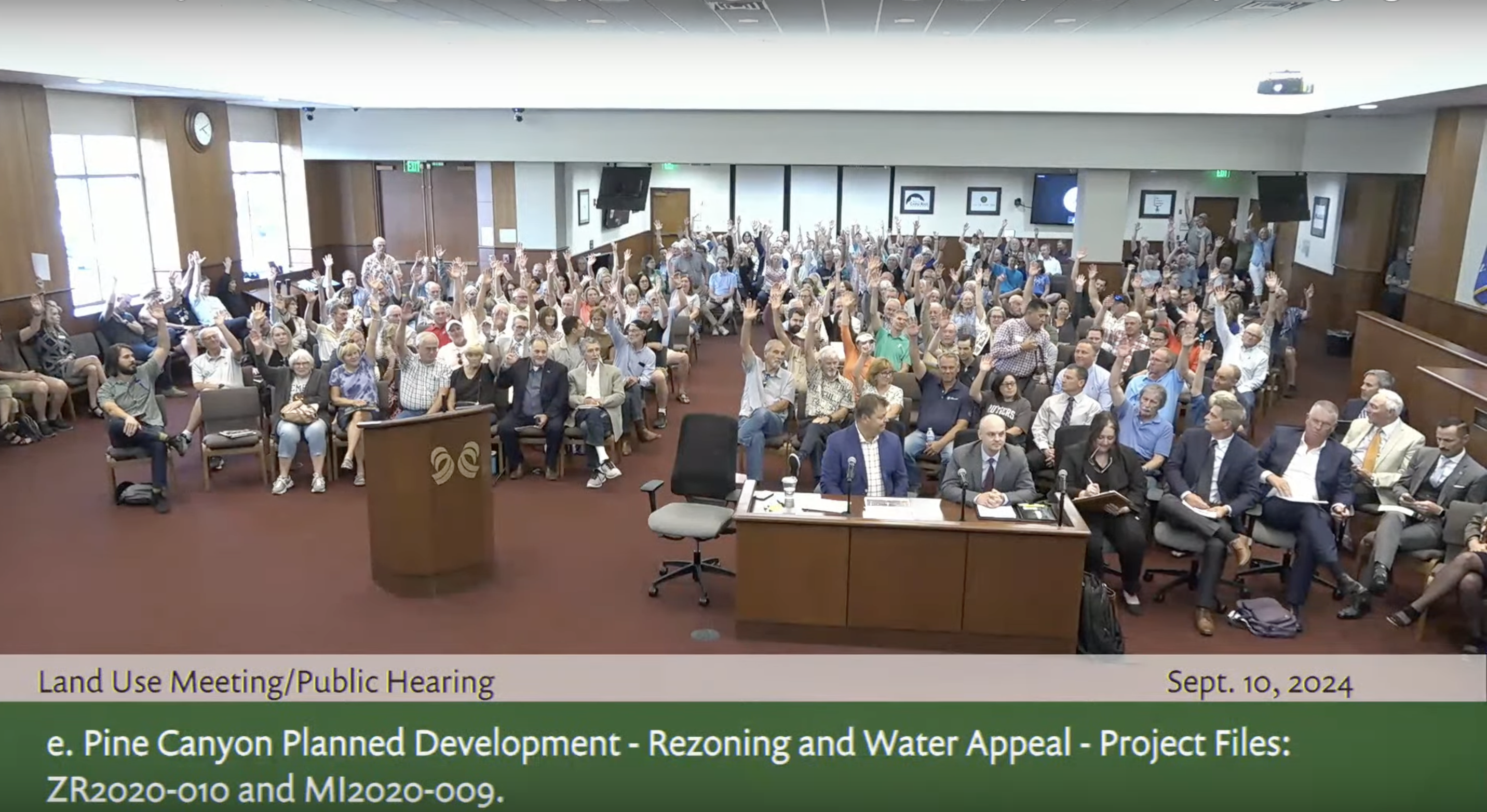
That water plan — separately being voted on as a water appeal for the development — was a focus during Douglas County’s land use meeting public hearing on Tuesday night.
During the meeting, Commissioner Abe Laydon asked the crowd who among them were in opposition of Pine Canyon’s proposal.
Nearly everyone raised their hands.
Castle Rock and Douglas County residents said they are concerned about the water situation — from water quality, quantity and sustainability.
The proposed two-pipe well water system would supply potable water for indoor residential usage, then be transferred to a wastewater reclamation facility for use as recycled water, according to Jehn Water Consultants Inc., which is assigned to create the new waterway in Pine Canyon.
“The request will not be detrimental to the health, safety, or welfare of the present or future inhabitants of Douglas County,” Jehn Water representatives said during Tuesday’s hearing.
Jehn Water Consultants estimated that the developments potable water demands call for 458.89 acre-foot amounts per year, and 343.43 acre-foot amounts per year for irrigation. Water acre-foot is measured by the amount of water needed to cover one acre of land with a depth of one foot.
With the 1,800 residential units, the water supply for residential units is planned to be .273 acre-foot worth of water each year, much less than Douglas County’s .75 acre-foot annual water mandate.
Many speakers on Tuesday criticized the water appeal, with some saying it would negatively affect Castle Rock residents.
“I believe that this is clearly unsustainable,” said Jerry Duncan, a local water treatment engineer who spoke at Tuesday’s meeting.
“Personally,” he said, “I think large developments such as this should no longer rely solely on ground water supplies in the state.”
Based on a 100-year aquifer life, Jehn Water officials said: “Pine Canyon is proposing to utilize its decreed nontributary and not-nontributary water rights, totaling 709.9 acre-feet per year to meet development demands.”
Meaning, water officials added, “this leaves approximately 35% of the groundwater rights available as decreed to the development of the Pine Canyon property, in the ground and unused as all irrigation demands will be met through the recycle system.”
Pine Canyon’s proposal comes after a fight among Douglas County commissioners over a Renewable Water Resources proposal to siphon water from the San Luis Valley through a 200-mile pipeline to the county.
Water continues to be a top issue not only in Douglas County, but statewide.
Laura Cavey, councilmember in Castle Rock and local resident near Pine Canyon, said the redevelopment proposal doesn’t meet the requirements for sustainable and renewable water supplies.
“It cannot sustain the needs of our water long term,” she said.
Kurt Walker, the sixth generation land owner of Pine Canyon, said: “We will be able to irrigate for the first time in our family’s history.”
The Walker family, who has owned the ranch since 1885, has attempted to redevelop it since 2003, with the hopes of annexing it into Castle Rock. After three failed attempts, the Walkers have pivoted to receive Douglas County approval.
In a July statement, Castle Rock officials said: “These impacts will burden the residents of Castle Rock with additional costs related to traffic impacts, degradation of existing roadways, odors and potential overflows from the proposed sewage treatment.”
The current Pine Canyon development plan calls for 800 single-family units, a maximum of 1,000 multi-family residential units and a 600,000-square-foot limit for non-residential space. Developers hope to retain 176 acres for parks, open space and trails.
A new mobile transportation hub on the west side of I-25 is also being proposed. Residents expressed worries that it would increase traffic in the area.
George Teal, former Castle Rock councilmember, recused himself from the vote to avoid a conflict of interest. Meanwhile, Commissioner Lora Thomas said she will not comment on the matter until a vote.
“It is not possible to develop this property without causing true impacts to the Town of Castle Rock’s community and infrastructure,” Castle Rock’s statement said. “The higher the density, the higher the impacts will be on a community that is not currently regulating this area.”
County commissioners plan to conduct another public hearing and a final vote on Monday.