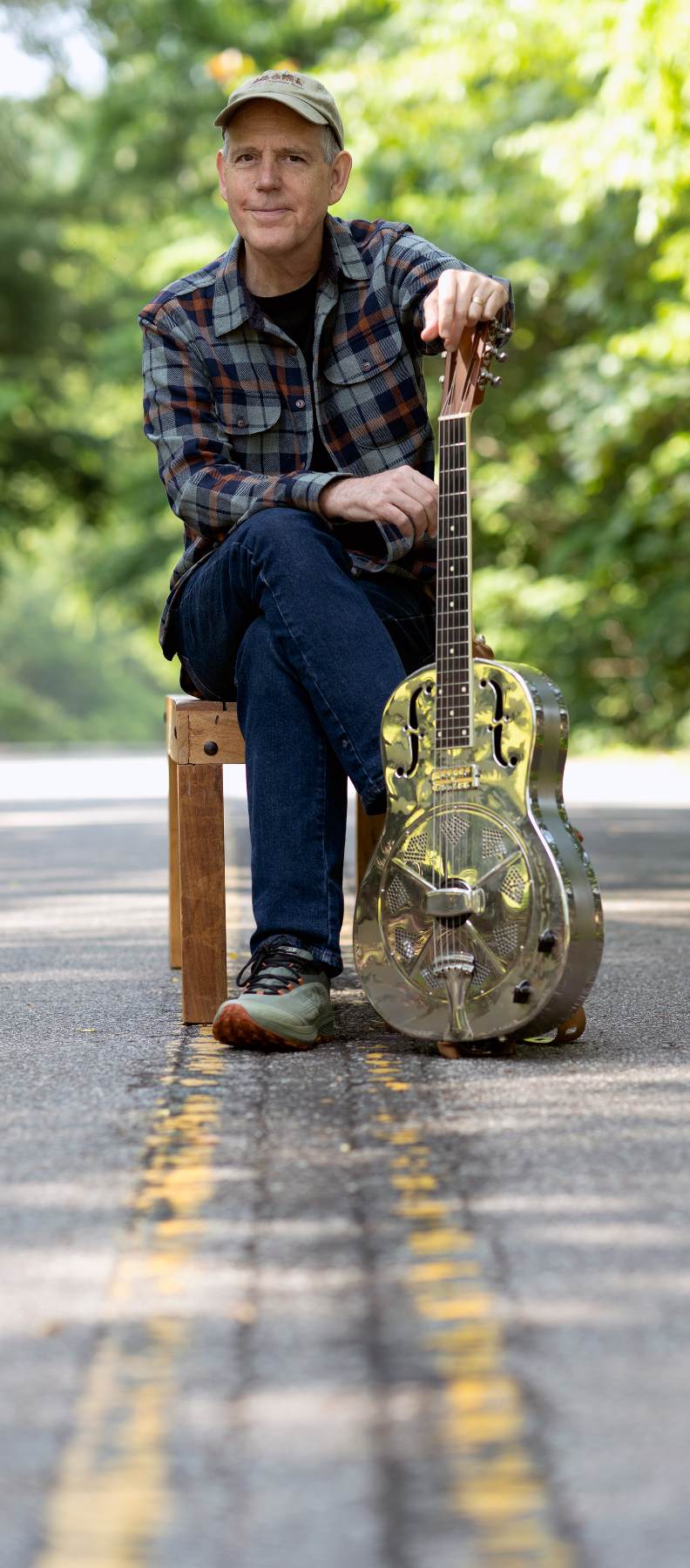
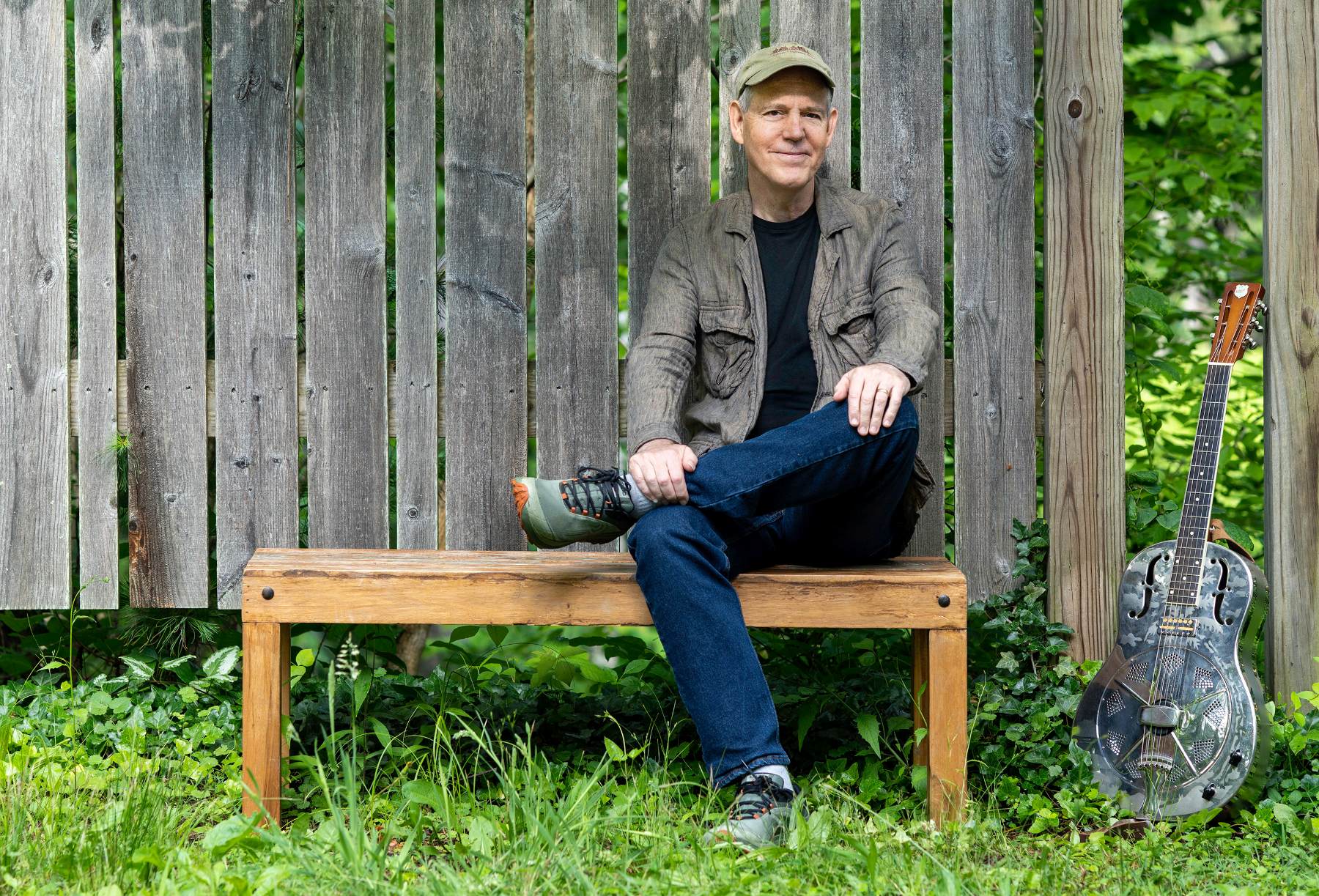
For David Wilcox, the joy of life is truly delicious
“We should talk every 24 years or so, don’t you think?”
Thus began my illuminating, heart-expanding – and very first conversation with the venerated yet still somehow unmistakably giddy singer-songwriter David Wilcox since 2001.
That talk had been a bit of a breakup, to be honest. For a dozen years, I had been an admitted Wilcox acolyte. He was the friend I always needed and I was the one he never knew he had. My musical minister.
I had been introduced to his signature folk philosophies in 1989 by one of my high-school students who suggested I might feel better about my prematurely receding hairline if I listened to “Top of My Head” – a song that restored a smile to my face if not a follicle to my scalp. But that song was a gateway to an entire canon of powerful, insistently hopeful songs that challenged my relentless, guarded cynicism. His apt ruminations on cars, death, failed relationships and spiritual despair always manage to find their way out of the darkness.
My 20s were a vagabond professional decade, with journalism jobs in Denver, New York, Raleigh, Dallas and Denver again. Everywhere I went, I stayed connected – not with who I was, but with who I always aspired to be – through Wilcox, a constant tourer who always turned up right when and where I needed him to.
He’s best known for the upbeat anthem “Rusty Old American Dream,” about a vintage car longing for adventure on the open road. But songs like “That’s What the Lonely is For,” “Show the Way” and “How Did You Find Me Here?” are lyrical lifelines akin to someone tossing you a rescue rope down a pit.
Wilcox’s insistent optimism carried weight with me because he has been down in the pit himself. But early on, he made the proactive decision that he was going to crawl out and live in the insistent sunshine.
“I think that part of the advantage of growing up in a dysfunctional family is I do have these useful survival skills,” he said. “I have this odd ability to find my hope from deeper sources and even the ability to disassociate when I need to. And so, many of the things that would’ve destroyed other people didn’t destroy me.”
Things like, say, his parents’ drinking. “Instead of falling into alcoholism myself, I would say, ‘Oh yeah, that’s how you wreck your life,’” said Wilcox. “From early on, I was aware of how easy it is to run your ship right up on the rocks and sink it. And that’s a great thing to find out early. And so I’m always on watch – looking for icebergs.”
But with that interview in 2001, I pretty much said goodbye to a friend. Wilcox’s new songs about marriage, spiritual exploration and an empty heart filled were among his very best. But that was not the journey I was on.
I recently came across his latest single, “My Good Friends,” which instantly transported me back to 1989. This was quintessential Wilcox singing not about his best lifelong pals over decades, but rather those who have died along the way, which leaves him asking how he got to be so lucky not to be among them. Like the time he was shot at – twice – as a 12-year-old. Angels working overtime, he says with a shrug.
I asked him about the audacity of those of us who have come to count him – or at least his songs – as among our own “good friends.”
“Thinking of the title of the record that way is actually so much better – and I hadn’t thought of that before,” he said. “I get it. I am very grateful for the songs I have heard that have changed my life, and I do consider them as important as friends.”
Last month, when I heard that song and saw that Wilcox is returning to Colorado this week for a concert Saturday at Swallow Hill, followed by a full concert at e-Town Hall on Sunday, I tracked down his press agent and requested an interview.
It was time to catch up.
Within seconds on the phone, it was clear that the now 67-year-old Wilcox is just as friendly, just as searching, just as wide-open-hearted as I remembered him in 2001. Considering the general gravitational pull of aging and the current state of affairs in this country, I bluntly asked: “Why aren’t you more pissed off right now?” The question was greeted by that signature expressive Wilcox laugh that sounds like he’s a 12-year-old hyena on laughing gas.
“It was clear to me very early on that being angry is just not an option in my life – although that’s definitely the way the ruts were steered,” he said. I knew that’s what would have happened to me if I didn’t really consciously do something else.”
He gave himself a rather stark choice: “I said, ‘We could die, or – why don’t we do something else?’” he said. “That kind of ultimatum gives you a radical sense of freedom. It gives you this ability to say, ‘Yeah, I could plummet into the depths of sorrow, but I want to really feel that sorrow as I stretch. Feeling the depth of sorrow, of compassion, of all that’s wrong is a grounding that stretches me into a more complex and nuanced appreciation of the choices that I have in every moment and how to honor what I’ve been given. So, believe me, that part of me knows that having life is a blissful exception to the rule.”
Thousands of songwriters sing, in their ways, about the elusive pursuit of happiness. But Wilcox is among the two or three who have actually found it. The wife he makes music with. The 20 acclaimed albums. The grown son, Nate, now 31, who still calls him Papa and who has made him a meal this very day that Wilcox instantly transmutes into a grand and glorious metaphor for how we metabolize suffering into wonder, energy and vision.
In this lyrical family, a sandwich is never just a sandwich.
“Man, the joy of life is really delicious,” Wilcox says with unabashed joy.
So, too, apparently, is lunch by Nate.
The Telluride connection
Wilcox hails from Ohio and is considered as native to Asheville, N.C., as the Blue Ridge Mountains. But Colorado has been a constant throughline in his journey, amassing a larger following all along the way without ever tiptoeing too close to the flame of fame.
That was by design.
Wilcox was the talk of the 1989 Telluride Bluegrass Festival, giving him a small taste of what it might be like to actually have a big music career like, say, James Taylor.
“I did have this little bit of success after Telluride – and I did not handle it well,” he said. It turns out, he added, “being famous is a lot of work. And it takes a strong person.
“There are people in this business who know that notoriety is an entirely separate job, and it has nothing to do with your music. There are people who take it on as a job – like Dolly Parton, and she’s great at it. But it was really hard for me to keep track of the reality of who I was.
“I’m just this frumpy little guy, and I have this one thing that people are paying attention to. And if I’m not careful, I could start to believe that I’m somehow special. when I’m not. Music, for me, it’s blue-collar work, and I’m good at it. But I’m also a really good plumber. And around the house, plumbing is a hell of a lot more useful.”
Wilcox soon realized that, rather than chasing arenas and amphitheaters, “It’s probably better for me to be banging it out on the freeways of America playing in these little 150-seat rooms,” he said. “I love it. It’s good for me.”
Over the years, Wilcox has played dozens of venues across Colorado, many smaller than 150. The Little Bear in Evergreen. The Denver Botanic Gardens. Chautauqua Park in Boulder. You name it. He’s developed a devoted fanbase who think of him as Colorado’s own.
His Colorado story began at the Arvada Center’s outdoor stage in 1989. He remembers going onstage barefoot for the very pragmatic reason of a blister, “and being surprised because people took it as a fashion statement,” he said with that infectious laugh.
His later breakout at Telluride was a little jarring because he wasn’t ready for it. “That kind of shook me in a way that was unnerving,” he said. “It actually made the writing go to (bleep) for a while because the attention made me self-conscious. I thought I had this thing to uphold or something. I kind of lost the innocence, and I’m so glad that I got all that back.”
Wilcox got back to playing music for much better reasons. “Reasons that have no gatekeeper involved. Because when I write now, it’s all about listening to my heart and knowing how to navigate this life to bring the most joy to the most people,” he said.
Now he’s of an age when he is asking his own heart, “What do I need to say to people in my life before it’s too late?” And, “What’s my better self asking me to do?’
“Those are the questions that are keeping me honest.”
He’s looking forward to being in Colorado this week, especially returning to eTown Hall. This is not a taping of the popular national radio program, but rather a full evening of Wilcox in concert presented by eTown. But Wilcox has a seminal place in the show’s history. He and The Subdudes were among the four musical acts that appeared on Nick and Helen Forster’s premiere episode when the legendary radio show launched on Earth Day 1991.
“I so love hanging out with Nick, and I love what he’s done with his life,” Wilcox said. “He gave himself an absolutely impossible goal – to heal the world. And I think it’s good to have an impossible goal. It’s inspiring. I love the whole story of eTown.”
Colorado, my home
I asked Wilcox to try to articulate why Colorado, of all places, has become his chosen second musical home.
“I think what’s so fun about the Colorado vibe for me is if you’re going to climb that high, it takes effort,” he said. “You don’t get there by accident. The people sorted themselves out according to who wanted to see a long way. Because that’s what mountains are about. They’re about the thing in the distance that draws you to it, and they’re about the peak that you climb to that you want to remember.
“The Colorado mountains are steeped in metaphor. And I just feel like the people who are drawn to those mountains are people who ask themselves, ‘How do I make this life a story worth telling? How do I make it feel like an adventure?’ And when it comes to music, all those metaphors line up. A song is a thing that you navigate toward from a great distance. And when you see from that higher vista, it’s a thing that holds you accountable.”
At that exact moment, Wilcox asked me if I knew a poem called “The Time to Decide,” by the colorful Colorado character Bruce Kiskadon, also known as the quintessential cowboy poet of the 20th century. It opens with Kiskadon asking the reader:
Did you ever stand on the ledges,
On the brink of the great plateau
And look from their jagged edges
On the country that lay below?
It’s a poem that captures the transformative experience of witnessing an expansive landscape from a high vantage point, unobstructed by the constraints of daily life. I asked Wilcox what it means to him.
“For me, that poem is about a beautiful song that sends my heart to a place that I haven’t arrived at yet,” he said. “But my heart has been there. And once I’ve experienced it, I know it’s real. And then what I want is not just to play the song again, but I want my life to feel like that. There is a clarity in those beautiful epiphanies that is absolutely sacred, and you have to value it more than the lowly logic of practicality.”
A ‘custom’ made footnote
You’ve probably heard of Cameo, where you can hire famous people to make a personalized video message for any occasion. Wilcox was contacted by a fan asking him to write a song that might help him process a childhood trauma. Wilcox is the kind of guy who says yes, so he interviewed the man in depth and wrote a song to encourage him in his time of need.
“He was afraid of coming into his own power, so I reframed the issue by talking about lightning,” Wilcox said. “Yes, lightning can burn down your barn, and it’s scary, and it’s sudden. But electricity can also light up a city and do work, and it’s a good thing.’ So I sent him the song and he loved it.”
Wilcox mentioned it on his website, he was flooded with requests, and now he’s created about 75 custom songs on demand. Many are posted on his website. Going forward, he’s accepting about two commissions a week each month.
There is a fee, because writing songs is exhausting and time-consuming. But true to his nature, Wilcox is not doing it for the money.
“It’s a great excuse to have good conversations,” he said just as ours was coming to an end – with a promise to circle back around to do it again in 2049.