







‘Road diet’ in Denver sparks worries as E. Alameda Avenue project looms

In this May 2025 photo, a billboard campaign bids cars to “Slow Down for the Love of Safety,” as part of Denver’s SPEED accident reduction campaign.
Mark Samuelson
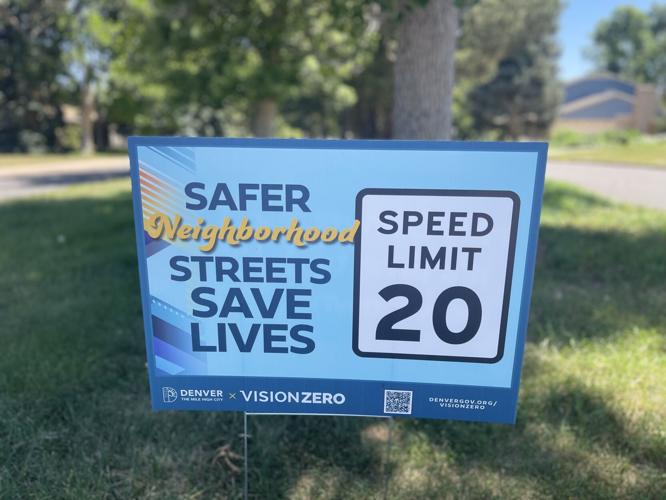

The City of Denver plans to slim down the flow of cars and trucks along East Alameda Avenue from four lanes of traffic to just two. And that has some residents worried as the project nears its launch date.
Supporters view the strategies to downsize traffic lanes — called “road diets” in transportation planners’ parlance — as a means to make roads safer by cutting down vehicle speeds and creating protected lanes for left turns. Critics, meanwhile, question the wisdom of the approach, fearing it would squeeze and back up traffic, forcing cars onto nearby interior roads and creating dangerous situations there.
The East Alameda Lane Repurposing project, currently set to launch this summer, would narrow the traffic corridor for a 12-block stretch from S. Logan Street east to S. Franklin Street. Further east, Alameda’s traffic from Franklin to S. University Boulevard is already two lanes, one lane in each direction.
“The basic goals are to improve safety and reduce crashes,” Nancy Kuhn, director of Communications for the Department of Transportation and Infrastructure (DOTI), told The Denver Gazette.
She said her agency classifies Alameda as a high injury network street, seen as having greater numbers of fatal and serious injury crashes.
That span includes a traffic light at S. Downing Street, one of several light-controlled intersections along Alameda with shopping and restaurants. Downing, Marion, Logan and Washington Streets all connect E. First Avenue, a major corridor feeding out of downtown and Cherry Creek, to Alameda and to neighborhoods further south.
A block east on Alameda at S. Marion Street are painted crossings that link to Steele Elementary School, where pedestrians have to cross four lanes of traffic. Kuhn said the transportation agency has received specific requests from the community to aid pedestrians, given the vehicle activity on the corridor.
Pedestrians were on the minds of many this week, after four people were killed over the weekend in separate pedestrian accidents around the city of Denver — three of them by hit-and-run drivers.
Three accidents involved freeway traffic. None occurred on the stretch of Alameda targeted in the city’s “road diet” proposal.
Key to the plan is a series of protected left turn lanes along Alameda that would be created from the repurposed lanes. Planners said drivers making left turns would be less forced into rushed decisions they have to make now, turning against two lanes of oncoming traffic with added pressure from cars backing up behind them.
The plan calls for westbound Alameda traffic to be narrowed to a single lane between S. Clarkson and S. Pearl Streets, creating a protected left turn at S. Pennsylvania; and for westbound and eastbound traffic to be slimmed to single lanes along a 10-block stretch from Pearl to Franklin, creating another 10 protected left turns.
Left turns are prohibited now from Alameda onto S. Downing and S. Marion, and that restriction would remain.
According to a 2019 study, E. Alameda carries between 15,000 and 19,000 vehicles per day — regarded by transportation engineers as too few for four lanes of traffic. Planners vary in their estimates, some citing 19,000 vehicles as a four-lane minimum, others suggesting a 28,000 vehicle minimum.
Residents push back
Residents are pushing back at the project, as they imagine E. Alameda squeezed to a single lane in each direction.
“There’s so much traffic that goes in that area in both directions at all times of the day,” South Denver resident Nanci Ricks told The Denver Gazette.
“Once you eliminate two lanes in both directions, people who are trying to turn are going to back up into the only traffic lane, and cars trying to go straight through won’t be able to.”
Ricks, who both drives and cycles through the corridor, said she already sees how drivers react to slowed traffic on avenues like Alameda, as frustrated cars spill over onto parallel neighborhood streets.
Those quieter side streets are preferred routes for bikers like herself, Ricks said. She added that she opts for them over the city’s bollard-protected bike lanes, where, she said, she’s had a flat tire after street sweepers miss accumulated debris.
“Closing down lanes of through traffic will make people go to the side streets,” Ricks said. “When they get frustrated, drivers just take a shortcut, and they go fast, which ends up making things more dangerous.”
DOTI’s Kuhn said the Alameda plan anticipates that issue and that protected left turn lanes would function to avoid backups.
“We developed a design that would work to slow vehicle speeds, reduce incidents of rear end and left turn collisions, and minimize conflict for all users traveling along the corridor,” Kuhn said.
The center turning lanes, she added, would serve as “a place for drivers to be while they wait to make a turn, preventing backups in the through-travel lane and the unsafe maneuvers drivers sometimes take to get around cars waiting to turn.”
Critics: ‘Road diet’ is not needed along corridor
Some critics questioned whether the volume of accidents and injuries along the corridor justifies the remedies that the city plans.
A recent map of traffic fatalities compiled by an advocacy group using Denver Police data shows fatalities occurring throughout the city over a 10-year span, from 2014 to 2023, including a dozen deaths on E. Colfax Avenue, and four along a half-mile stretch of E. First Avenue facing the Denver Country Club.
However, no fatalities register along the mile-long stretch of Alameda targeted by the repurposing project.
Indeed, that stretch shows only four serious injury accidents over the decade. A half mile west of the zone, a single pedestrian fatality shows as having taken place along Alameda between heavy trafficked S. Broadway and S. Lincoln.
Economist Randal O’Toole, author of numbers of books on transportation issues, told The Denver Gazette that regardless of how roads perform safety-wise, “road diet” strategies are more likely to cause a net increase in accidents than to reduce them.
O’Toole, who directs the Transportation Policy Center for the Denver-based Independence Institute, noted that road diet strategies being applied in Denver and other cities follow the approach of Vision Zero, a global movement to rid traffic fatalities that was first launched in Europe during the 1990s. U.S. cities began adopting Vision Zero in 2014, and DOTI broadly referenced the program in support of its Denver Moves masterplan.
In European cities, Vision Zero reportedly saw great success, but in the U.S., the performance is less clear. U.S. traffic deaths peaked at around 55,000 deaths in 1972, before safety technology was widely adopted by the auto industry.
U.S. deaths fell to 32,700 in 2011, but then topped out during the pandemic at 43,200 deaths, according to the National Highway Traffic Safety Administration. In 2023, as the pandemic waned, national traffic deaths fell only to around 41,000 and are estimated to have remained at around 39,000 last year.
O’Toole noted that, despite having adopted Vision Zero over a decade ago, traffic fatalities here have increased. Colorado Department of Transportation data show a 66% hike in fatalities statewide since 2011, and the city of Denver saw near-record fatalities in 2021 and 2022.
“Traffic calming is presented as way to make streets safer, but actually makes streets more dangerous for bikes and pedestrians,” he said.
“When you do a road diet, traffic slows,” O’Toole continued. “If every day a road is congested, it will make it more so.”
O’Toole noted the worsening of traffic safety during the worldwide pandemic, from 2020 to 2023, stood in marked contrast to similar historic events that affected traffic volumes.
“In the 2008 financial crisis, driving declined 5% and fatalities plummeted, a huge decline in fatalities for a small decline in driving,” O’Toole said.
“During the pandemic,” he continued, “driving dropped much more, but fatalities increased. It was a nationwide phenomenon and no one knows why the numbers changed.”
Traffic fatalities, said O’Toole, need the same sort of detailed analysis that airline crashes receive. He noted that studies of crash data by the Federal Aviation Administration helped create a long lull in commercial airline fatalities in the U.S., leading up to this year’s crash at Washington National Airport.
“Nobody is really using (the traffic data),” he added. “They’re just coming up with slogans and one-size-fits-all solutions.”
Denver deploys speed cameras and billboards
In addition to the lane repurposing project, DOTI is applying what it calls its SPEED initiative along Alameda, aimed at crash reduction. Drivers will see a greater saturation of speed limit signs — 30 miles per hour, along with electronic speed feedback signs and traffic signals programed to slow vehicles down.
Also as part of SPEED, DOTI’s Kuhn said that fixed, automated speed enforcement cameras are being deployed on Alameda and on Federal Boulevard to test how they work and to evaluate whether measures are slowing traffic down.
“People won’t be getting tickets,” Kuhn noted.
Drivers would also see a billboard safety campaign bidding cars to “Slow Down for the Love of Safety.”
Previously, DOTI had tried a lane reduction on E. Alameda at S. Downing 15 years ago, and Kuhn said the project had resulted in a stacking of vehicles eastbound. Average daily traffic measured back then was at 20,000 vehicles, and recent studies show traffic on the stretch now to be lower, she said.
The lane repurposing along E. Alameda has been scheduled for mid-year, summer 2025. However, testing on the fixed camera technology may adjust the schedule, Kuhn noted.
“Alameda is a better candidate now for a lane reduction,” she added.
Will DOTI carry on additional outreach to the community coming into the slim-down project?
Kuhn said that the agency has already done considerable outreach on the plan, including a 2024 neighborhood meeting and flyers and constant contact notices to local residents and businesses.
“We typically engage the community through traditional media and social media as we get closer to construction and will review what other methods might be needed or helpful as we get closer,” Kuhn said.
“My understanding is that businesses along this stretch have been supportive,” she added.

EDITORIAL: Applause anew for Polis on school choice
The Gazette Editorial Board
thegazette-editorial-board@gazette.com
Updated 10 hours ago
Kudos once again to Gov. Jared Polis for standing up — and sticking out his neck — for a promising federal initiative that incentivizes school choice. Thanks to the governor’s recent decision to OK our state’s participation, Colorado’s kids and...

The Gazette Editorial Board
Reporter

DPS inflamed fears about ICE raids | Jimmy Sengenberger
Jimmy Sengenberger
jimmy-sengenberger@denvergazette.com
Updated 15 hours ago
Protests seemingly swept cities across the country Friday and Saturday as part of a “National Shutdown” opposing immigration enforcement. The premise: “No Work. No School. No Shopping. Stop Funding ICE.” Nurses, teachers and others were urged to walk off the...

Jimmy Sengenberger
Reporter

The Governor and the inmate: Trying to make sense of Polis and Peters
Eric Sonderemann
eric-sonderemann@gazette.com
Updated 21 hours ago
Amidst the excess of news and outrage competing for our attention, much time and oxygen have been expended in trying to make sense of Jared Polis’s angst-ridden consideration of a sentence reduction for Tina Peters, former county clerk and now...

Eric Sonderemann
Reporter

Denver area events for Feb. 3
Carlotta Olson
carlotta-olson@denvergazette.com
Updated 16 hours ago
If you have an event taking place in the Denver area, email information to carlotta.olson@gazette.com at least two weeks in advance. All events are listed in the calendar on space availability. Tuesday Sipping N’ Painting Hampden — “Moonlit Pine,” 6:30-8:30 p.m., Sipping...

Carlotta Olson
Reporter

Avalanche shut out for the first time this season as Red Wings down them 2-0
Evan Rawal
evan-rawal@denvergazette.com
Updated 7 hours ago
There might have been just as many Red Wings fans in the arena as Avalanche fans, but none of them were treated to an entertaining hockey game. Marco Kasper scored just 33 seconds into the game and Detroit packed it...

Evan Rawal
Reporter

Ex-tackle Ryan Harris calls it ‘a crime’ Broncos’ Vance Joseph passed over for NFL head coach
Chris Tomasson
chris.tomasson@gazette.com
Updated 8 hours ago
Former Broncos tackle Ryan Harris expressed plenty of displeasure Monday about Vance Joseph failing to land an NFL head position. “It’s a crime that Vance Joseph did not get a head-coaching position, especially when there are far less proven coaches...

Chris Tomasson
Reporter
Colorado legislators advance proposal allowing lawsuits against federal immigration agents
Marianne Goodland
marianne-goodland@denvergazette.com
Updated 8 hours ago
A divided panel of Colorado legislators on Monday advanced a proposal to give individuals injured during an immigration enforcement operation the ability to sue federal agents in state court. The measure comes amid speculation that Colorado could be next on...

Marianne Goodland
Reporter
Big snow could bring double-digit totals to Colorado peaks in upcoming days
Spencer McKee
spencer@outtherecolorado.com
Updated 8 hours ago
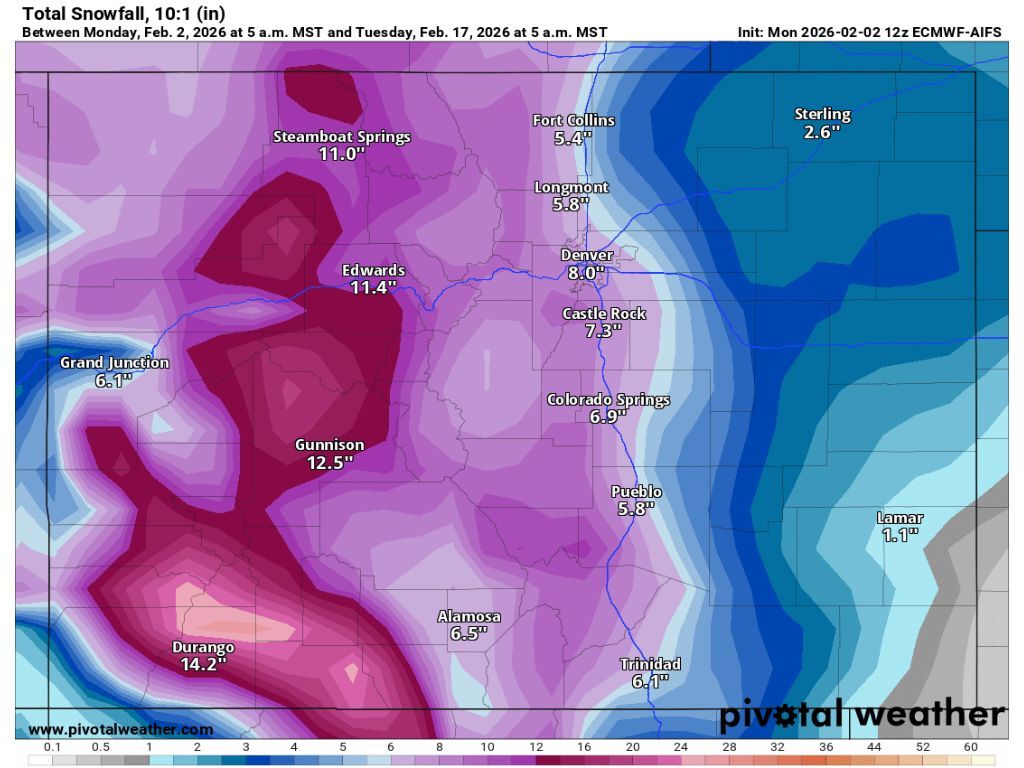
Not much snow is expected this week in Colorado, but the extended forecast is showing that heavy precipitation is likely later this month. According to the National Weather Service, parts of northern Colorado could get about 1 to 3 inches...

Spencer McKee
Reporter
Denver City Council approves $325K settlement, $15M equipment purchase
Deborah Grigsby
deborah.smith@denvergazette.com
Updated 11 hours ago
The Denver City Council on Monday approved a $325,000 liability settlement involving the Denver Sheriff’s Department, along with a $15 million purchase order for parks and golf equipment. This is the first liability settlement of this type approved by the...

Deborah Grigsby
Reporter

So … why do we care about Bad Bunny?
Isabelle Rosewater, Special to The Gazette
Isabelle-Rosewater@gazette.com
Updated 10 hours ago
Puerto Rican superstar’s selection to headline first Super Bowl halftime show in Spanish has sparked global conversation and controversy Bad Bunny: The artist who has sent America down a rabbit hole. The Puerto Rican superstar’s selection as the first artist...
