







‘Life can be good again’: Local program brings healing to vets, military families through animal therapy
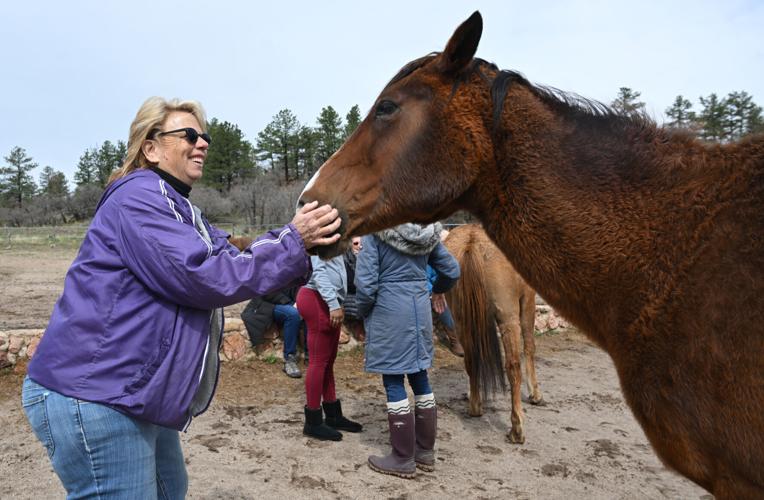
Gillian Sirles greets one of the horses at the stables at the Air Force Academy this month , 2025 . When Sirles came to the Remount Foundation nine years ago, she was looking for healing through the program with horse-assisted therapy. Today, Sirles is a peer mentor with Remount, helping other veterans find healing with horse-assisted therapy. The Remount Foundation is a Colorado Springs nonprofit that uses equine therapy to help veterans, active-duty personnel and military families
photos by Jerilee Bennett, The Gazette

When Gillian Sirles came to the Remount Foundation nine years ago, she had survived multiple suicide attempts.
Sitting on a picnic table outside the horse stables at the Air Force Academy, Sirles recounts her story of survival.
Decades earlier, the Navy welder was discharged for alcohol use, an attempt to push down past trauma. In the years following, she struggled with drug addiction and alcoholism, eventually turning to sex work for money.
“I lost my family, I lost my job, I lost everything because of it, and I ended up homeless,” Sirles said, remembering how she would rummage through trash cans on South Nevada Avenue in search of food. “I had wanted to give up a lot. I cut my wrist. I tried every type of suicide there could be, and just, it never took.”
In 1993, Sirles was gang raped in Denver and left for dead in a dumpster, her throat cut three times. Airlifted to Aurora Regional Hospital after being found by a little girl, she was placed into a coma for two months. Doctors said she would never walk again. “Watch me,” she thought. Soon enough, she was walking and talking again.
But, after being released from the hospital, she returned to the streets.
“I hadn’t dealt with anything,” she said. She eventually signed up to go to Pikes Peak Community College, though, which kept her busy. “I was still doing drugs, drinking, but I was passing my classes, and after three years, I finally got a degree.”
Goats, goats, goats: Nonprofit uses goats to help memory care centers around Colorado
She got an apartment. Her relapses got further and further apart. The VA gave her 100% disability. But she was still struggling. So, she looked into therapeutic riding centers, interested in horses because her sister had one, she joked.
“I went to three other therapeutic riding places, and they all said, ‘We don’t have a horse big enough for you,’” Sirles said. So, in a last-ditch effort, she called the Remount Foundation, asking if it had a horse that could accommodate her.
“She started laughing. She said, ‘Be here at 9 o’clock.’ The next morning I was here, I stopped at that stop sign and just started crying my eyes out,” Sirles said, pointing to the stop sign behind the stables. “That was the first sense of relief that I’ve had in so long.”
That day, she was assigned to Mackenzie, a towering brown mare standing at the fence directly across from us.


Gillian Sirles gives a hug to one of the participants in horse therapy at the stables at the Air Force Academy on Wednesday, May 7, 2025. The Remount Foundation rents out the Air Force Academy Equestrian Center for its weekly peer support group meetings, where veterans can socialize with each other and work with the dozens of horses at the stables. “At the end, you’ll hear this: ‘I’m so glad I came, it’s been a rough week.’ You know, ‘I’m much calmer.’ ‘I was afraid to be here, and it was just great to be with others,’” said Jeanne Springer, co-founder and program director of the Remount Foundation.
Almost a decade later, Sirles is a peer mentor with Remount, helping other veterans find healing with horse-assisted therapy. On Wednesday mornings like this one, the Remount Foundation hosts groups from the VA Center. Today, it’s survivors of sexual trauma. Next week, it’ll be a grief group.
The Remount Foundation is a Colorado Springs nonprofit that uses equine therapy to help veterans, active-duty personnel and military families. The organization rents out the Air Force Academy Equestrian Center for its weekly peer support group meetings, where veterans can socialize with each other and work with the dozens of horses at the stables.


A participant in the Remount Foundation program at the stables at the Air Force Academy gets a kiss from monthold Peach this month. The Remount Foundation depends on grants, donations and the passion of volunteers to keep running.
“At the end, you’ll hear this: ‘I’m so glad I came, it’s been a rough week.’ You know, ‘I’m much calmer.’ ‘I was afraid to be here, and it was just great to be with others,’” said Jeanne Springer, co-founder and program director of the Remount Foundation.
Springer founded the nonprofit in 2009 alongside Billy Jack Barrett, a Vietnam-era Army veteran. The two had worked together at the Academy Equestrian Center prior to creating the organization, inspired by the impact they saw among service members who worked with the horses.
Since its start, the program has worked with 16,000 veterans — and is on track to serve 4,000 more this year. Remount helps service members and their families who have experienced physical or emotional trauma, including PTSD, and children with special needs.
The services are free to use, with the organization relying on grants, donations and the passion of volunteers to keep running.
Roughly half of the veterans who join the program enter with suicidal ideations, Springer said. For many, like Sirles, this is a lifesaving treatment.
At each meeting, there’s a VA counselor present. The counselors help participants navigate their emotions as they work with four-legged friends.


Participants in the Remount Foundation program at the stables at the Air Force Academy spend time with one of the horses this week. The Remount Foundation is a Colorado Springs nonprofit that uses equine therapy to help veterans, active-duty personnel and military families.
For some, like board of directors member Scott Sweedler, that peer-to-peer connection is key.
An Army veteran, Sweedler suffered a traumatic brain injury that resulted in neurological complications and seizures. After surgery in 2019, Sweedler and his wife, who’s his full-time caregiver, moved to the Springs.
It was Sweedler’s wife who first learned about Remount through the VA Center. The pair used to ride at the Air Force Academy when stationed here earlier in his career, so they were familiar with the stables. So, upon the insistence of his wife, Sweedler stopped by.
“I really didn’t want to participate, because I was self-isolating,” Sweedler remembered. He felt self-conscious about his abilities. “I really didn’t want to be physically in front of other people. I didn’t want them to see what I was going through.”
Here, horses heal: The impact of therapeutic riding in Colorado Springs
As he ventured into the program for the first time, he started to feel more comfortable seeing other vets.
“It brings a level of understanding and trust,” he said. “I realized, hey, we’re all just trying to get through what we’ve got in front of us, and that camaraderie and that ability to feel like (I) was in a familiar place with folks who understood my situation really made a big difference for me.”
He also noticed that interacting with the horses impacted his health, from improving his emotional regulation to reducing his seizures.
“The horses would almost seemingly pick me out, especially when I was having a seizure, and literally just bring their bodies up against mine. One would lift my hat off my head and nuzzle and lick the scar where I had brain surgery,” he recalled.
For others, the horses provide a special comfort. One survivor, who asked not to be named, stopped by for the first time seven years ago.
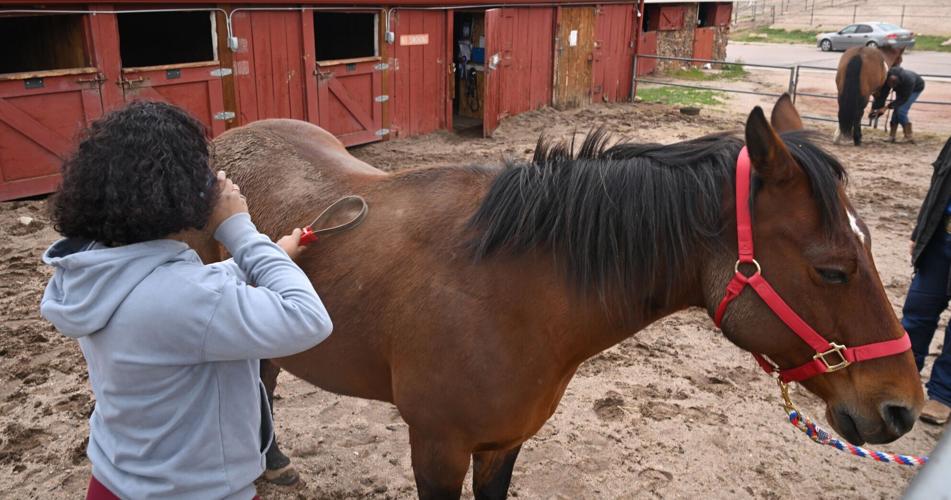
Her youngest son had just died, and visiting as part of the veteran’s grief group, she wasn’t sure what to expect. That was until she came face to face with Cinnamon, a light brown mare. As we talk, she’s brushing out Cinnamon’s fluffy winter coat.
One day, she remembers coming in and not feeling up to anything. So, she sat down on the stone ledge out in the field. Cinnamon approached her and gently rested her head on the woman’s shoulders. That was exactly what she needed, the veteran said. For about two years now, she’s been volunteering with the program as a peer mentor.
“The horses are so kind and gentle. They can know when you’re going through something,” she said.
How Earth’s rarest horse — once extinct in the wild — ended up on Colorado ranch
“We can learn from animals. There’s so many of us who isolate from life experiences, but we’re really meant to be in a community, and they kind of teach you how to do that again.”
As for Sirles, after working with Mackenzie for a year, she decided to take a walk through the geldings’ stables.
There, three stalls in, she found Frankie, a spotted horse with deep blue eyes.
“Our eyes met, and he just filled my empty soul. I quit drinking, I quit drinking. I haven’t touched a drop or smoked any crack since,” she said, proudly showing me a picture of him lying down. He’s the screensaver on her phone.
That was seven-and-a-half years ago. Since meeting Frankie, Sirles has come to the stables nearly every day to care for him and ride the thousand acres of trails.
“I came in on 16 different medications. Now I’m down to two, and one’s my horse,” Sirles, who eventually adopted Frankie, said. “Life can be good again.”


Live Well: Fall back in love with your ticker this month
Jennifer Mulson
jennifer-mulson@denvergazette.com
Updated 1 day ago
Well, well, well, you thought you were going to get away without me mentioning your heart health this month, didn’t you? I don’t mean to be a downer, but the stats are sobering. According to the Centers for Disease Control...

Jennifer Mulson
Reporter

We’re looking for Denver’s best ice cream shop. Submit your nominations.
Daniel Boniface
dan.boniface@denvergazette.com
Updated 9 hours ago
The mild winter has already got us thinking about ice cream. So, we’re on the hunt for Denver’s best ice cream shop. The Denver Gazette’s Ice Cream Shop Bracket is launching next week, pitting the best of the best against...

Daniel Boniface
Reporter
Colorado history told through poetry, spoken word by poets laureate
Linda Navarro
linda-navarro@denvergazette.com
Updated 6 days ago
Young poet and social justice activist Amanda Gorman, the first National Youth Poet Laureate, was just 22 when her “The Hill We Climb” launched the literary art back into a major worldwide spotlight with her 2021 Joe Biden inaugural poem....

Linda Navarro
Reporter

Little-known legend of Colorado Nick to be celebrated at Colorado Springs Pioneers Museum
Seth Boster
seth-boster@denvergazette.com
Updated 2 days ago
For years in Colorado Springs, Scott Boyer had been learning little by little about a tattoo artist in local lore who went by Colorado Nick. His real name was Leonard Newell Wisner, Boyer learned. And in learning this he learned...

Seth Boster
Reporter
Ancient biblical coins talk; here’s what they’re saying
Debbie Kelley
debbie-kelley@denvergazette.com
Updated 2 days ago
With the penny being ushered out of circulation early in the 21st century, theologians, historians, archaeologists and numismatists continue to glean insights from coins of the first century, when Jesus Christ walked the Earth and his followers promulgated the new...

Debbie Kelley
Reporter

Friends forever: Broadway superstars Denver-bound to sing praises of legends
John Moore
john.moore@denvergazette.com
Updated 3 days ago
Sutton Foster and Kelli O’Hara will honor Carol Burnett and Julie Andrews with tribute concert joined by Colorado Symphony I remember seeing Sutton Foster’s utterly charming breakout role as Millie Dillmount in the 2002 Broadway musical “Thoroughly Modern Millie” and...

John Moore
Reporter
After Colorado’s big snow this week, two more chances for winter storms in the forecast
Spencer McKee
spencer@outtherecolorado.com
Updated 5 days ago
Following a week of heavy snow in Colorado’s high country, more snow is on the way in upcoming days. Per National Weather Service mapping, large swaths of the San Juans and peaks near Aspen have gotten more than 36 inches...

Spencer McKee
Reporter
With new book, Colorado climber turns the page on horrific chapter
Seth Boster
seth-boster@denvergazette.com
Updated 1 day ago
In her hospital bed on the morning of May 8, 2017, Melissa Strong asked her husband, Adam, for a pen. She could barely grip it; her fingers hardly resembled fingers, more like dark and swollen nubs after tense, reconstructive surgeries...
Seth Boster
Reporter
The Braun brother arrives
John Moore
john.moore@denvergazette.com
Updated 4 days ago
For this tight-knit basketball brood representing the Nuggets and Roadrunners, it’s family first It’s wild to think that Christian and Landon Braun, two tightly bonded basketball brothers from Burlington, Kan., play their home games about 1,000 feet apart in Denver....
John Moore
Reporter
ABA series screening soars ‘above the rim’
John Moore
john.moore@denvergazette.com
Updated 1 day ago
‘Soul Power’ gathering brings players, fans, family and media to sold-out Sie FilmCenter for nostalgic look back at Denver’s renegade basketball past “Bring back the ball!” That was Hall of Fame coach George Karl’s message to the NBA at Wednesday’s...
John Moore
Reporter
PREV
PREVIOUS

CSU releases 'Top Performing' perennials for upcoming garden season
Facebook Twitter WhatsApp SMS Email Print Copy article link Save Facebook Twitter WhatsApp SMS Email Print Copy article link Save Colorado State University has announced its “Top Performing” perennials. The results of the 2024 CSU Perennial Trial program highlight nine plants that flourished amid harsh winters and arid summers. “The goal is to basically see […]
Denver novelist Peter Heller recipient of Colorado Springs book award
Facebook Twitter WhatsApp SMS Email Print Copy article link Save Once you go fiction, you can’t go back. Award-winning Denver author Peter Heller lived a swashbuckling life as a nonfiction adventure and environmental writer before finally succumbing to the lifelong internal nudge to write novels. “Once you start making it up, it’s tough to go […]