







The psychology of camping: Throwbacks yield popular contemporary tradition
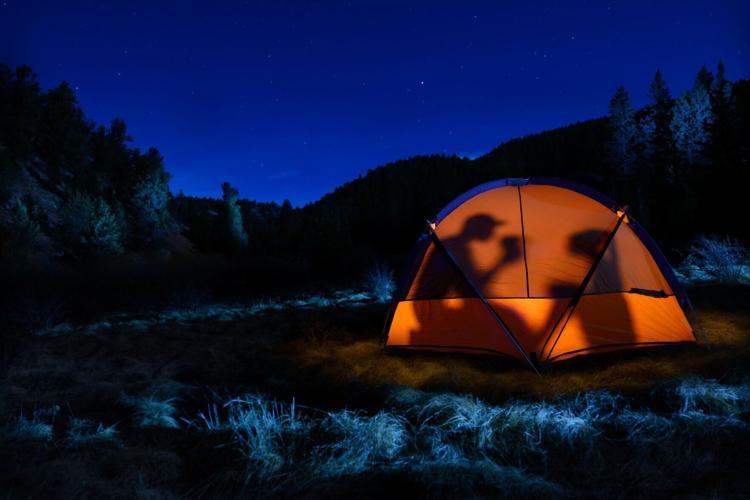
The ful moon illuminates a Colorado Campsite near Divide, Colorado April 12, 2025. Photo by Mark Reis
Mark Reis, Special to The Gazette

Why anyone would happily forgo hot showers, dreamy sheets and an indoor commode in favor of scant bathing, a rocky snooze and vault toilets could be traced to a deep, ancestral pull.
Think cave dwelling, teepee living, overnighters along wagon trails.
“We all used to camp out,” said Minette Church, an archaeologist who teaches anthropology at the Colorado Springs campus of the University of Colorado. “For us, it’s a fun choice to go camping; for people in the past, it was the life you led.”
Unlike today, forebearers bedded down outside not for sport but to survive, work the land and be mobile.
But perhaps the throwback doesn’t go back quite that far.
Church sees cultural influences; her research shows the attraction to 21st-century camping is particularly strong among city dwellers who live in places that are the most urbanized and densely populated.
Each year, many out-of-state visitors come to Colorado specifically to camp, said Bridget O’Rourke, spokesperson for Colorado Parks and Wildlife, which manages upward of 4,400 campsites. But plenty of locals also enjoy the activity.
No matter the style or method — backpacking or glamping, tent or RV — connecting with nature remains a primary incentive for modern-day campers to pack up and head out, according to O’Rourke.
“We have campsites that’ll book six months out from the summer, with July our busiest season,” she said. “A lot start booking in February, and campsites fill up. We have more demand to build more campsites.”
Other entities that oversee camping — on public land and private property — report similar clamor for the state’s estimated 14,000 sites.
“It’s by far and away one of the most popular activities on forest service land in Colorado,” said Chad Schneckenburger, regional trails and dispersed recreation program manager for the U.S. Forest Service’s Rocky Mountain Region.
The agency oversees thousands of sites in 370 campgrounds in Colorado, as well as a growing number of designated dispersed sites that are undeveloped, not formalized and free to camp on, he said.
Attesting to the popularity is a survey in the 2025 Statewide Comprehensive Outdoor Recreation Plan, which shows that 28% of respondents participate in tent camping, another 23% in RV camping and 21% in backcountry camping.
The reasons people love to camp are as varied as the constellations visible in a wide-open, inky-black night sky.
The practice of campfire cooking, the challenges of unpredictable weather and the unfettered ability to eschew technology and social media speak to why millions of Americans leave the comforts of home for an outdoor stay.
Humans have an innate desire to commune with nature, O’Rourke believes, as outdoor activity has been proven to reap mental and physical benefits.
Setting up camp and exploring provides exercise, which flushes the lymphatic system and removes waste from the body, sunshine adds vitamins, and aromatherapy from the fresh, earthy smells boosts the immune system, she said.
“You’re bringing yourself to a simpler way of life, focusing on what are you going to eat that day, making sure you have enough water,” O’Rourke said. “Are you going to go hiking or fishing? It can be as relaxing or as challenging as you want it to be.”
The experience can be as simple as hanging a hammock between trees and reading a book, or watching birds forage while listening to water gurgle in a creek.
And it’s easily accessible to people of all backgrounds, Schneckenburger said.
“We see people from rural or urban areas and all socioeconomic levels,” he said. “For a lot of history, people lived in harmony with nature and relied on the outdoors for food and shelter. It allows us to experience the simplicity and resourcefulness that comes with camping that our ancestors did — sleeping under the stars, waking up to the sounds of nature, cooking over a fire.”
And why is it that coffee, chili and s’mores seemingly taste better when cooked over a campfire?
Camping heightens the senses, O’Rourke said. There’s the views of towering mountains, scents of blooming wildflowers, sounds of falling rain, feelings of crisp, cool air and tastes of a wood-fired meal.
Many families and friend groups have carved out a tradition of returning to a favorite spot every summer. It become a generational pastime, O’Rourke said, as people who camped as a child are more likely to take their children and grandchildren camping.
“Camping strengthens relationships,” she said. “You’re sharing in an adventure and building core memories.”
Contact the writer: 719-476-1656.