







Colorado Parks and Wildlife commissioner calls relocation of Copper Creek wolf pack a ‘mistake’
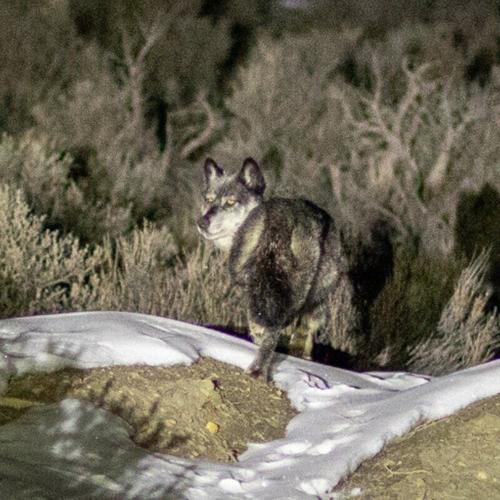
Colorado Parks and Wildlife posted this image of a wolf release that took place recently in either Pitkin or Eagle counties.
Colorado Parks and Wildlife image

While Wednesday’s agenda for the Colorado Parks and Wildlife Commission didn’t include an update on the wolf program, that didn’t stop commissioners from bringing up the most recent rash of problems from reintroducing the apex predators.
The conversation that followed showed the frustration commissioners are experiencing over the wolf reintroduction program, the public feedback and media scrutiny.
One commissioner, who is also a cattle rancher, called the relocation of the Copper Creek wolf pack into his county a “mistake.”
It started when Commissioner Marie Haskett of Meeker said she was glad not to see wolves on the commission’s agenda Wednesday. But, she added, “I feel like wolves have taken over this agency and we’re not getting the business done at this commission for all the other species that we manage.”
Haskett wondered whether the wolves brought to Colorado from British Columbia were trying to return home, referring to two wolves that had traveled into Wyoming. The latest group appears to be wandering a lot more than the first group from Oregon, she noted.
Two of the British Columbia wolves died in Wyoming during the spring. One was killed by U.S. Fish & Wildlife after multiple attacks on sheep; no cause of death was announced for the second wolf.
The recent death of the fifth British Columbia wolf, out of 15 brought to Colorado, is also raising questions about the success of the program.
The wolf management plan calls for an evaluation of the “short-term success of wolf reintroduction efforts,” and among the criteria is a survival rate of less than 70%, which would initiate a protocol review.
State wildlife director Jeff Davis noted that, with the death of the fifth wolf, the survival rate, at 67%, has now dropped below the 70% trigger.
The agency will examine the causes of mortality for the three Canadian wolves — for which necropsies are being conducted by the U.S. Fish & Wildlife. Davis said officials are looking for any aspect of the “translocation protocol” that could be modified to prevent the same trend from occurring in the next round of translocations.
The wildlife agency has not yet announced where it will obtain the next group of wolves or when. Lawmakers at the state Capitol have made it clear they want to see the non-lethal deterrents program fully operational before any more wolves are brought to Colorado, and they have threatened to hold up future relocation funding if that doesn’t happen.
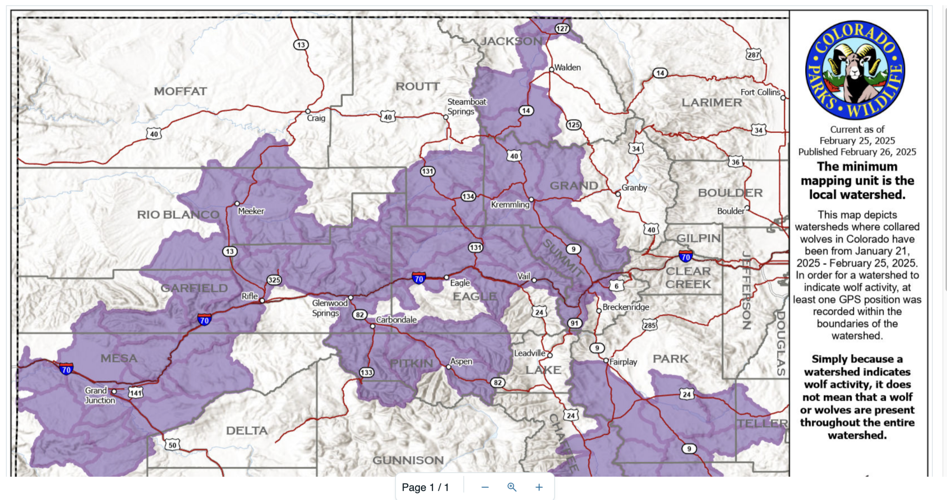
The British Columbia wolves, along with the surviving female and four yearling wolves from the Copper Creek pack, were all dropped in Eagle and Pitkin County in January.
Over Memorial Day weekend, wolves attacked at least three livestock herds in Pitkin County, and the state agency shot and killed one of the yearling wolves from the Copper Creek pack for repeated attacks on livestock, in hopes it would impact the behavior of the rest of the pack.
That’s not good enough for Commissioner Tai Jacober, a Pitkin County rancher whose neighbors are now dealing with wolf attacks. Jacober has been criticized in the past by ranchers for failing to stand up for production agriculture on the wolf issue.
His comments on Wednesday were markedly different.
“It’s been quite ugly,” Jacober told fellow commissioners. “We went against our management plan, captured the wolves, went further against the management plan, re-released the wolves, and here we are today,” he said.
This is not only a “blunder” for the agency, it’s also blunder for the wolves and it’s been difficult for the ranchers, he said.
“We need to be accountable for a mistake that we’ve made by putting this depredating pack back on the landscape, and make a quick, fast discussion about how to move forward with clearly, unfortunately, a bad pack of animals. And I think that if we don’t deal with a chronic depredating pack, it’s just going to continue to kind of rub on all of us and on the program and make it unsuccessful,” he said.
“We have an opportunity with a lot of wolves out on the landscape that aren’t causing problems. But we went against what we said we were gonna do, and here we are facing problems,” he said.
Biologically, this isn’t challenging, Davis responded. It’s a social evolution factor, he said. The state wildlife agency can hear from other states with an abundance of wolves, but “there’s no ‘on-off switch’ for the social component of wolves on the landscape,” he said.
He said the movement of the Copper Creek pack is being monitored daily, and the agency will act as necessary according to the plan.
Commission Chair Dallas May of Lamar also expressed concerns. A year ago, the problems were in Grand County, with criticisms from the pro-wolf community that ranchers weren’t utilizing all the available tools.
Today, ranchers are using every non-lethal tool available, May said, including cleaning out carcass pits when possible. He questioned how well the new range rider program is working and asked whether range riders are acting as a buffer between the wolves in Pitkin County and the livestock. May also noted that CPW has been feeding wild game, including “roadkill,” to the wolves.
“It seems like we’re right back in the same place where we were a year ago,” May said.
Davis pushed back, stating he believes they aren’t even close to the problems of a year ago because of the non-lethal programs.
The “diversionary feeding” is something CPW learned from their counterparts in other states, Davis said.
“This is the most monitored group of animals that I’ve ever seen, and we will react promptly when we see evidence of behaviors that are not going to be tolerated,” he said.
Travis Black, the northwest regional manager for CPW, said there are two range riders near the Copper Creek pack, one specifically assigned to monitor the group.
Jacober acknowledged the range rider and other non-lethal techniques, but, he insisted, “the perfect storm has been said about this one group of animals. Well, it’s a perfect storm again up there.”
“I don’t see how it could be viewed different,” he said.
He said he believes that more animals have been lost in Pitkin County than were lost last year in Middle Park in Grand County due to depredations from the same group of animals.
Wolves have gone through his property several times, Jacober said, adding, “Producers feel like they’re being left in the dark.”
He pointed to the incident at Tom Harrington’s ranch, where wolves killed a calf over Memorial Day weekend. They had a range rider on the allotment, but the rider wasn’t in the right place, Jacober said.
Jacober questioned why CPW wouldn’t call the producer, warn them that a wolf is in the area, and help the range rider get to the right place.
“There’s a lot of frustration, and I have avoided it, and I’ve understood where we stand, and I understand how well the CPW does, but the more I’m watching it in my backyard, the more I’m realizing that there’s some truth to this,” he said.
Jacboer said his frustration is that it’s one group of animals removed from Grand County and relocated to Pitkin County, and it is now causing the same problems.
“Why are we blundering an entire wolf program with one group of animals?” he asked.
Haskett noted that the problems are creating hardships, including an emotional toll on the ranching families. These wolves have established a presence on private land, she said.
“All of these issues have happened on private land that belongs to someone,” and CPW must work with those people because wildlife, not just wolves, cannot be supported without private lands.
“I just hope we can do better and try to figure this out and do something about the problems,” she said.
Commissioner Murphy Robinson said the issue is determining the role of the board in addressing the problem.
“What can we do as a policy board?” he said.
Complaining about it month after month takes a toll and doesn’t reveal anything about the commission’s role, he said.
If the commission doesn’t figure out the policy and its role, these problems would continue to surface year after year, Robinson warned.
The commission is on the first day of a two-day meeting in Glenwood Springs. Public comment is slated for Thursday afternoon.
Editor’s note: story has been corrected to properly identify CPW Director Jeff Davis.