







Millions of acres of Colorado public lands could be up for sale in Senate budget bill
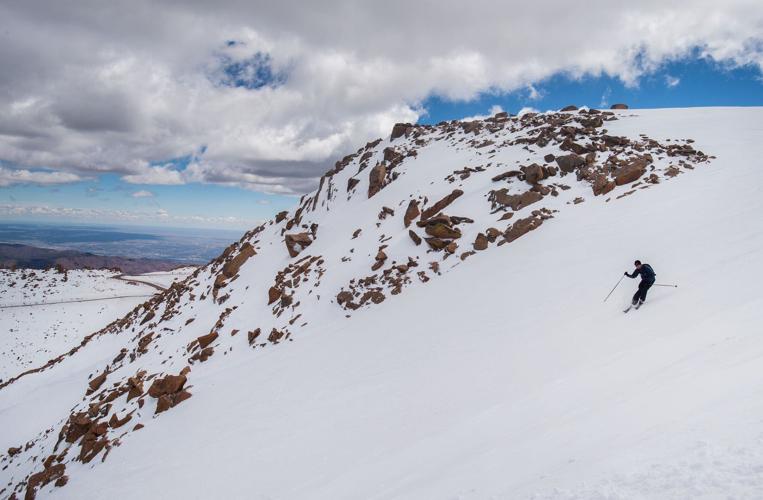
Steve Stowell of Colorado Springs skis Little Italy above Glenn Cove on Pikes Peak in May 2016 after storms blanketed the north side of the 14,115-foot mountain.
christian murdock, the gazette file
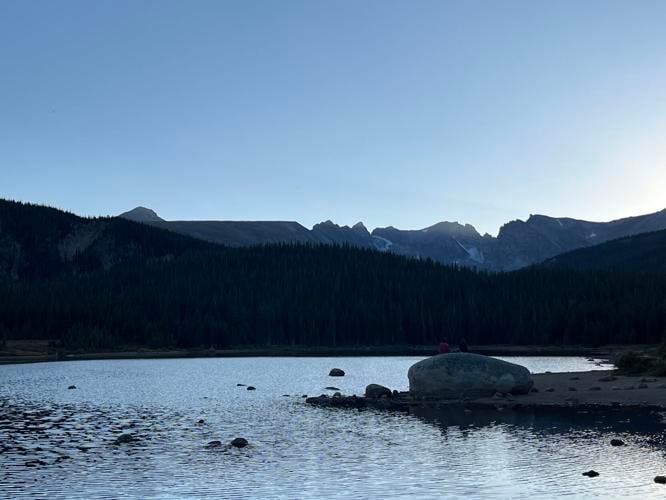
Some of Colorado’s most iconic public lands, including popular recreation areas, could be eligible for sale in the current version of Congress’s budget bill.
The newest language requires the sale of 0.5% to 0.75% of U.S. Forest Service and Bureau of Land Management holdings in 11 Western states over the next five years — a percentage that could total over 3 million of the 640 million acres of public land, according to analysis by the land conservation nonprofit The Wilderness Society.
Championed by U.S. Sen. Mike Lee, R-Utah, the budget provision says it will help address the nation’s housing shortage. The text, most recently updated this past weekend, says land nominated for sale “must be used solely for the development of housing or to address associated infrastructure to support local housing needs.”
The provision does not include housing-affordability requirements or restrictions on which parties can nominate land for sale. While excluding national monuments, national parks and other federally protected land, the sale mandate could still apply to millions of acres in Colorado.
In total, the U.S. Forest Service operates 11.3 million acres in the state while the Bureau of Land Management is responsible for 8.3 million acres.
The text of the bill would give 5% of land profits to local municipalities, 5% to deferred maintenance in federal lands, and the rest to the U.S. Treasury.
A fact sheet released by Lee’s committee last week said that selling off government-owned land would “increase the supply of housing and decrease housing costs for millions of American families.”
Lee said in a June 11 video that the bill would turn “federal liabilities into taxpayer value.”
According to a map compiled by The Wilderness Society, over 14 million acres in Colorado are eligible. The area includes well-trafficked areas like the north side of Pikes Peak, the “lunch loop” trails popular in the Western Slope mountain biking community, and areas surrounding the Indian Peaks Wilderness Area on the outskirts of Boulder.
Critics of the provision say it could make popular public lands in Colorado vulnerable.
“Every Coloradan stands to lose places that they recreate if this bill goes through,” said Brian Bergeler, conservation director at the Colorado Mountain Club.
Another Aspen
The possible land sales were the main topic at a town hall meeting in Creede last week. The southern Colorado community of less than 300 is surrounded by public land, including the Rio Grande National Forest.
“We’re in shock that they’re trying to sell this property,” said Creede Mayor Jeffrey Larson.
Larson said that the town has struggled for years with the issue the land sales provision says it would address. Lack of housing has become a major barrier to attracting needed workers to the town, including three missing teacher positions for Creede’s school district.
Still, he said selling public land would create problems instead of solving them. For the mayor of a town that depends on the national forest as an economic driver, he said the bill does little to soothe fears that the sales provision would be exploited for profit to the detriment of Creede.
“I know that there are developers just gnawing at the bone to come buy it,” Larson said of the surrounding public lands.
The current version of the bill would allow any “interested party” to nominate a parcel of land to the relevant land agency — the Bureau of Land Management or the U.S. Forest Service. The head of each would then have the authority to initiate a fair-market sale of the parcel if it meets criteria for use as housing or housing-related infrastructure.
Land that already borders urban areas or with access to existing infrastructure are to be prioritized. Larson said his community was concerned bordering forest land could be nominated to land managers without the knowledge of anyone in Mineral County. A potential developer could push for a project at the national level without local input, he worries.
“You know if this is available, they are going to get pressure from everybody,” he said.
Gunnison County Commissioner Jonathan Houck has similar concerns for his communities, which rely on access to USFS and BLM land for recreation and cattle grazing.
“Public lands, at least to the Gunnison-area communities, are everything,” he said.
Houck said that the bill’s provision to allow local governments first right of refusal on a sale was a “red herring.” Neither Gunnison County nor local towns would have the funds necessary to pay fair market for the land, were it up for sale.
“Local governments are not equipped financially to be able to purchase these lands,” he said.
Instead, he feels the sales could be used to allow resource exploitation and the building of high-end housing.
Larson has a similar concern that Creede’s current residents, whose average income hovers around $50,000 a year, could be priced out if developers gain access to prime land for luxury homes. He said a genuine affordable housing project would require governmental buy-in beyond land acquisition; an unlikely scenario with dwindling available funding from the Colorado Department of Local Affairs.
“We’re going to become another Aspen, and the people who live here won’t be able to live here,” he said.
But Lee said in his video on the bill that it would create better uses for land resources.
“Washington has proven time and again it can’t manage this land. This bill puts it in better hands,” he said.
Grazing rights
The multi-generational LaValley Ranch grazes cattle on BLM, USFS and even the Black Canyon of the Gunnison National Park land. Robbie LaValley said access to public lands has been a symbiotic relationship, benefiting the ranching operation while fulfilling conservation and wildfire mitigation goals for federal land managers.
While waiting for a finalized version of the bill to surface, LaValley said she was concerned about the potential impact of the land sales.
“There would be significant conversation about what that would look like,” she said.
While the bill excludes land with “valid existing rights” from sale, The Wilderness Society’s BLM campaign director Michael Carroll said the newest version of the bill can be interpreted to exclude agricultural rights — nearly doubling the amount of eligible land.
That would include grazing rights for LaValley and many other ranchers in Colorado. A past president of the Colorado Cattlemen’s Association, she said that 41% of animals spend some of their time grazing on the state’s public lands.
For Houck, the ranching community “underpins” Gunnison County. Like municipalities, ranchers would also be hard pressed to pay market value for the land they use.
“The margins are often slim for our ranching community.”
Restrictions can be set on the agricultural use of public land to protect and conserve fragile wildlife, said Houck.
“You can’t force someone on private land to protect big game habitat,” he said.
A permeable boundary
If public land sales in their current form stay in the budget bill, recreation areas near metropolitan areas could fit the criteria best due to their urban proximity.
A previous version of the text included a call to prioritize land that was remote and difficult to manage as well, but that provision was later removed in the version leaked last weekend.
The Wilderness Society’s map shows large swaths of eligible land on and near Pikes Peak and the Rampart Range, minutes from Colorado Springs.
Corey Sutela, the executive director of Medicine Wheel Trail Advocates, said that the “permeable boundary” between the city and the Pike National Forest, with numerous access points, is one of the area’s biggest draws. A mountain biker, he said Colorado Springs had some of the best trails in the United States, thanks to easy public land access and a long riding season.
“It’s abundantly clear that a huge portion of the people who live here choose to live here because of access to public lands and the healing experience of being on those trails,” he said.
Sutela said that land near the forest boundary has historically been prime real estate for development.
“I will expect there to be huge interest,” he said.
In Grand Junction, Adam Kinsey thinks of the lunch-loop trails beloved by Western Slope mountain bikers when considering applications of the bill. The trails are largely on BLM property minutes from downtown.
“It’s an incredibly popular, high-use area,” he said.
As one the state’s hot spots for mountain biking, Mesa County’s popular trails support an economy of outfitters, restaurants and breweries. Kinsey, the president of Colorado Plateau Mountain Bike Trail Association (COPMOBA), said that local money was entwined with the health of public lands.
The flow of funds goes both ways, he said, since organizations like COPMOBA spend countless hours maintaining and expanding the trails system.
“Potentially all those dollars and investment are at risk,” Kinsey said.
Break something
Volunteers with the Indian Peaks Wilderness Alliance have been busy this summer. With almost no seasonal employees to assist from the U.S. Forest Service, IPWA board chair Fiona Garvin said volunteers with the organization have been taking up the slack when it comes to managing trails and the public.
Volunteers have limitations, especially when they come across prohibited campfires and campsites.
“We don’t give tickets, we don’t enforce, and people know that,” she said.
With the news of potential land selloffs, Garvin has her suspicions. While the wilderness area itself would likely be excluded from sales, surrounding land is not. She is concerned that recreationists may be pushed into the wilderness if other access options are privatized, at a time when federal land agencies are cutting resources.
“I do wonder sometimes if the plan is to break something and then say, ‘Look, it’s broken. Let’s sell it,’” she said.
Public land agencies already have processes in place to dispose of acreage in private sales on a case-by-case basis. LaValley said she would prefer that process become more efficient.
“It’s just very extended and there does need to be a modernization of that,” she said.
Houck also said land agencies in Gunnison County were noticeably understaffed.
“I think there’s a design in what they’ve done with the workforce,” he said.
Garvin said she was concerned that land-sale discussions were happening in the forum of budget reconciliation without a public comment process.
Before Lee’s addition to the Senate bill, a separate amendment with public land sales was cut from the House version. The amendment would have sold about 500,000 acres of public land in Utah and Nevada. The proposal saw vocal opposition from some Western Republicans, including Montana U.S. Rep. Ryan Zinke.
U.S. Rep. Jeff Hurd, a Republican for Colorado’s 3rd Congressional District, initially voted against the land selloff in a House Committee on Natural Resources meeting but later voted for the full budget package including the amendment.
Colorado Democrats in Congress have come out strongly against the new provision in the reconciliation bill, which greatly expands the scope of sales.
“Auctioning off these lands to pay for President Trump’s radical agenda, including the prioritization of tax cuts for billionaires and big corporations, is an affront to our core values,” said Sen. Michael Bennet and Rep. Joe Neguse in a joint statement on June 12.
Some Democrats in Western states have supported limited efforts to allow more construction on public lands. During her presidential campaign last year, Vice President Kamala Harris said she would “take action to make certain federal lands eligible to be repurposed for new housing developments that families can afford.”
Under a law passed in 1998 that authorized some sales, the Bureau of Land Management has already sold or conveyed nearly 44,000 acres of public land for homes and other development near Las Vegas, including about 50 acres for affordable housing.
Other Senate committees are revising portions of the reconciliation bill, with a finalized version expected in coming weeks.