







A Sherpa’s unlikely journey to food and drink fame in Boulder | Craving Colorado

Pemba Sherpa poses for a photograph at Sherpa’s Adventurer Restaurant and Bar on Wednesday, May 21, 2025, in Boulder, Colo. In addition to running the restaurant, Sherpa founded Sherpa Chai, a tea brand created using a family recipe passed down through generations.
Parker Seibold, The Gazette



BOULDER • Pemba Sherpa is often sipping chai. Not just any chai, but his chai. The chai of Sherpa Chai, the company that grew out of his longstanding restaurant here in an old Victorian house along Walnut Street.
More importantly, it’s the chai of his mother, the chai of his mother’s mother. “It’s a generational recipe,” Pemba says with a mug here on the spacious, leafy patio of Sherpa’s Adventure Restaurant and Bar.
It’s a blend of ginger, cinnamon, cardamom and black pepper, among other ingredients sourced from his native Nepal. He calls it “a product,” ever the businessman who tracked annual growth around 20% in the years after Sherpa Chai’s establishment a decade ago. But Pemba knows the hot, spiced drink to be much more than a product.
“I used to walk three hours to school every morning,” he says. “My mom made me this chai before I left every morning.”
The chai would provide warmth and energy for the journey, made long due to the absence of a bridge out of his little village in the shadow of Mount Everest. Occasionally a bridge was available, a makeshift passage of bamboo over the notorious Dhudh Kosi River. Often the river washed the bridge away. Sometimes the rushing water claimed lives as well, among them a childhood friend.
It’s a memory at the heart of Pemba’s autobiography, “Bridging Worlds,” published in 2019. The book recounts a journey even more remarkable than that long, daily trek to school — the broader journey of a Sherpa from harsh, poor beginnings who went on to riches in Boulder.
“With my wife and young daughter, I enjoy a life of relative affluence. But this only begins to tell the story,” reads the book, written with James McVey. “I have never forgotten the poverty and hardship of my people. … I am both Sherpa and American, walking in two worlds.”
With a mug of chai in hand, Pemba walks them every day at Sherpa’s Adventure Restaurant and Bar.
The restaurant stands as a testament to his success — beloved by locals since 2001, opened amid an expanding business and real estate portfolio — and a testament to his past.
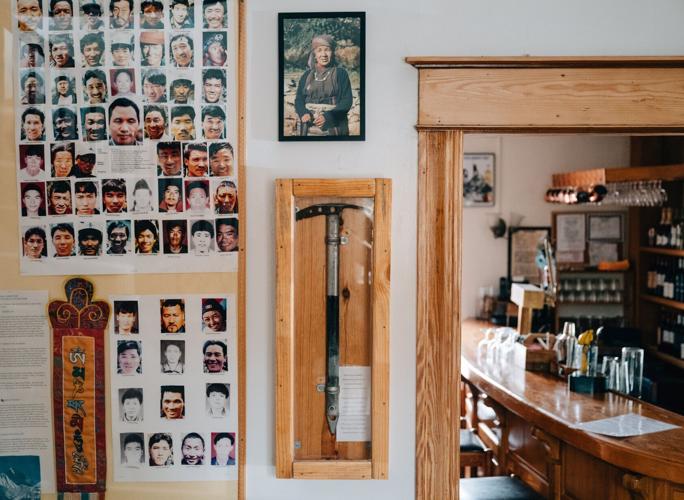
A wall honors his fellow Sherpas (“faces of character, dependability, perseverance and tradition”), while other walls display a former mountain guide’s gear and various recognitions. They are awards for physical feats (a single-day jaunt up Mount Kilimanjaro, a 5K dashed in 15 minutes and 17 seconds) and for food.
Wrote The New York Times once: “Eating at a restaurant run by a world-class mountaineer may conjure up images of spartan food served in freeze-dried pouches.” On the contrary, Pemba Sherpa has served carefully crafted specialties from his side of the world.
Much of it comes from a tandoor oven that roasts, for example, the marinated meats for tikka masala. Naan is dipped in fragrant sauces and other spiced curries and stews. Momos are similarly devoured — Tibetan dumplings stuffed with spiced veggies.
Over the years it’s been a Sherpa chef in the kitchen; one’s ice ax is on display, along with words on him ascending Everest 10 times without supplemental oxygen. Pemba has always employed people from Nepal, immigrants and others holding visas.
“I can retire now if I really wanted to, but I want to keep doing it because I’m providing jobs,” he says. “I have people that work here and help their families. I think it’s a good thing.”
He has tried to do good, sending money back to Nepal and building infrastructure there over the years. He sees two worlds: one in need, that world he came from, and the world he lives in now, one of lavish temptations.
“Personally, I like to live simply,” Pemba says. “For me, to find happiness and peace is going to the mountains. That doesn’t cost me much.”
So he’s had money to give away. After Nepal’s devastating earthquake in 2015, he raised $110,000, sent loads of supplies and saw 282 homes rebuilt. Previously, Pemba saw a hydroelectric plant bring power to his home village of Sengma. And he saw a permanent suspension bridge built there.
The bridge had long been a dream of his, ever since a nightmare as a boy.
A friend ahead of him fell into the river. The boy drowned.
“This thing kept staying in my mind,” Pemba says. “Watching your friend floating down the valley, the villagers screaming and trying to chase this little boy…”
There are other hard images from childhood. There was his father, whom Pemba remembers as an abusive alcoholic. The man died when the boy was young, leaving his mother to care for him and 11 siblings in their village of stone homes with no running water and sanitary systems. Half of his brothers and sisters would not survive.
But there are also bright images in Pemba’s mind: the surrounding Himalayas, the countryside painted by wildflowers, forests streaked by waterfalls. And there was his adoring mother, whose picture is framed through the front door of Sherpa’s Adventure Restaurant.
Pemba’s book recounts her giving birth to him sometime in 1971, alone in a bamboo shelter. She would go on to make that chai and see him off for those long, barefoot walks to school. Pemba would go eagerly.
“Despite all the challenges, I liked school and was good at it. I was especially good with numbers,” he reflects in his book.
He reflects, too, on the sight of Sherpas hauling the fancy gear of trekking Westerners. “I suppose it was just a matter of time before I got into the business myself …”
He’d work through his teenage years, growing American connections and business acumen along the way. Both served him well upon immigrating to Colorado in 1991. He would start a travel company and expand it over the next 20 years, guiding clients around the world, including to mountains of his “beloved kingdom.”
But never Everest, no matter “how lucrative it was,” he explains in his book: “I knew the business of climbing all too well: the big money and egos, the government bureaucracy and corruption, the environmental degradation.” All at the cost of Sherpa lives, Pemba has emphasized in interviews over the years.
It’s another mission of his: to raise awareness of the exploit and plight of his people. And to break misconceptions.
While popularly known as Everest guides — a result of Nepal opening its borders and foreign climbers fueling an industry — “to be a Sherpa is to be a member of a tribe,” reads a display at Sherpa’s Adventure Restaurant, chronicling ancient origins in eastern Tibet. The restaurant sends an unwritten, unspoken message as well: Sherpas are cooking and waiting tables, people like all people working and trying to better their lives.
They have Pemba for inspiration. Asked if he saw himself as that, he shrugs. “I’ve come a long way,” he says.
But never too far — always “walking in two worlds,” as he puts it.
While he’s watched Sherpa Chai expand its footprint in America, he’d like to see it expand in Nepal. The tea leaves are grown there, and he wants to buy land and issue small loans to women, who would then grow and sell to him. “I want to empower women, because women don’t have much opportunity,” Pemba says.
Young women like the young woman his mom was. She’s 96 now. He often travels back to Nepal to visit her.
Some things have changed. “She lives a comfortable life now,” he says.
And some things have not changed.
“The first thing she does when she sees me,” he says. “She goes and prepares the chai for me.”