







The rebirth of the iconic Mishawaka Amphitheatre in Poudre Canyon
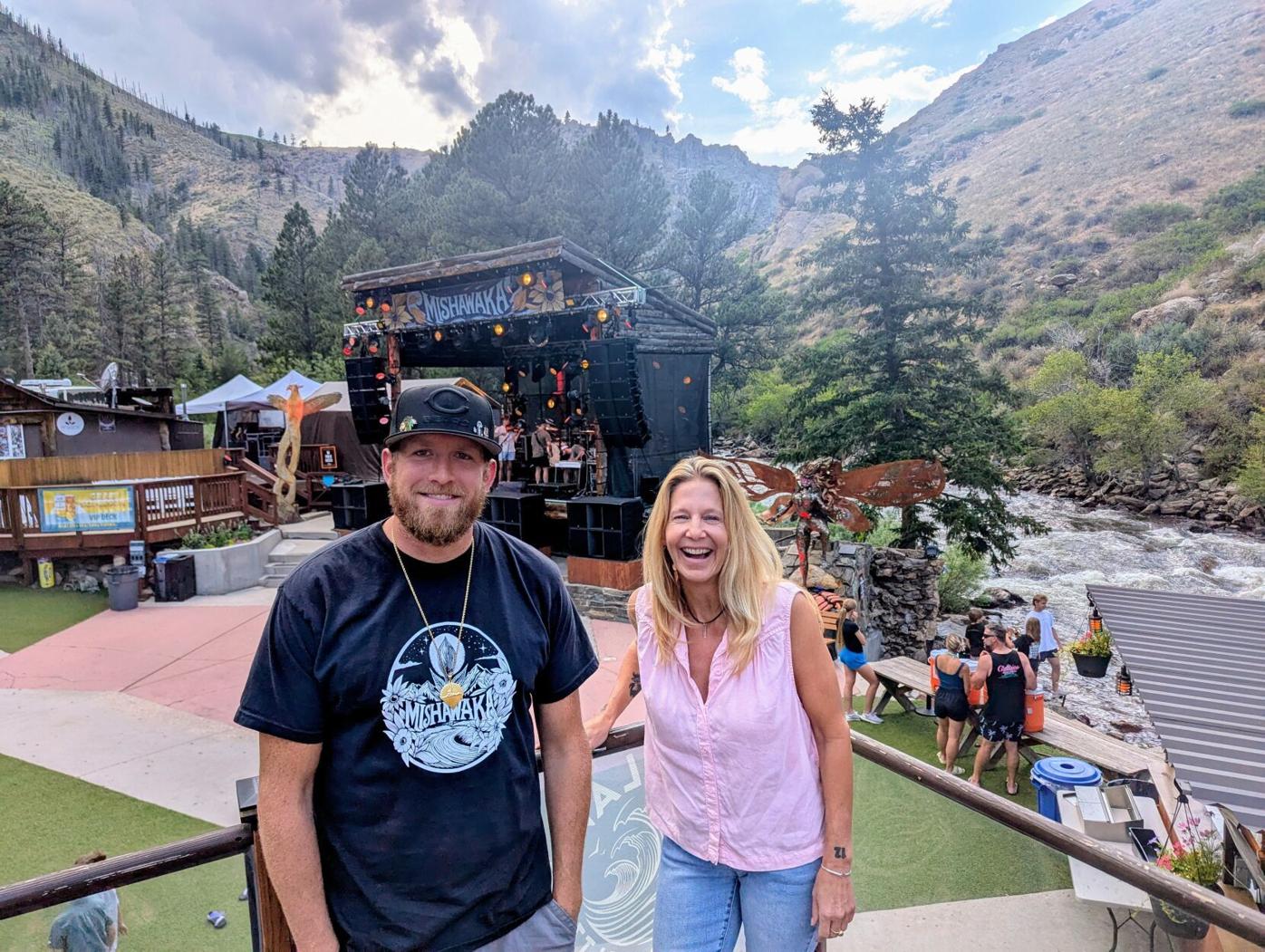
Photo by Hap Fry
BELLVUE — Louie Kucera is jazzed up and feeling content.
He’s got a few beers to spare and the rest of the week off. More importantly, the Fort Collins resident is on a shuttle and making the trek up to the Mishawaka Amphitheatre on a mid-July Wednesday night to see Social Distortion.
It’s Kucera’s first trip to the famed venue that he can recall since the late 1990s, when he saw Bella Fleck and Flecktones, before starting and raising a family.
Kucera is readily aware that handshakes, high fives and hugs will be awaiting him.
“It’s just a one-of-a-kind venue,” Kucera said. “It’s a totally freeing place where you can leave all of life’s problems and other concerns at the door — just kick back, relax and have a good time.”
Colorado has no shortage of iconic music venues. Red Rocks, and possibly rightly so, often shoots to the top of most people’s lists as the best.
But the Mishawaka, tucked away in the Poudre Canyon alongside the Cache la Poudre River 23 miles outside of Fort Collins, with its capacity of 1,000, can more than hold its own with any concert locale in Colorado or elsewhere.
One legend about the Mishawaka’s name is that it is a Native American-derived word that may mean “big rapids” or “swift floating water,” which seems appropriate given its setting.
“It truly is a magical place,” Mishawaka co-owner Dani Grant said. “A lot of people have had their first kiss or even gotten engaged here. The stories are endless. It’s a venue that’s stood the test of time.”
Today’s Mishawaka
The Mishawaka opened in 1916 and arguably has never been better than it is today under the leadership of Grant and co-owners Dan Mladenik and Cristin Gauthier.
Its summer concert season is in full bloom with performances already by Head for the Hills and Yonder Mountain String Band and three-day runs still to come by popular jam bands the Disco Biscuits and Umphrey’s McGee before the season closes with another three-night banger by Emancipator on the final weekend of September.
“A big thing for Dani is diversity and getting different types of bands up here,” Mladenik said. “That’s sometimes not an easy task because we’re an independent venue and we have to find the bands that can sell tickets up here. The Mish is a heavy lift at times. It’s up in the mountains — 40 minutes from Fort Collins and an hour and a half from Denver.”
Parking and lodging have long been issues with the venue, but things appear to be on the up and up.
The venue bought what was once the Columbine Lodge and has renamed it Riverside. It is located about 3 miles away from the venue and features tiny homes, cabins and a general store. The state-run Ansel Watrous Campground is another option for those looking to stay the night after a show.
Things are even better transportation-wise. Grant and Mladenik prioritized having an efficient shuttle service to and from Fort Collins.
The night of the Social Distortion show, Mladenik said they ran 13 shuttles to and from the tennis courts at Colorado State University. He said about 600 concertgoers chose to use the shuttle service that night.
Once a shuttle arrives at the venue, concertgoers are given a de-briefing or pep talk of sorts from one of the venue’s employees.
The efficiency and overall appearance of the venue, including the restaurant and bar, is worth noting because to truly appreciate where the Mishawaka is today, one has to know where it aesthetically stood before Grant came on board.
The Riot House
Before Grant’s arrival in 2010, Robin Jones had owned and operated the Mishawaka from 1991 to 2010.
To Jones’ credit, he did rescue the venue from becoming a parking lot with his purchase of it in 1991.
But residents in the area grew weary of the all-night parties that often took shape after a show. Three people died in drunk-driving-related accidents connected to the venue between 1990 and 2006. Locals also were more than a little skeptical of Jones’ lifestyle. They weren’t the only ones.
Local police and U.S. marshals seized 280 pounds of marijuana, along with ecstasy, cocaine and meth from him in the summer of 2010. Jones was sentenced to three years of community corrections and was forced to give up the Mishawaka.
To many, attending shows at the Mishawaka during Jones’ ownership meant wild and fun nights. They were also hectic ones for employees.
The venue’s current general manager, Natalie Volk, worked one year under Robin Jones in 2010 and said she quickly had to establish boundaries.
“It was pretty hectic,” Volk said. “I wouldn’t work show nights, just only like Tuesday nights or day shifts because it was so chaotic.”
Taking it on
With the venue in limbo, Grant was willing to take a gamble on the iconic venue despite hearing numerous objections from others.
Grant was becoming well-known in the Fort Collins music community, having just founded SpokesBuzz, a grassroots nonprofit that sought to develop and champion Northern Colorado bands during its time of operation from 2009 to 2016.
Grant had also resurrected a couple of bowling alleys, most notably Chipper’s Lanes in south and north Fort Collins. She saw similar potential in the Mishawaka, but even she was taken aback by its condition, initially.
“It was in shambles, and it was so overwhelming when we first got here,” Grant said. “I removed 120 cubic yards of trash just from the exterior. This (dining) room alone was covered floor to ceiling with old furniture, trash, newspapers, you name it.
“The kitchen had no dishwasher and very little equipment that worked. Dishes were stacked up everywhere. A local band and their families lived up here and basically ran it. It’s kind of unbelievable how resilient everybody who worked here was, including the production staff with all that was going on.”
Still, Grant forged ahead, but more obstacles awaited, including the unforeseen one that was the High Park Fire in 2012.
According to the Colorado Encyclopedia, the High Park Fire became one of the largest and most destructive wildfires in Colorado history, burning 87,415 acres and more than 180 homes along the Cache la Poudre River in the mountains west of Fort Collins.
Somehow, the Mishawaka was spared from the fire’s incendiary path. Firefighters used the venue as a community center in the canyon during the fire and food was brought to them by Grant and other community members.
Grant said one fire chief left a beautiful letter thanking the Mishawaka and saying how there were firefighters from all over the country who had come to know and love the venue. That letter, titled “Long Live the Mish,” is framed and hanging at the Mishawaka today.
The High Park Fire had another effect on the venue — this one a positive one. Public sentiment of the Mishawaka shifted among the locals from wanting the venue to just go away to wanting to support it and viewing it as a source of pride.
Still, Grant also had to repair the reputation of the Mishawaka so that booking agencies would be willing to work with her and musicians would once again want to play. The venue’s reputational fallout had been extreme in many ways.
She recalls making several trips to Los Angeles to plead her case that the Mishawaka had changed, for the better.
“Everyone had a terrible taste in their mouths,” Grant said. “We were up in LA — William Morris, and we were at all the stars’ offices just trying to plead our case about how the Mish now has a new face and that they could feel good about artists performing up there again.”
Dynamic duo
There is a presence to Dani Grant.
She has piercing green eyes, a welcoming smile, and a genuine care about wanting people to have a good experience at the Mishawaka. But don’t mistake her as being someone who avoids confrontation.
Most of all, though, Grant has vision and can think conceptually, she is someone who likes to think five steps ahead.
Still, even she knew she needed help to take the Mishawaka to a higher level.
While the COVID-19 Pandemic was a blow for almost everyone involved in the music world, Grant used the time to further solidify the venue.
She was able to successfully recruit Mladenik to come over as a co-owner. Mladenik had established his name in the Northern Colorado music scene by running Hodi’s Half Note, a successful Old Town Fort Collins concert venue from 2010 to 2020.
When Covid hit, Mladenik sold Hodi’s, and Grant made her move to bring Mladenik on board.
“Dani and I had always talked about working together,” Mladenik said. “When Covid happened, I kind of got a chance to re-evaluate things, and there was an opportunity for me to sell Hodi’s. Around April or May of 2020, Dani was like, ‘come work for me,’ so I came up here. It’s been a good partnership.”
Grant and Mladenik renovated the restaurant, installed new fencing, reinforced the concert stage and redid all the lighting, among other improvements.
Mladenik, who handles much of the booking as the lead talent buyer, prioritized getting traditional acts back to the venue, including Yonder Mountain String Band and Leftover Salmon.
“You know, it’s the best the Mish has ever looked,” Mladenik said. “We don’t really have any big other projects in front of us like we had before. We’re back, and we’re better than we’ve ever been.”
That’s apparent to concert-goers like Louie Kucera.
“It’s just such an iconic venue,” he said. “I’m glad it’s doing so well.”
Natalie Volk, meanwhile, always knew the venue was magical. She bought a house in the canyon 17 years ago because of the Mishawaka.
“What Dani did was so amazing when she bought it,” Volk said. “She put so much effort, work and love into this place, and it needed it all. It’s cleaner and it’s more reliable. It’s the best it’s ever been.”


Denver breaks heat record for Feb. 15
Piper Russell
piper.russell@outtherecolorado.com
Updated 40 minutes ago
Denver has broken another heat record this winter, with the National Weather Service announcing that the Mile High City saw the hottest Feb. 15 in recorded history. The NWS Boulder said that temperatures at Denver International Airport hit 68 degrees...

Piper Russell
Reporter

Fire breaks out near I-70 Sunday afternoon
Piper Russell
piper.russell@outtherecolorado.com
Updated 1 hour ago
Firefighters are working to put out a fire that ignited in Silver Plume on Sunday afternoon. According to the Clear Creek County Sheriff’s Office, a home in Silver Plume was fully engulfed. The Clear Creek County Sheriff’s Office also said...
Piper Russell
Reporter

Avalanche at the Olympics: Canada secures the top seed; Makar breaks through on power play
Evan Rawal
evan-rawal@denvergazette.com
Updated 1 hour ago
As expected, the United States and Canada finished the round robin portion of the tournament undefeated. Only one can take the top seed, and it’ll be our friends north of the border. Switzerland defeats Czechia 4-3 in overtime Martin Necas...

Evan Rawal
Reporter

FBI: DNA recovered from glove found near Guthrie home that appears to match glove worn by suspect
Jacques Billeaud
jacques.billeaud@associatedpress.com
Updated 2 hours ago
A glove containing DNA found about two miles from the house of “Today” show host Savannah Guthrie’s mother appears to match those worn by a masked person outside her front door in Tucson the night she vanished, the FBI said...

Jacques Billeaud
Reporter

NWS issues winter storm warning with 10-18 inches of snow possible
Piper Russell
piper.russell@outtherecolorado.com
Updated 2 hours ago
The National Weather Service (NWS), has issued a winter storm warning including parts of Colorado’s high country. According to the NWS, the warning is in effect from 11 p.m. Monday to 5 a.m. Thursday. The warning includes the northwest San...
Piper Russell
Reporter
NWS issues winter storm warning with 10-18 inches of snow possible
Piper Russell
piper.russell@outtherecolorado.com
Updated 2 hours ago
The National Weather Service (NWS), has issued a winter storm warning including parts of Colorado’s high country. According to the NWS, the warning is in effect from 11 p.m. Monday to 5 a.m. Thursday. The warning includes the northwest San...
Piper Russell
Reporter

A dream for spring? Colorado gardeners still wait to see if winter comes first
Bernadette Berdychowski
bernadette.berdychowski@denvergazette.com
Updated 2 hours ago
Last year, Front Range Gardens began selling cacti and succulents sourced from the Phoenix area and they were a hit. The desert-climate plants sold out, said Scott Jeffries, the owner of the garden center located in Broomfield. And this year,...

Bernadette Berdychowski
Reporter
Broncos set to hire Doug Belk as defensive backs coach, source says
Kyle Fredrickson
kyle-fredrickson@denvergazette.com
Updated 4 hours ago
The Broncos expect to hire Doug Belk as their next defensive backs coach, a source confirmed Sunday to The Denver Gazette. Belk, 38, spent the last two seasons as the secondary coach at the University of Southern California. He was...

Kyle Fredrickson
Reporter

Coroner identifies four people killed in plane crash near Steamboat Springs
Piper Russell
piper.russell@outtherecolorado.com
Updated 3 hours ago
The Routt County Coroner’s Office (RCCO) has identified the four people who were killed in the plane crash that occurred near Steamboat Springs early Friday. According to the RCCO, the victims were 47-year-old Aaron Stokes, 21-year-old Jakson Stokes, 21-year-old Colin...
Piper Russell
Reporter
Coroner identifies four people killed in plane crash near Steamboat Springs
Piper Russell
piper.russell@outtherecolorado.com
Updated 3 hours ago
The Routt County Coroner’s Office (RCCO) has identified the four people who were killed in the plane crash that occurred near Steamboat Springs early Friday. According to the RCCO, the victims were 47-year-old Aaron Stokes, 21-year-old Jakson Stokes, 21-year-old Colin...
Piper Russell
Reporter