








Denver museums and arts hit new economic milestone, but visits still down

The economic impact of metro Denver’s cultural arts and science institutions is continuing to grow, yet there are some trends that continue to be worrisome for the industry.
The region’s cultural industry — which includes museums, theaters, dance groups, orchestras and the zoo — saw its economic activity hit $3.12 billion in 2024, according to a new report from the Colorado Business Committee for the Arts released Thursday.
It grew by nearly 20% since 2022, when economic activity was $2.6 billion, according to the CBCA.
Economic activity is an aggregate measure of spending activity ranging from rent, supplies, programs, events, capital projects, renovations, expansions and audience spending.
“The latest data demonstrates how the nonprofit cultural sector continues to contribute to the economic growth of the Metro Denver region, reaching a new milestone in total economic activity,” said Christin Crampton Day, executive director of CBCA, in a news release.
The CBCA has been tracking the economic activity and impact of the arts every other year since 1993.
The report is compiled from self reporting by the 285 arts, culture and scientific organizations who are part of the Scientific and Cultural Facilities District (SCFD) in Adams, Arapahoe, Boulder, Broomfield, Denver, Douglas and Jefferson County.
The top organizations funded by the SCFD include the Denver Art Museum, Denver Botanic Gardens, Denver Center for Performing Arts, Denver Museum of Nature & Science and the Denver Zoo.
While economic activity is up, the arts and culture industry is still struggling with several issues following the pandemic including attendance numbers, higher costs of operations and sources of funding.
RACE TO FIGURE OUT NEW CUSTOMER HABITS
One of the biggest concerns continues to be in-person visits.
It’s grown 27% since 2022, but the region’s 14.5 million engagements at arts and science institutions is still down 5% from the record levels seen in 2019.
Colorado Ballet has been a “microcosm” of what the wider industry around Denver is seeing, said Sameed Afghani, Colorado Ballet’s executive director, during a panel at the Denver Art Museum.
The ballet company had record revenues in 2023 at $15.7 million, according to ProPublica’s nonprofit database. In 2024, it fell to $14.1 million.
In 2019, Colorado Ballet reported $10.7 million in revenue.
“We’re growing very rapidly, but we’re still chasing some of those attendance levels.” Afghani said. “That’s what keeps me up at night. I think that’s a big red flag.”

The numbers show museums, dance groups and theater companies are still adjusting to changing consumer behaviors following the pandemic, said Nathan Richie, the director of Golden History Museum & Park.
These nonprofits and organizations are not just competing against each other or different leisure activities such as skiing anymore, he added.
“We’re actually more in competition with the couch,” Richie said.
Local organizations are starting to catch up to new trends to capture visitors who have changed their habits from the era since the pandemic, said Betty Hart, co-artistic director at the Local Theater Company and president of the Colorado Theatre Guild.
“One of the things that’s happening nationally, that Colorado’s just beginning to do, is that Saturday afternoon is the new Friday night,” Hart said.
Tickets for shows are selling better during Saturday and Sunday afternoons than for evening shows, she explained.
“It’s a big change from 2019 and 2022,” Hart said.

TOURISM AND JOBS ARE UP, THOUGH
Meanwhile, the bright spots are job growth, cultural tourism and education outreach for the sector.
The economic impact of tourism for Denver’s arts world went up to $692 million, up from $654 million two years ago.
Employment is up to nearly 14,500 jobs, the report said, up by 6.8% from 2022. But costs of employees have also grown faster than jobs, it explained. Personnel expenses grew by 27% in the last two years hitting $312 million.
“It’s a good sign, we should be paying our cultural workers what they’re worth,” said Meredith Badler, deputy director of the CBCA. “But it also means that’s a bigger brunt for these cultural organizations to carry in terms of their operating costs.”
FUNDING STILL A CONCERN
Many arts and sciences nonprofits rely on donations and grants to support their operations.
Arts institutions across the Denver metro area received a total of $286 million in 2024. It’s up 34% from 2019, before the pandemic. Yet, gifts dropped by 2.6% since 2022.
The largest source of funding though is the SCFD, a seven-county tax district approved by voters that collects one penny on every $10 in sales and use tax. The SCFD gave about $85 million in 2024 to art and science organizations across the region, making up 30% of all the contributions they received.
The SCFD is beginning work to prepare for reauthorization going on the ballot in 2028, where voters will have to approve in order for the district to continue.
The report said many organizations saw a large drop from federal funding as pandemic relief programs have dissipated. Almost 90% of funding from the federal government is no longer coming in since 2022, the CBCA said. The report covering 2024 does not include data from the time President Donald Trump began cutting federal programs and grants across the board.
Individual donations have helped “bridge the gap,” the CBCA said. Corporate sponsorships rose slightly in 2024, yet much slower than other sources of funding.
While the economic activity is up around the industry, Hart warned that some arts departments and theater groups closed in 2025 after the data was collected.
Without federal, state and business support, she said it will be difficult to continue bolstering the arts and called on more organizations and people to donate to the nonprofits or performing arts groups they love.
“Though we’re doing well,” Hart said, “we still have a way to go before we sleep.”


With ‘Follies,’ Vintage makes no concession to age
John Moore
john.moore@denvergazette.com
Updated 10 hours ago
2025 DENVER GAZETTE TRUE WEST AWARDS: DAY 22 Directors assemble a huge cast of seasoned and starting performers for historic, first local run at Sondheim’s ‘Follies’ The Vintage Theatre in Aurora pulled something off in June the likes of which...

John Moore
Reporter

Justine Lupe comes home: Everybody wants this
John Moore
john.moore@denvergazette.com
Updated 3 days ago
2025 DENVER GAZETTE TRUE WEST AWARDS: DAY 19 A remarkably large class of Coloradans excelled in 2025 on screens large and small, and on stages near and far Justine Lupe started to get famous around 2018 because she was versatile,...
John Moore
Reporter

Phamaly flips the script with a ‘Pericles’ for the neurodivergent
John Moore
john.moore@denvergazette.com
Updated 4 days ago
2025 DENVER GAZETTE TRUE WEST AWARDS: DAY 18 Remarkable traveling production not only welcomed audience members on the spectrum, it put them in the show Over the past 25 years, I have seen about 4,000 live theater productions in my...
John Moore
Reporter

Kelly Van Oosbree is the cat in the hats
John Moore
john.moore@denvergazette.com
Updated 5 days ago
2025 DENVER GAZETTE TRUE WEST AWARDS: DAY 17 Prolific director and choreographer is the artistic director of two local companies at the same time Kelly Van Oosbree swears it’s not so much ambition as it is “an Iowa work ethic.”...
John Moore
Reporter

‘Legally Blonde’ staged by Air Force Academy cadets? Elle, yes!
John Moore
john.moore@denvergazette.com
Updated 6 days ago
2025 DENVER GAZETTE TRUE WEST AWARDS: DAY 16 The cast was made up of ‘Bluebards’ – more than 40 Academy cadets, each destined to be an Air Force officer one day Michelle Ruehl, like Elle Woods, just finished No. 1 in...
John Moore
Reporter
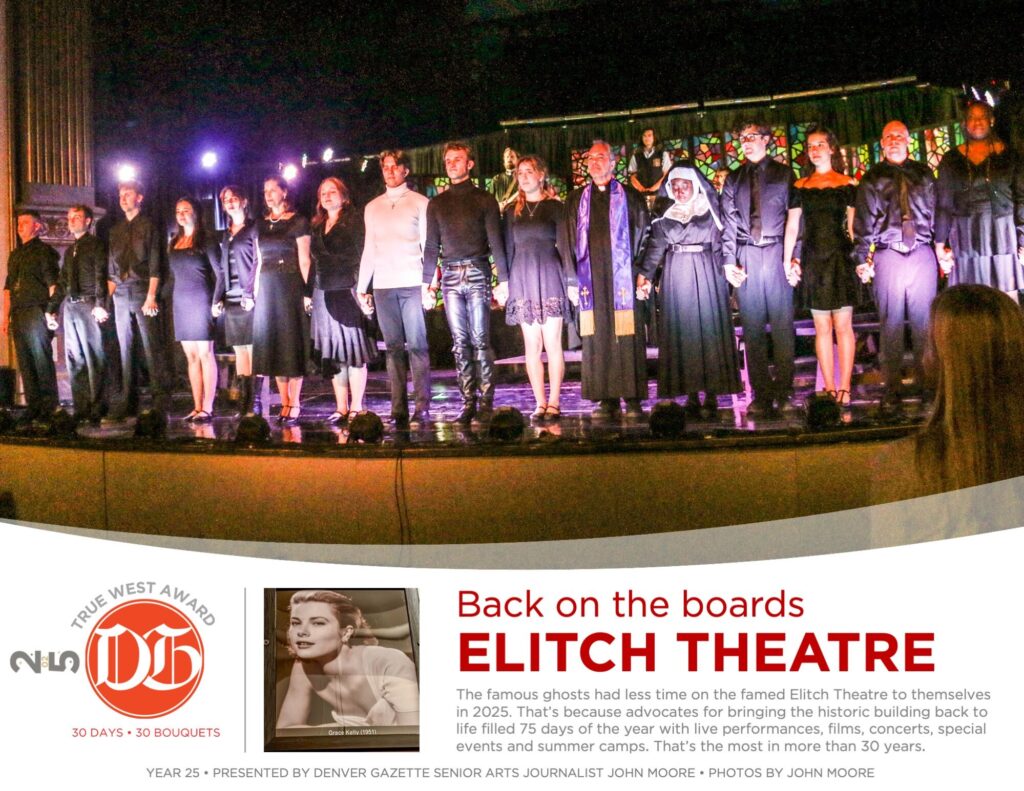
Storied Elitch Theatre stage no longer a ghost town
John Moore
john.moore@denvergazette.com
Updated 1 week ago
2025 DENVER GAZETTE TRUE WEST AWARDS: DAY 14 Long-neglected stage filled its dance card with 75 days of theater, films concerts and more in 2025. That’s the most in more than 30 years. The state of Colorado was just 15...
John Moore
Reporter

PHOTOS: The Georgetown Christmas Market
Stephen Swofford
stephen-swofford@denvergazette.com
Updated 1 week ago

Stephen Swofford
Reporter

New Christkindlmarket to open in Colorado Springs
Jen Mulson
jen-mulson@denvergazette.com
Updated 2 weeks ago
Colorado Springs will soon add a bit more German culture to its repertoire. The inaugural Old Colorado City Christkindlmarket, created by the Colorado chapter of the German American Chamber of Commerce (GACC), will open Thursday and run over two weekends...

Jen Mulson
Reporter

High flying, adored: Cleo Parker Robinson is dancing on air at 77
John Moore
john.moore@denvergazette.com
Updated 2 weeks ago
2025 DENVER GAZETTE TRUE WEST AWARDS: DAY 5 Denver dance trailblazer’s historic year included first solo dance performance in four decades Cleo Parker Robinson is a trailblazer – and the fire that fuels her was smoking hot throughout her historic 77th...
John Moore
Reporter

Mission possible: Phamaly alumni made national impact in ’25
John Moore
john.moore@denvergazette.com
Updated 3 weeks ago
2025 DENVER GAZETTE TRUE WEST AWARDS: DAY 3 From film to Broadway, Denver disability artists ‘are living proof that anything is possible’ When five students created Denver’s first disability theater company back in 1989, it was to create performance opportunities...
John Moore
Reporter
PREV
PREVIOUS

Gov. Jared Polis releases 'roadmap' to cut auto insurance costs in Colorado
Gov. Jared Polis and the Colorado Department of Insurance released a “roadmap” intended to reduce auto insurance premiums for Colorado drivers on Thursday. “In Colorado, we are focused on saving people money and making Colorado the best place to live, work, and play,” Polis said. “Auto insurance is too costly, confusing, and often a burden […]

Musk could become history's first trillionaire as Tesla shareholders approve giant pay package
NEW YORK (AP) — The world’s richest man was just handed a chance to become history’s first trillionaire. Elon Musk won a shareholder vote on Thursday that would give the Tesla CEO stock worth $1 trillion if he hits certain performance targets over the next decade. The vote followed weeks of debate over his management […]